

Travel insurance for Cambodia from USA trips should be built around cash payment, available local care and a verified transfer chain. A high evacuation limit is useful only when the traveler can reach initial treatment, obtain authorization and enter a receiving facility.
Key takeaways
- Insurance is officially recommended, not presented as a current entry mandate.
- Hospitals and ambulances may require cash or proof of local insurance.
- Map rural stabilization and higher-level care before travel.
- Check regional advisories and unexploded-ordnance areas by route.
- Preserve every provider, transport and payment handoff.
Planning information reviewed August 16, 2026. Advisories, entry rules, medical access, payment systems and policy terms can change. Recheck official and supplier information for the dates.
Map the Cambodia route by care access
Separate Phnom Penh, Siem Reap, provincial towns, islands and rural activities. List road transfers, domestic flights, boats, tours and nonrefundable lodging. Mark communications and the nearest plausible higher-care facility.
Use the delay and interruption guide to classify replacement transport and unused arrangements.
Distinguish recommendation from requirement
Current State Department Cambodia travel guidance highly recommends buying insurance and checking evacuation, medical and cancellation coverage. It does not establish a universal $50,000 entry requirement.
Recheck the Cambodian government’s official eVisa service, the relevant embassy guidance and the carrier before departure. Visa eligibility is a separate question from insurance eligibility. Do not repeat a commercial insurance minimum as Cambodian law without a current primary source.
Prepare for cash medical care
Official guidance says most Cambodia providers accept only cash and cards are not always available. Medical care is not free, even in public facilities.
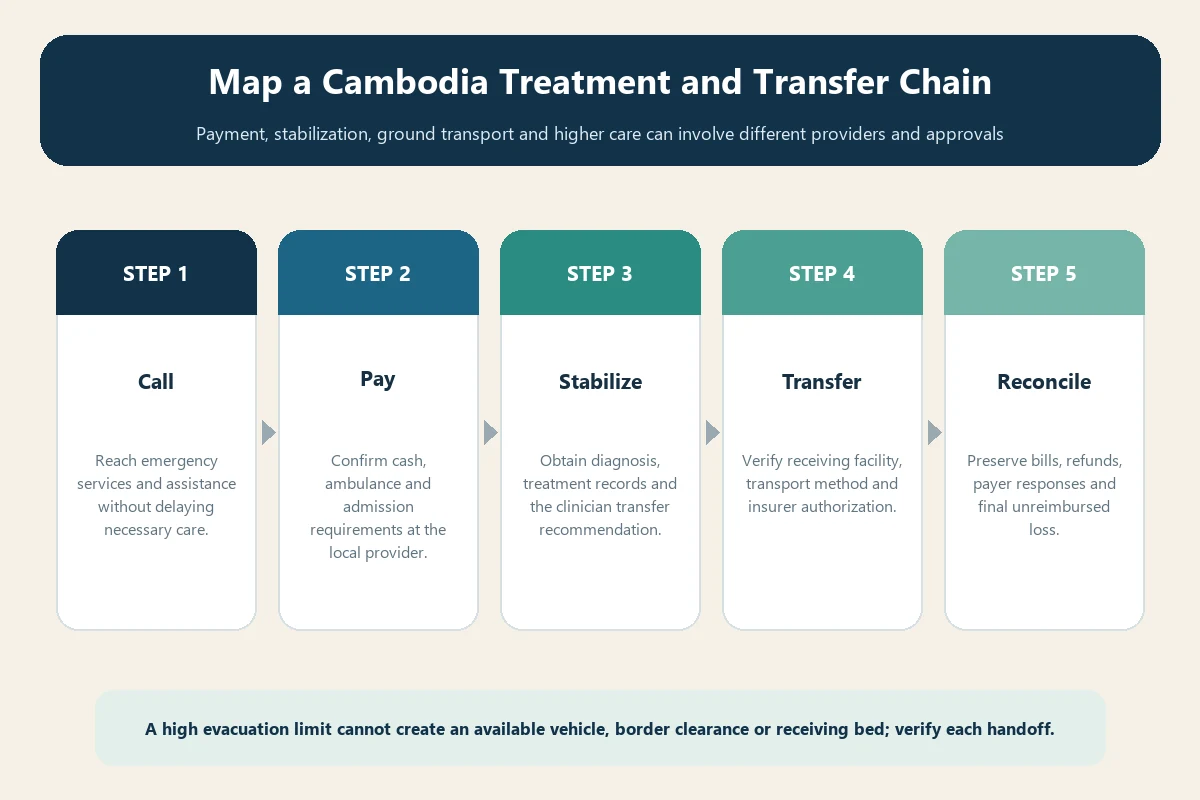
Ask the insurer whether it can issue a payment guarantee and which facilities accept it. Keep secure cash and card access. The health insurance abroad guide structures the U.S. plan call.
Include ambulance payment in the rehearsal
State guidance says public and private hospitals and ambulance services may require payment or proof of local insurance before treatment or admission. Store 119 for medical emergencies and the insurer number offline.
Ask whether ambulance cost requires prior approval when reasonably possible. In an emergency, do not delay necessary care; document why advance contact was impractical and notify the insurer promptly.
Build the stabilization-to-transfer chain
Ask assistance to identify a local provider for stabilization and a possible receiving facility for higher care. Confirm who selects the destination, who secures acceptance and whether ground or air movement is medically necessary.
The evacuation planning guide maps the handoffs. Preserve the clinician recommendation and receiving-facility confirmation.
Do not equate evacuation with repatriation
The first movement may be a vehicle from a rural clinic to a city hospital. A later international transfer depends on medical necessity, insurer authority, border documents, transport availability and receiving care.
Ask whether companion travel, dependent children and return after treatment are included. The evacuation limits guide helps compare sublimits and control.
Check regional advisory geography
Review the current advisory for border areas, unrest, crime and unexploded ordnance. Match the exact province and road to the itinerary. Do not treat a country headline as identical risk everywhere.
The country exclusions guide provides a method for checking territorial and advisory wording. Insurance cannot make a prohibited or unsafe route permissible.
Stay on established routes
Ask guides about marked access, emergency communication and transport. Avoid unknown metal objects and off-route areas where official guidance identifies unexploded-ordnance risks.
If an authority or operator closes a site, follow instructions. Preserve the closure and supplier refund decision before claiming unused costs.
Review destination health guidance
The CDC publishes current Cambodia traveler health guidance. Review it with a clinician for the route, season, length and activities.
Ask the policy about illness, pre-existing conditions and preventive care. The waiver guide explains purchase deadlines and look-back tests.
Audit digital and cash evidence
Official guidance describes U.S. dollars, riel, cards, ATMs and tourist QR payments. Acceptance varies. A phone transaction screenshot without an itemized medical bill is weak evidence.
Request diagnosis, services, local amount, payment proof and discharge instruction. Record the actual currency conversion and preserve originals.
Test road and boat dependencies
List each bus, driver, boat, domestic flight and onward booking. Ask which is a common carrier under the policy and what delay threshold applies.
Obtain supplier cancellations, refunds and alternate offers. The ferry guide helps separate sailing, port access and missed onward arrangements.
Compare one Cambodia scenario
Use identical ages, dates and costs. Include Phnom Penh, a provincial stay, guided rural activity, paid road transfer, local clinic, ambulance and higher-care transfer.
- What must be paid before care?
- Can assistance identify an accepted provider?
- Who authorizes and pays each transfer?
- Which territories or activities are excluded?
- How are road or boat delays treated?
- What documents prove final loss?
Read the certificate. Avoid universal evacuation destinations or limits unsupported by the route and policy.
Use assistance without assuming approval
The assistance versus claims guide distinguishes coordination from adjudication. Record representatives, times, instructions and case numbers.
Give a companion consent, medicines and policy contacts. Store the hospital and route information offline.
Assemble the claim chronologically
Keep emergency call, provider record, diagnosis, cash receipt, ambulance invoice, transfer approval, receiving record, supplier refunds and travel changes.
The claim guide explains payer coordination. Label every cost by date, person, location and reason.
Verify capability instead of relying on a facility name
A hospital appearing in an online directory does not prove that it can treat the traveler’s condition, admit the patient, communicate in English, accept an insurer guarantee or arrange the next transfer. Before a remote segment, ask assistance how it verifies a facility at the time care is needed. Record the difference between a clinic suitable for stabilization and a hospital considered for higher-level treatment.
Use scenario questions. For a fracture, severe infection or head injury, ask what the first practical care point would be and who would contact the receiving clinician. Do not ask assistance to promise a destination in advance; availability and medical need can change. The useful answer describes the decision owner, contact sequence, payment method and documents required.
If the traveler has mobility, medication or language needs, add them to the scenario. Confirm whether a companion can accompany a transfer and what happens to checked luggage or prepaid lodging. Those costs should be mapped separately from the patient’s eligible medical transport.
Rehearse the ambulance payment conversation
Store a short script with the traveler’s name, policy number, location, symptoms, local contact and requested destination. In an emergency, contact public services first when necessary. A companion can call assistance, record the case number and ask whether the ambulance or hospital needs cash, local proof of insurance or a written guarantee.
Ask the provider for an itemized invoice even if payment is demanded before departure. The record should identify pickup and destination, date, patient, service and local amount. Photograph paper receipts, but keep the originals. If the driver or facility cannot issue a full document immediately, note the name, phone number and reason, then request the completed bill as soon as possible.
Do not delay urgent treatment while negotiating an ideal receipt. The evidence goal is to reconstruct the decision afterward: why transport was necessary, who directed it, what was paid and whether any part was refunded.
Build a rural and island handoff table
Divide the itinerary into Phnom Penh, Siem Reap, provincial road, island or river, and guided-site segments. For each, list the transport operator, communications, first care option, higher-care route and last scheduled connection. Mark places where darkness, rain, water conditions or border advisories could remove an assumed transfer path.
Add a “decision evidence” column. Examples include an official advisory, operator cancellation, road closure, clinician transfer recommendation, receiving-hospital acceptance and insurer authorization. These records prove different facts and should not be collapsed into one screenshot.
Also add a “recovery” column for supplier refunds, credits, airline changes and health-plan payments. The final insurance request should show the unreimbursed amount after those recoveries. This table is particularly useful when one event produces a clinic bill, ambulance charge, replacement hotel, unused tour and new flight.
Compare purchase timing and insured trip cost
Record the first trip payment and every later nonrefundable addition. Ask each insurer how its initial-deposit date, purchase window and trip-cost updates affect time-sensitive benefits. Do not change dates or omit costs to fit a benefit.
Use the same insured cost when comparing plans, then test how each treats a refundable hotel, cash-paid local tour, domestic ticket and last-minute transfer. A lower premium may reflect a different trip-cost basis rather than better value. Save quotes, certificates and purchase confirmation as they existed on the transaction date.
Bottom line
Finish the plan with a contact sheet for each paid provider and transport operator. Include booking number, cancellation channel, after-hours number, payment method and document needed for a refund. Add the insurer’s notice deadline and claims channel. Record which contacts require mobile data and which can be reached by voice or from a hotel desk. Carry the essential numbers on paper with the patient’s name and policy details. During a disruption, update one chronological log instead of scattering evidence across messages. This makes it easier to show what care was necessary, which replacement was reasonable and how much value each supplier returned.
A strong Cambodia plan replaces a vague evacuation promise with a verified payment and transfer workflow. Check the route, official advisory, initial care and receiving facility, then preserve each handoff needed to support the remaining claim.