

Travel insurance waiver full trip cost language is not one universal rule. One certificate may require all cancellation penalties, another may refer to full nonrefundable trip cost, and another may use a maximum or different update deadline. The exact noun, amount, and date matter.
This U.S.-focused guide builds a trip-cost ledger for a pre-existing-condition exclusion waiver. It is insurance, not legal, tax, financial, or coverage advice. Confirm the issued certificate and declarations before relying on any example.
Key takeaways
- Copy the exact cost phrase from the waiver instead of relying on “full trip cost.”
- Track every component, payment date, refund status, and cancellation penalty.
- Calendar later costs and costs that change from refundable to nonrefundable.
- Treat points, redeposit fees, supplier credits, and policy premium as separate buckets.
- Reconcile the insured amount with receipts, declarations, refunds, and claim limits.
Reviewed August 16, 2026. Trip-cost definitions, maximums, and update windows vary by state and plan. The issued certificate, schedule, declarations, and endorsements control.
Why “insure the full trip cost” is incomplete
Marketing pages often compress a longer waiver condition into four words. The form may actually refer to all prepaid nonrefundable costs, all cancellation penalties, or the amount up to a stated maximum. Those phrases can produce different numbers.
The pre-existing waiver guide explains the full waiver sequence. This article isolates the financial requirement so a traveler can document it accurately.
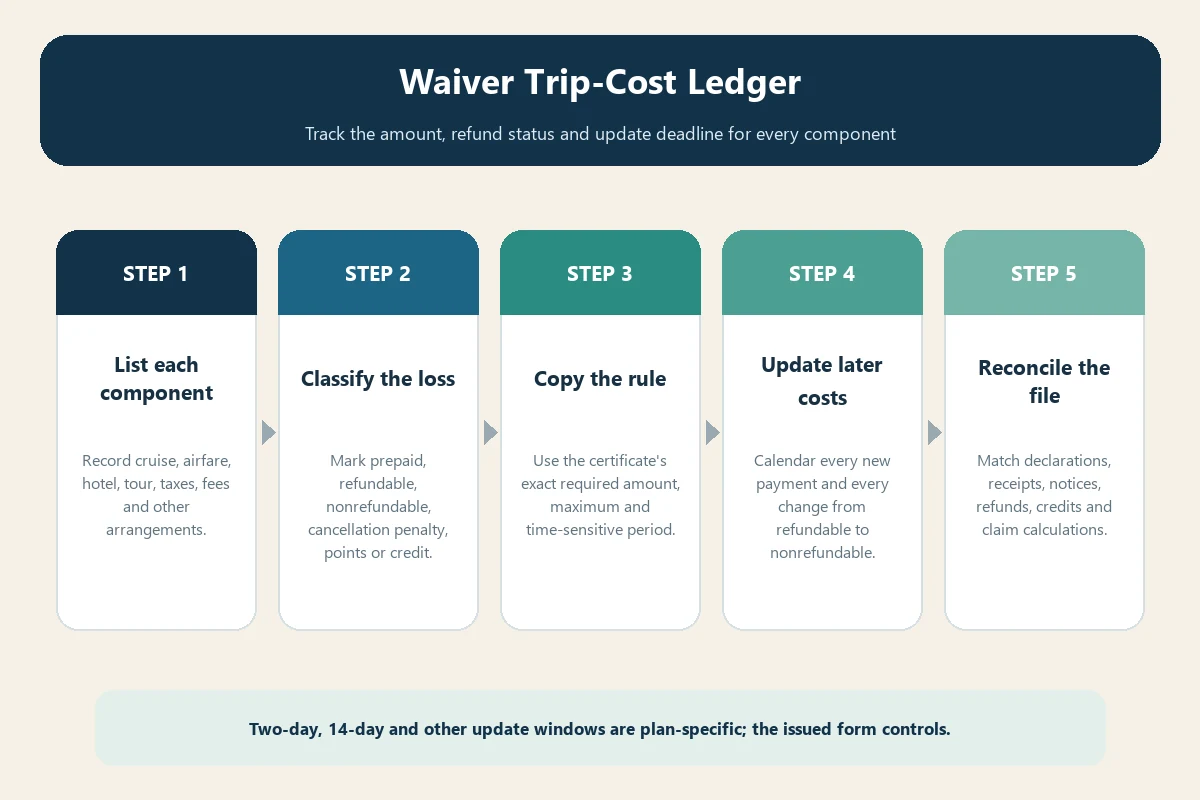
Find the exact phrase and its cross-references
Search the certificate for pre-existing medical condition exclusion waiver, trip cost, cancellation penalties, nonrefundable, subsequent arrangements, time-sensitive period, and maximum insurable trip cost. Follow every defined term and footnote.
Then copy four items: the amount that must be insured, the deadline for initial purchase, the deadline for later costs, and any maximum. Do not transfer an update window from a comparison article or another state’s form.
Build one row for every trip component
Create rows for airfare, cruise, hotel, tour, rail, rental car, event tickets, taxes, resort fees, and other arrangements. For each row, record supplier, traveler, booking date, payment date, amount paid, currency, refundability, cancellation schedule, points used, credit used, and insurance update date.
Attach the invoice, terms, payment proof, and any later change notice. The ledger should explain both the original insured amount and the amount at the time of a claim.
Separate five financial buckets
Bucket one is prepaid nonrefundable money. Bucket two is money currently refundable but subject to a future penalty. Bucket three is money not yet paid. Bucket four is loyalty points or other non-monetary awards. Bucket five is a fee, credit, or refund associated with cancellation.
Do not add all five without reading the definition. Some forms exclude the value of points yet may cover a redeposit fee. Some exclude the insurance premium from trip-cancellation reimbursement. Some focus on cancellation penalties rather than the total retail value.
Use the first payment as a separate clock
Many waivers are time-sensitive. Record the first payment or deposit for the trip and the plan purchase date. A refundable deposit can still be the initial trip payment under some wording, even if it is not yet an insured nonrefundable cost.
Do not assume the largest payment starts the clock. The waiver eligibility checklist separates the timing, medical-ability, trip-cost, and later-update conditions.
Later airfare or hotels create new deadlines
A traveler may insure a cruise deposit, then buy airfare weeks later. Add the airfare as a new ledger row and calendar the plan’s update window from the relevant payment or booking event. Keep the confirmation showing when the insured amount changed.
A current Travel Guard Vermont sample policy requires its waiver’s coverage amount to equal all cancellation penalties up to the schedule maximum, including subsequent arrangements. It says those additional costs must be added within two days of payment. That is a state-specific example, not a universal deadline.
Refundable costs can change status
A hotel may be fully refundable when booked and become nonrefundable 30 days before arrival. A tour’s cancellation penalty may rise in stages. Record each date on which the potential loss changes.
Allianz’s current existing-condition explanation describes a plan-specific requirement to insure full nonrefundable cost at purchase and add later nonrefundable costs within 14 days. It also states that the same update applies when an expense changes from refundable to nonrefundable or becomes subject to a cancellation penalty. Compare that rule with the reader’s certificate.
Points bookings need two values
Record the number of points used, the cash taxes and fees, and the redeposit or reinstatement fee. Do not assign a cash value to points unless the certificate explicitly uses one. The amount needed for waiver eligibility can differ from the amount eligible for trip-cancellation reimbursement.
The Travel Guard Vermont sample excludes costs paid with loyalty points or other non-monetary awards from its trip-cancellation expenses while listing the cost of redepositing frequent-traveler awards as a potentially reimbursable expense. The points-booking guide provides a broader evidence worksheet for award travel.
Supplier credits and refunds reduce the loss file
If a supplier refunds cash, issues a reusable credit, or waives a penalty, record the value and restrictions. Trip-cancellation benefits generally coordinate with recoverable amounts under the issued form. Do not submit the original invoice as if no refund or credit existed.
The trip cancellation guide separates the covered reason from the financial loss. A valid waiver does not convert a refundable expense into a payable claim.
Credit-card protection is another contract
A credit card may provide cancellation coverage for some purchases. That does not automatically satisfy a travel policy’s waiver requirement or duplicate payment. Keep the card benefit guide, purchase statements, denial or payment, and coordination-of-benefits records.
The credit-card cancellation guide identifies common scope and documentation gaps. Ask both administrators how other coverage and supplier recovery affect the claim.
Waiver eligibility and reimbursement are different math
The waiver test asks whether the pre-existing exclusion is removed under specified conditions. The claim calculation asks what loss is eligible under a covered benefit after refunds, credits, limits, deductibles, and other insurance. A traveler can satisfy the cost condition and still have no covered cancellation reason.
The reverse problem also occurs: a cancellation reason may otherwise be listed, yet a missed waiver cost update can leave the pre-existing exclusion in force. Keep the two calculations on separate pages.
Insured cost can affect premium
Trip-cancellation plans often price partly from declared trip cost and traveler factors. Adding later nonrefundable costs can require additional premium. Do not understate costs to save premium or overstate them to expect a larger benefit.
The travel insurance cost guide explains general price drivers. Use the selected plan’s quote and update process for the actual amount.
Compare two limited form patterns
The Travel Guard Vermont sample uses all cancellation penalties up to a maximum and a two-day later-payment update. Allianz’s current explanation describes full nonrefundable cost and a 14-day update. These examples conflict only if they are incorrectly treated as one universal policy.
Travel Guard’s current pre-existing-condition page says waiver eligibility can require all nonrefundable trip costs, early purchase, and medical fitness. The page correctly points readers back to policy documents for plan-specific details.
Work through four cost examples
Cruise deposit followed by airfare
Record the cruise as the initial trip payment and its current cancellation penalty. Add airfare when paid and notify the insurer within the form’s deadline. Keep both declarations versions and payment confirmations.
Refundable hotel becomes nonrefundable
Record the booking date, penalty-change date, and amount at risk. Ask which event starts the update deadline. Do not assume the original refundable booking amount belonged in the initial insured cost.
Award flight with cash taxes
Separate points, cash taxes, booking fees, and redeposit fees. Apply the certificate’s definition to each. The retail price of a comparable cash ticket is not automatically an insured cost.
Supplier issues a future credit
Record the credit’s amount, expiration, transferability, and restrictions. Ask how the form treats it when calculating nonrefundable loss. A limited credit can still affect reimbursement.
Reconcile the ledger before departure and claim
Compare the ledger total with the declarations page. Check that every later update was acknowledged and any added premium was paid. Recheck cancellation schedules shortly before departure because refundability can change automatically.
For a claim, retain all invoices, receipts, card statements, points records, cancellation terms, refund confirmations, credits, declarations versions, update notices, and insurer acknowledgments. Use the claim documentation guide to reconcile sources and submission dates.
Ask cost questions in writing
Provide the state, plan, form number, trip component, payment date, refund terms, and amount. Ask what amount must be insured for the waiver, what starts the later-cost deadline, how changing refundability is handled, whether points or redeposit fees count, and what maximum applies.
The National Association of Insurance Commissioners’ travel-insurance examination standard emphasizes clear disclosure of pre-existing exclusions and the circumstances in which they can be waived. Obtain the full fulfillment materials before relying on a sales summary.
Bottom line
Full trip cost is a shorthand, not a calculation. Inventory every component, classify its refund and penalty status, copy the certificate’s required amount and maximum, calendar each update, and reconcile the declarations with actual loss. The correct number and deadline come from the issued form.
