

Travel medical insurance sublimits are smaller benefit ceilings inside a policy’s overall medical maximum. A plan can advertise a substantial medical limit yet pay much less for a hospital room, emergency dental treatment, prescriptions, therapy, ambulance service or another named expense. The useful comparison is therefore not “Which maximum is larger?” but “Which limit reaches this exact service first?”
Key takeaways
- A sublimit caps one service, expense or event within the overall medical maximum.
- Record both the amount and its unit: per day, visit, incident, prescription, condition or trip.
- Apply eligibility, sublimits, deductibles and coinsurance in the order stated by the certificate.
- Check schedules, definitions, exclusions and endorsements; a marketing summary is not enough.
- Compare the likely provider balance, not only the amount the insurer may pay.
Planning information reviewed August 16, 2026. Benefit amounts and policy wording vary by product, state, traveler and trip. The issued certificate, schedule and endorsements control each claim.
What a travel medical sublimit actually does
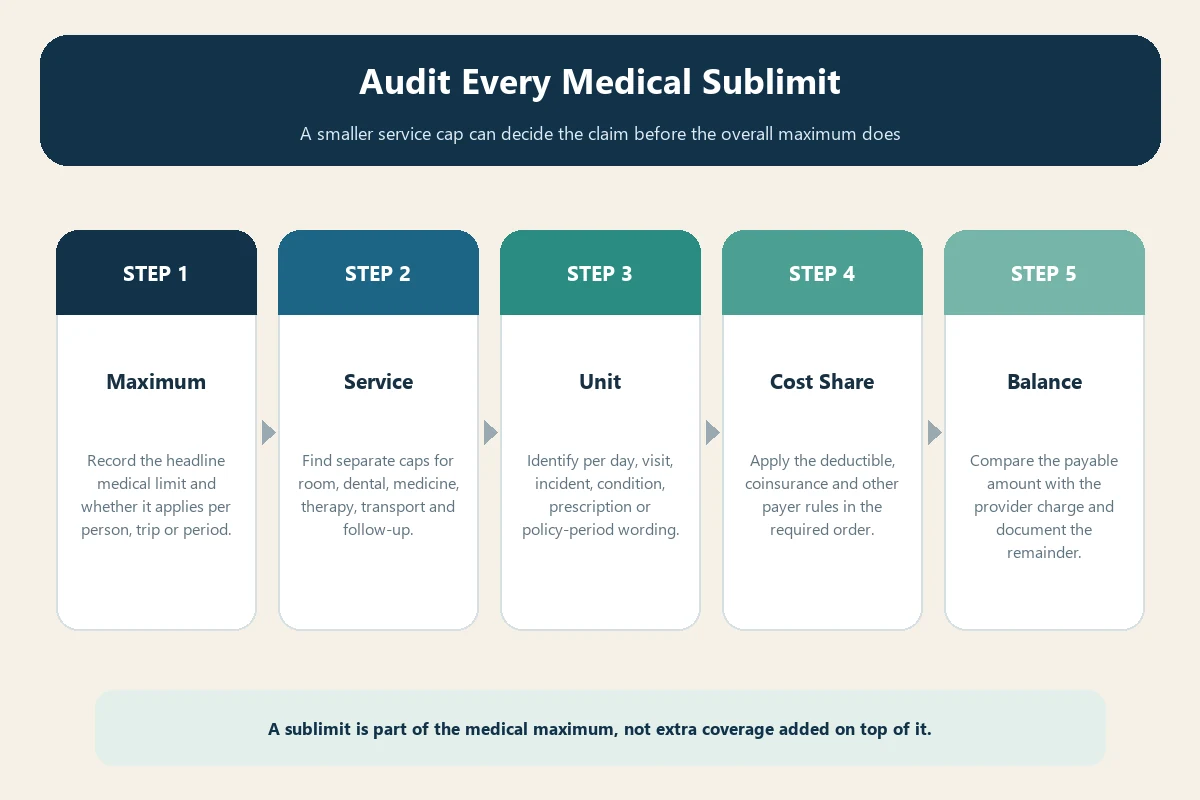
A sublimit sets the most the insurer may recognize for a defined part of a covered loss. It normally sits inside, rather than on top of, the overall medical maximum. If the specific cap is exhausted, unused room under the headline maximum does not automatically move into that service.
The current NAIC consumer guidance says each policy sets its own limits and situations it will or will not cover. That is why a product name, comparison card or quotation page cannot prove the payable amount.
Start with the schedule, then read the certificate
The schedule of benefits is the index. Copy every medical row into a worksheet: overall maximum, deductible, coinsurance, service limit, time unit and any footnote. Then follow each row into the certificate’s definitions, covered expenses, exclusions and claim provisions.
Use the travel policy reading guide to trace defined terms and endorsements. Search the document for “maximum,” “limit,” “per,” “daily,” “visit,” “incident,” “condition,” “treatment,” “reasonable,” “customary” and “subject to.” A cap can appear outside the main table.
Separate a sublimit from an exclusion
A sublimit can reduce payment for an otherwise eligible expense. An exclusion can remove eligibility altogether. A percentage cost share divides an eligible amount. These mechanisms are different even when they produce the same practical result: a provider balance for the traveler.
Work in order. First confirm that the illness, injury, date, place, activity and service qualify. Next identify the recognized charge. Then apply the service cap and cost sharing as the certificate directs. Never use the overall maximum to override an exclusion.
Hospital room and board limits
A certificate may recognize a standard semiprivate room, impose a daily amount or exclude the price difference for a private room. Intensive care, nursing, surgeon, anesthesia and facility charges can sit under different rows. Do not assume “hospitalization” is one undivided benefit.
Ask the hospital for an estimate broken down by room, physicians, operating room, imaging, laboratory, medicine and supplies. Compare each component with the policy. A room cap may leave a balance even when surgery and physician charges remain within their own limits.
Emergency dental caps
Emergency dental treatment often has a separate ceiling and can distinguish injury to a sound natural tooth from sudden pain. Temporary pain relief, extraction, repair and follow-up may be treated differently. Routine, cosmetic or delayed restoration can fall outside the eligible expense definition.
Record whether the amount applies per tooth, incident, trip or policy period. Keep a tooth-specific diagnosis, procedure description, radiograph when available, invoice and payment proof. The medical benefits guide explains why dental should be compared as its own benefit rather than inferred from the medical headline.
Prescription and pharmacy ceilings
A medicine row may limit each prescription, the total for the trip or a defined course of treatment. It may cover medicine ordered for a new eligible event but not a routine refill, preventive drug or replacement after careless loss. Brand and generic substitution can also affect the recognized cost.
Keep the clinician’s diagnosis, written prescription, pharmacy itemization, quantity, generic name and payment evidence. Ask whether an over-the-counter medicine needs a written recommendation. A pharmacy receipt showing only a total price does not establish medical necessity.
Therapy, rehabilitation and follow-up visits
Physical therapy, chiropractic care, mental-health treatment, home nursing and post-discharge follow-up can have visit limits, daily caps or prior-approval rules. “Medically necessary” does not always mean “covered without a ceiling.” The certificate may require a physician’s order or treatment during the covered trip.
Map the full course, not only the first visit. A plan that appears adequate for an emergency consultation can expose the traveler to later visits if the sublimit resets differently than expected. Ask whether care after returning home is outside the coverage period.
Ambulance and local transport limits
Ground ambulance, interfacility transfer and medical evacuation are not interchangeable. A local ambulance may have a service cap, while evacuation may have a separate maximum and authorization process. A taxi chosen for convenience may not become an ambulance expense.
Review the medical evacuation limits guide for receiving-facility and approval language. Record who arranged the transport, the clinical reason, origin, destination and receiving facility. A high evacuation benefit does not increase a smaller local-ambulance cap.
Diagnostic, physician and surgery sublimits
Some certificates split physician visits, specialist fees, diagnostics, surgery, anesthesia or durable equipment. A per-visit maximum is different from a total cap for the condition. A fixed amount for a procedure can also leave a balance if the provider charges more.
Request an itemized bill rather than a single hospital total. Match every line to a benefit category and note ambiguous items. If the insurer uses a recognized or reasonable charge, ask how that amount is determined and whether the provider has agreed to it.
Age-based and condition-based ceilings
A schedule can change limits at a stated age or for a defined condition. Do not import an age threshold from a different plan or a comparison website. Confirm the traveler’s age measurement date and whether an endorsement changes the base schedule.
Pre-existing-condition provisions are separate from age-based limits. The same symptom can involve both an eligibility question and a service cap. Preserve purchase dates, prior medical records and the initial clinical note when the insurer requests them.
Understand the reset unit
“Per day,” “per visit,” “per incident,” “per condition,” “per prescription” and “per policy period” create different exposure. Two clinic visits for the same diagnosis may consume one condition limit, two visit limits or a trip-wide total. A midnight hospital stay can also be counted under the certificate’s own definition of a day.
Write the unit beside every amount. If the wording is unclear, ask the insurer for a written explanation using a concrete scenario. Keep the answer with the quote and later issued documents, but remember that the final certificate governs.
Apply the deductible and coinsurance in the stated order
A sublimit does not erase a deductible or percentage share. Some certificates cap a service before cost sharing; others define the eligible or covered expense differently. Do not assume a domestic health-plan calculation applies to short-term travel coverage.
The travel medical deductible guide explains reset units, while the coinsurance guide follows the billed, recognized and payable amounts. Use the issued calculation sequence for the plan being evaluated.
Run an illustrative sublimit scenario
Assume an eligible illness leads to two hospital nights, imaging, a physician fee and a prescription. This is a worksheet example, not a universal policy calculation.
- List each provider charge separately.
- Remove any excluded or unrecognized amount.
- Apply the room, diagnostic, physician and prescription caps to their own rows.
- Apply deductible and coinsurance in the certificate’s order.
- Subtract other payer amounts and provider adjustments.
- Compare insurer payment with the remaining provider balance.
This exercise reveals whether the room or prescription ceiling matters long before the overall maximum is approached.
Compare plans using a cap matrix
Create columns for the service, eligible event, amount, unit, approval, cost share, required provider and claim evidence. Add a final “traveler exposure” column. Repeat the same scenario across every plan rather than comparing different marketing examples.
The policy limits guide helps evaluate the overall ceiling, age, route and evacuation layer. Sublimits are the next level down. A plan can win the headline comparison and lose the service-by-service one.
Ask direct questions before purchase
- Which medical services have a smaller limit than the overall maximum?
- What is the unit for every cap?
- Do age, destination, activity or condition endorsements change it?
- Does authorization affect eligibility or only provider coordination?
- How are recognized charges determined?
- Which documents prove each expense?
- Can the provider balance-bill the traveler?
The U.S. Department of State’s travel insurance checklist recommends reviewing destination, trip length, medical care, transportation, current conditions and activities. Add the sublimit matrix to that review.
Do not confuse direct payment with a larger benefit
The CDC advises travelers to consider a policy able to make payments to hospitals directly. Direct payment changes the payment path, not the contractual ceiling. A hospital may still request a deposit, and the traveler can remain responsible for deductibles, excluded charges and amounts above a sublimit.
Ask whether a guarantee of payment is provisional and how final reconciliation works. Save assistance case numbers, hospital communications and every revised statement.
Build evidence around each benefit row
For every service, keep the clinical reason, date, provider, currency, itemized charge, payment proof, authorization and other payer decision. Label records with the benefit row they support. This makes it easier to see whether the insurer applied the correct cap and unit.
Use the claim documentation guide to reconcile invoices, card settlements, refunds and explanation-of-benefits records. Challenge a calculation with the exact certificate section and invoice line, not only the headline maximum.
Make the final coverage decision
Choose a plan only after the likely services for the traveler and route have been tested against their smaller ceilings. Consider local payment practice, provider pricing, trip length, planned activities, existing coverage and access to appropriate care.
The health insurance abroad guide helps document the U.S. plan layer first. Then compare the travel certificate’s overall limit, sublimits, cost sharing, exclusions and payment route as one system. The most useful maximum is the one that survives every narrower rule that applies to the real claim.
Emergency dental care can have its own trigger, definition and sublimit. Use the travel medical insurance emergency dental guide to test pain relief, accidental damage, payment and claim evidence.
