

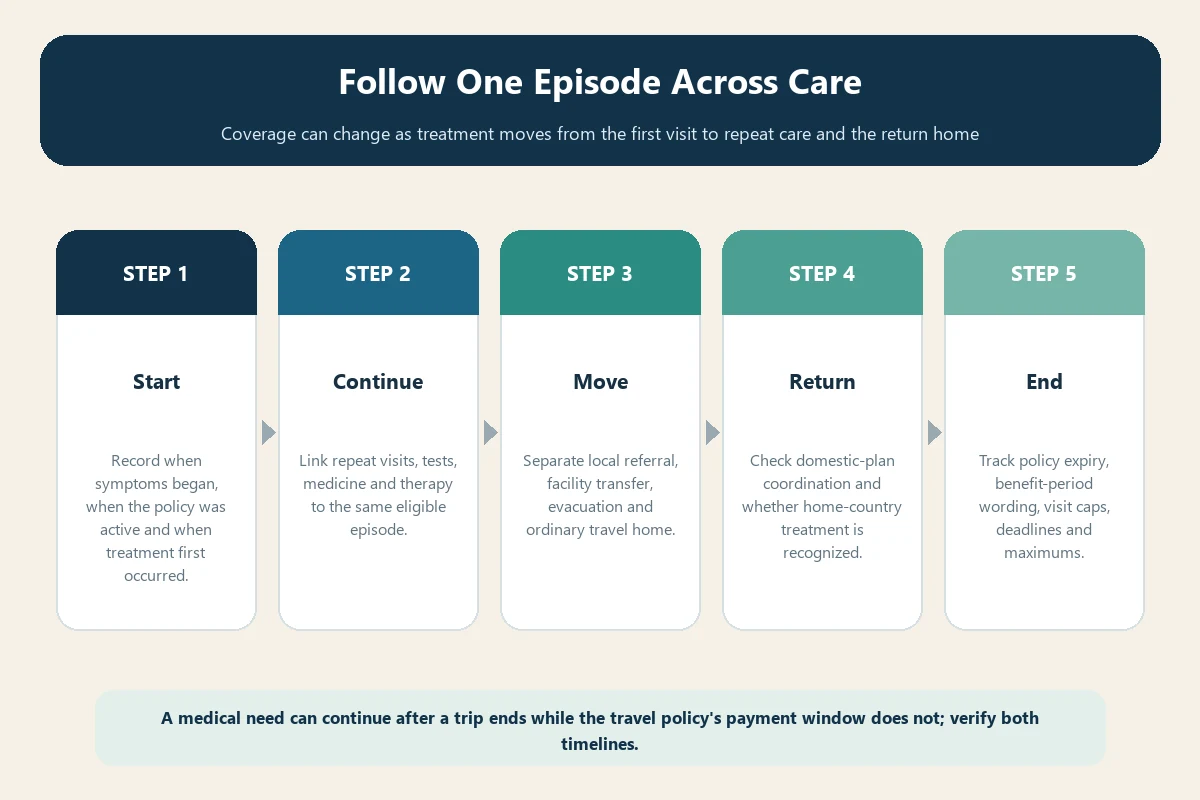
Travel medical insurance follow up care depends on whether later treatment remains part of the original eligible episode and occurs within the policy’s location, service and time rules. A repeat visit abroad, rehabilitation after discharge, a specialist appointment, care after returning home and treatment after the certificate ends can produce different results. Track the medical episode and the insurance timeline separately.
Key takeaways
- Link every later service to the first covered illness or injury with clinical records.
- Distinguish repeat care abroad from treatment after returning home.
- Policy expiry and a continuing-treatment benefit period are not the same concept.
- Rehabilitation, medicine and specialist visits can have their own limits.
- Coordinate the travel policy with the domestic health plan and avoid duplicate recovery.
Planning information reviewed August 16, 2026. Medical needs and policy terms vary. Follow the treating clinician’s instructions and confirm any continuing-treatment rule in the issued certificate.
Build two timelines for one episode
The medical timeline begins with symptoms or injury, first evaluation, diagnosis, treatment, discharge and later care. The insurance timeline includes departure from the home country, policy effective date, first treatment, scheduled end date, return home, any benefit period and claim deadlines.
Place both timelines on one page. The travel medical benefits guide explains why an eligible event must remain connected to each service and cost.
Define follow up care without assuming coverage
Follow up can include a wound check, repeat imaging, laboratory review, medication monitoring, specialist consultation, dressing change, physical therapy or removal of a cast or sutures. The clinical label describes continuity of care; it does not establish the insurer’s benefit.
Ask the first clinician to state what later care is required, when it should occur and what risk exists if it is delayed. This creates a medical link between the initial event and the next service.
Confirm the original event was eligible
Later treatment cannot repair an ineligible starting event. Check when the condition began, whether it was unexpected, whether a pre-existing or activity exclusion applies and whether the first provider met the certificate’s definition.
Keep the initial consultation note, diagnosis and claim decision. If the first claim is still pending, ask whether later bills should be submitted together or as supplements under the same incident.
Separate stabilization from continuing treatment
Short-term travel coverage often focuses on unexpected illness or injury and stabilization. Continuing care can be recognized only for a defined period, service set, location or maximum. A clinician’s recommendation can be necessary without making the expense payable.
Blue Cross Blue Shield’s current international coverage explainer distinguishes broader international health insurance from travel coverage that generally stabilizes a traveler and directs later follow-up home. Use that product distinction before choosing a plan.
Test repeat visits while still abroad
A traveler may need a second consultation, test result review or dressing change before moving to the next destination. Ask whether the original provider must perform the visit, whether a referral is required and whether assistance should approve or locate the provider.
The primary care coverage guide helps distinguish an unexpected-illness visit from routine or preventive care. The same test applies to a follow-up visit’s purpose.
Track referrals and specialist care
A general clinician can refer the traveler to orthopedics, cardiology, infectious disease or another specialty. Keep the referral, reason, urgency and receiving appointment. Ask whether the policy recognizes the specialty and requires assistance coordination.
If the traveler selects a distant or premium provider for convenience, document why. The insurer may evaluate necessity, provider qualifications and reasonable charges separately.
Handle repeat tests as evidence-linked services
Repeat imaging or laboratory work should be tied to the clinical question it answers. Ask the provider to state whether the test checks recovery, detects a complication or changes treatment. Retain the order and result, not only the receipt.
Where a test is duplicated because records could not be transferred, document the attempt to obtain the earlier result. A complete record can improve care and reduce avoidable cost.
Classify rehabilitation and therapy
Physical therapy, chiropractic care, home nursing and durable medical equipment can have separate benefit rows or per-day limits. A broad medical maximum does not prove that every rehabilitation service is covered.
Ask for the treatment plan, frequency, expected duration and clinical goal. Compare those details with the travel medical policy limits guide and record any visit or daily cap.
Connect later prescriptions to the episode
A refill, changed dose or new medicine can be follow-up treatment when it responds to the covered episode. It can also be ordinary maintenance for a condition that predated the trip. Keep the clinician note that explains the reason for the prescription.
The prescription medication guide separates new treatment, routine supply, loss and destination-law issues. Keep the pharmacy invoice and generic drug name with the episode file.
Plan care across destination changes
A traveler can leave the country where initial treatment occurred and need follow-up in the next country. Confirm that both locations are inside the coverage area and that the policy remains active. Ask how records should be transferred securely.
Do not assume a referral from one country is automatically valid in another. The receiving clinician may need a new evaluation, which should still be documented as part of the same episode when medically connected.
Use discharge planning before leaving a hospital
Request a discharge summary, diagnosis, procedures, test results, medication list, warning signs, activity restrictions, required follow-up and fitness-to-travel advice. Obtain contact details for record questions.
The hospitalized abroad guide provides a broader discharge and billing checklist. Do not let the final invoice replace the medical summary.
Distinguish medical transfer from ordinary return travel
A patient who cannot travel normally may need an ambulance, medical escort, upgraded seat or evacuation. Another patient may be stable enough for the original itinerary. The treating clinician and assistance medical team can have defined roles in that decision.
Keep written fitness-to-fly or restriction advice. If travel changes are needed, separate medical transport, trip interruption and ordinary ticket costs instead of submitting one combined amount.
Check what happens at the home-country border
Some travel medical policies end when the traveler returns home. Others may recognize continuing treatment for an eligible episode under a defined benefit period. A return home can therefore end general coverage while a narrow exception continues.
Search the certificate for home country, return, termination, benefit period, continuing treatment and extension. Ask the insurer to identify the exact clause and remaining maximum in writing.
Do not confuse policy expiry with a benefit period
The scheduled certificate end date is one clock. A continuing-treatment period can be another clock triggered by first treatment, hospitalization or another defined event. It can be shorter than the medical need and limited to the same condition.
A current product example is useful only to reveal the question. Never transfer its number of days to another policy. Record the traveler’s own trigger date, final eligible date, location rule and services permitted.
Coordinate the domestic health plan
After the traveler returns to the United States, the domestic health plan may become the main payer. The travel policy may pay only excess eligible expenses or require the domestic explanation of benefits before deciding.
The primary versus secondary coverage guide provides a payer-order worksheet. Give the U.S. clinician the overseas records so the care and claim histories stay aligned.
Preserve records for subsequent clinicians
The CDC Yellow Book’s current sick-abroad guidance tells travelers to request documentation of care and share it with clinicians providing subsequent treatment. Keep original-language records, translations, images, laboratory values and medication names.
Ask the next clinician to identify whether treatment continues the overseas episode, treats a complication or addresses a separate condition. That distinction supports both patient safety and accurate billing.
Track benefit maximums across all visits
Every eligible follow-up expense can reduce the remaining medical maximum or a service-specific sublimit. Maintain a running table of billed, allowed, paid and patient amounts. Add pending claims so the traveler does not treat the full original maximum as still available.
Include deductible and coinsurance application for each visit. Ask whether cost sharing resets with a new certificate period or remains tied to the original episode.
Meet notification and proof deadlines
A benefit period can remain open while a claim notice deadline expires. Record deadlines for initial notice, proof of claim, requested documents, appeal and supplemental bills. Do not wait until all treatment ends before opening the claim unless the certificate says to do so.
The travel insurance claim guide offers an evidence ledger. Use one incident identifier across every supplemental submission.
Read the certificate as a connected rule set
Search for follow-up, continuing treatment, benefit period, home country, termination, extension, inpatient, outpatient, rehabilitation, physical therapy, prescription, referral and medically necessary. Follow every cross-reference.
The policy reading guide helps connect the schedule, definitions, eligible expenses and exclusions. A continuation clause can be narrowed elsewhere.
Use a single-episode scenario before buying
Assume a traveler fractures an ankle abroad, receives emergency treatment, returns for imaging, starts therapy, flies home and needs an orthopedic visit after the policy’s scheduled end. Mark the location, service, date, payer and clause for every step.
NAIC’s current consumer guidance emphasizes that every policy sets its own limits and covered situations. The scenario tests those limits without relying on a generic promise.
Make the final follow up care decision
A strong plan can answer five questions: what original event qualifies, which later services remain connected, where treatment may occur, when the payment window ends and which payer acts first after the return home. Anything less leaves an important gap.
The safest travel medical insurance follow up care strategy combines a complete clinical record, early assistance contact, a verified continuation clause, domestic-plan coordination and a deadline tracker. Medical recovery can continue beyond the trip; the insurance plan must be tested against that reality before departure.
Rehabilitation may have its own referral, visit and timing rules. Check the travel medical insurance physical therapy guide before arranging repeat treatment abroad.
Later treatment is not one automatic continuation benefit. Use the travel medical insurance continuation of treatment guide to classify planned care, recurrence, complications, follow-up and post-trip benefit periods.
