
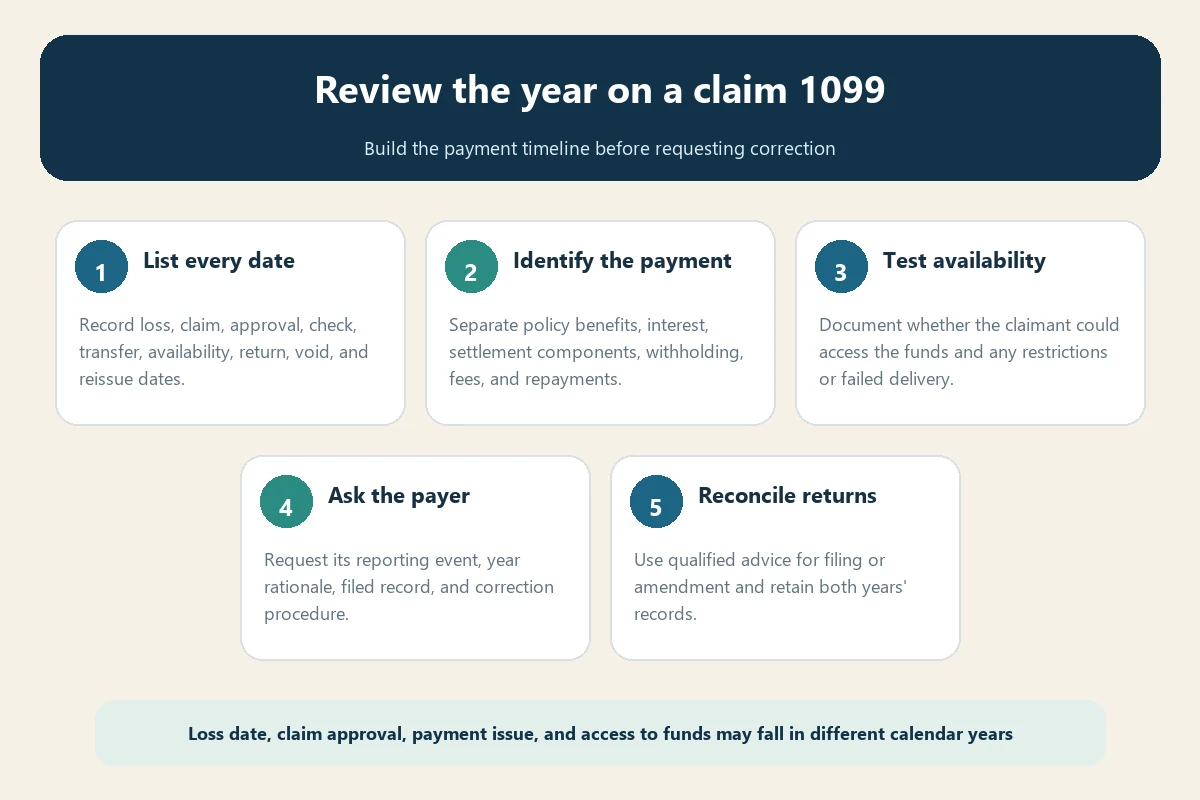
If a travel insurance claim 1099 shows the wrong tax year, build a dated payment timeline before asking for correction. The trip, insured loss, claim filing, approval, check issue, electronic transfer, availability of funds, void, return, and reissue can all occur on different dates.
Do not assume the loss year or claim-approval year automatically controls the information return. The correct result can depend on the payment type, reporting rule, recipient, access to funds, restrictions, and other facts. This U.S.-focused guide is general information, not tax, legal, accounting, or insurance advice.
Build one complete claim timeline
Start with source documents rather than memory or a portal status. Record every event using the date and time zone shown by the insurer, payment vendor, bank, card platform, postal carrier, and claimant.
| Event | Evidence | Question |
|---|---|---|
| Insured loss | Trip and incident records | When did the covered event occur? |
| Claim filed | Submission confirmation | When was relief requested? |
| Claim approved | Written decision | Was payment final or conditional? |
| Payment issued | Check, ACH, wire, or card advice | When did the payer initiate it? |
| Funds available | Bank or platform record | When could the payee access funds? |
| Failure or restriction | Return, void, freeze, or expiry record | Was access unsuccessful or blocked? |
| Reissue or repayment | Replacement and ledger | Did another year contain the final event? |
Separate the trip year from the payment year
A canceled trip or medical event can occur near year-end while the claim is not approved or paid until the next year. The policy may describe when a benefit becomes payable, but that language alone does not prepare an individual tax return.
Ask the payer which calendar-year event triggered its reporting and which payment component the form covers. The IRS General Instructions for Certain Information Returns explain that information returns report specified amounts received, paid, credited, transferred, or canceled during the calendar year. The exact verb and form-specific rule matter.
Identify what the 1099 amount represents
A travel claim can include reimbursement, a fixed benefit, interest, settlement additions, provider payment, attorney-related amounts, or another component. One component may relate to a different year or reporting rule from another.
Reconcile the form with the claim decision, gross payment, withholding, fees, and bank credit. The claim tax withholding guide helps match gross and net amounts, while the payment fee guide separates non-tax charges.
Approval is not always the same as access to funds
A portal can say approved before the payer finalizes the payee, obtains a release, validates taxpayer information, or initiates a payment. Conversely, a check may be issued while delivery or deposit remains unresolved.
Document whether approval was unconditional, whether the claimant could demand payment, and whether any substantial restriction remained. Do not make a legal conclusion from the word “approved” alone; give the records to a tax professional.
Document when an electronic payment became available
For ACH, record initiation, settlement, posting, reversal, and returned-payment dates. For a wire, record release, intermediary handling, receipt, rejection, and return. For a virtual card, record issuance, activation, access, expiration, redemption, and cancellation.
The returned ACH claim guide distinguishes a successful credit from a returned transfer. The expired virtual card guide helps document whether issued funds were actually usable.
A check date does not tell the whole story
Preserve the front and back of the check, mailing record, delivery date, deposit attempt, stop-payment, void, and replacement. State whether the claimant received the check, could negotiate it, lost it, or had it rejected.
Use the lost claim check guide and expired check reissue guide to create a clean payment trail. Do not assume a reissue changes the reporting year without professional analysis.
Returned, voided, and reissued payments need one ledger
A failed payment can produce records in two calendar years. The first may show an issued check or transfer; the second may show a void, return, replacement, or successful receipt. Ask the payer how its tax system treated every event.
Make the ledger mathematical: original gross disbursement, less returned or voided amount, plus replacement, less withholding or charges, equals final funds retained. Attach payer and bank proof for each line.
Overpayment recovery can cross tax years
If the claimant received funds in one year and repaid some or all in another, the issue is not merely a wrong year printed on the form. It may involve separate payment and recovery events.
The claim overpayment repayment guide explains how to document the demand, repayment, waiver, and corrected ledger. Obtain advice about both years rather than silently reducing one form.
Check the legal recipient and joint payees
A payment can involve the claimant, another traveler, provider, attorney, estate, business, or joint payee. The reporting year dispute may actually arise because one recipient received or controlled the payment at a different time.
Ask whose name and TIN the payer used, how the amount was allocated, and when that recipient had access. For joint checks, preserve endorsement, delivery, deposit, allocation, and account evidence, then obtain tax advice.
Request the payer’s written year rationale
Contact the legal filer shown on the form, not only the customer-facing claims administrator. Request the tax-reporting team and provide a concise timeline with supporting records.
Ask the payer to confirm:
- form type, reporting box, and tax year;
- legal payer, recipient, and masked taxpayer record;
- payment component and gross amount;
- the event and date used for reporting;
- how voids, returns, reissues, or restrictions were treated;
- whether both years contain an information return;
- whether correction is required; and
- when the corrected recipient statement will be furnished.
Do not ask a claims representative for individualized tax advice. Require the payer to explain its own record and give the explanation to a qualified adviser.
A corrected form must address the filed record
A revised claim letter or portal date does not necessarily correct information already filed with the IRS. Ask whether the payer will correct its federal filing and furnish a corrected recipient statement.
The incorrect claim 1099 guide covers amount, identity, form-type, and correction evidence. Keep the original because it documents the sequence; never alter the PDF yourself.
Check for duplicate records across both years
Sometimes a payer reports the entire amount in both years rather than moving or correcting the original record. Compare form type, payer TIN, recipient, account number, boxes, amounts, and correction status.
Use the duplicate claim 1099 guide to distinguish two recipient copies, separate components, an original-correction sequence, and true duplicate reporting.
Use transcripts as a time-sensitive cross-check
An IRS wage and income transcript can show Form 1099 data reported for a specific year. The official IRS Topic 159 explains transcript access through an online account or Form 4506-T.
Pull the relevant years when available and compare payer, form, account, and amount. Current processing-year information and recent corrections may not yet appear. A transcript is evidence of data received by the IRS, not a final ruling on the correct year.
Record the date each transcript was generated. A later payer correction may require a fresh transcript comparison, and a state information record may follow a different update schedule.
Protect both filing deadlines
A year dispute can affect a return already filed and a return currently due. Give a tax professional both years’ returns, forms, claim records, payment evidence, transcript, and payer correspondence.
Do not delay indefinitely while waiting for the insurer. Follow advice on accurate filing, extension options, explanatory documentation where appropriate, and amendment if a corrected form changes a previously filed return. IRS Topic 308 provides general information about amended returns.
Do not copy a form-specific workaround
The IRS publishes special instructions for particular forms and fact patterns, including some incorrect Form 1099-K situations. Those instructions do not automatically govern another 1099 type or a travel insurance payment.
Use the exact form instructions and professional advice. Do not zero out, shift, omit, or duplicate an amount solely because an online example involved a different information return.
Protect identity and payment data
A caller may promise to change the tax year for a fee or demand a full TIN, bank password, remote access, gift card, wire, or cryptocurrency. Verify the payer independently and use a secure portal for taxpayer documents.
The claim payment scam guide covers fake tax-release demands and changed banking instructions. A legitimate correction should produce a traceable case and recipient statement.
Keep a two-year correction file
Retain the policy, decision, timeline, gross-to-net ledger, check or transfer records, original and corrected forms, correspondence, transcripts for both years, filed returns, amendments, and professional workpapers.
The final file should let a reviewer identify the payment component, legal payer and recipient, access restrictions, final funds retained, payer’s reporting event, correction, and treatment on each tax return.
Bottom line
When a travel insurance claim 1099 appears in the wrong tax year, do not rely on the trip date or approval date alone. Build the full payment timeline, document access, failure, void, return, reissue, and repayment events, obtain the payer’s written rationale and correction, and reconcile both years with qualified tax advice.
