
If you received an incorrect Form 1042-S for a travel insurance claim, compare every field with the payment and foreign-status documentation. Verify the withholding agent, recipient, income and status codes, gross income, exemption, rate, tax withheld, country, account, tax year, unique form identifier, and amendment status.
Do not edit the form yourself or assume a corrected claim letter updates IRS records. Form 1042-S errors can affect a cross-border return, refund or credit claim, treaty position, and payer Form 1042. This guide is general information, not tax, legal, immigration, accounting, or insurance advice.
Inventory the form exactly as issued
Preserve the PDF or paper statement, envelope, portal notice, download date, and filename. Record whether the form is original or amended and whether it is Copy B, C, D, or a substitute recipient statement.
| Field group | What to compare | Evidence |
|---|---|---|
| Payment | Income code and gross income | Claim and settlement ledger |
| Tax | Chapter, exemption, rate, withholding | Payer calculation and net payment |
| Recipient | Name, country, address, TINs, status | W-8 and beneficial-owner record |
| Agent | Withholding and primary agent fields | Legal payer and intermediary map |
| Tracking | Year, account, unique identifier | Original filing reference |
| Amendment | Amended box and amendment number | Correction sequence |
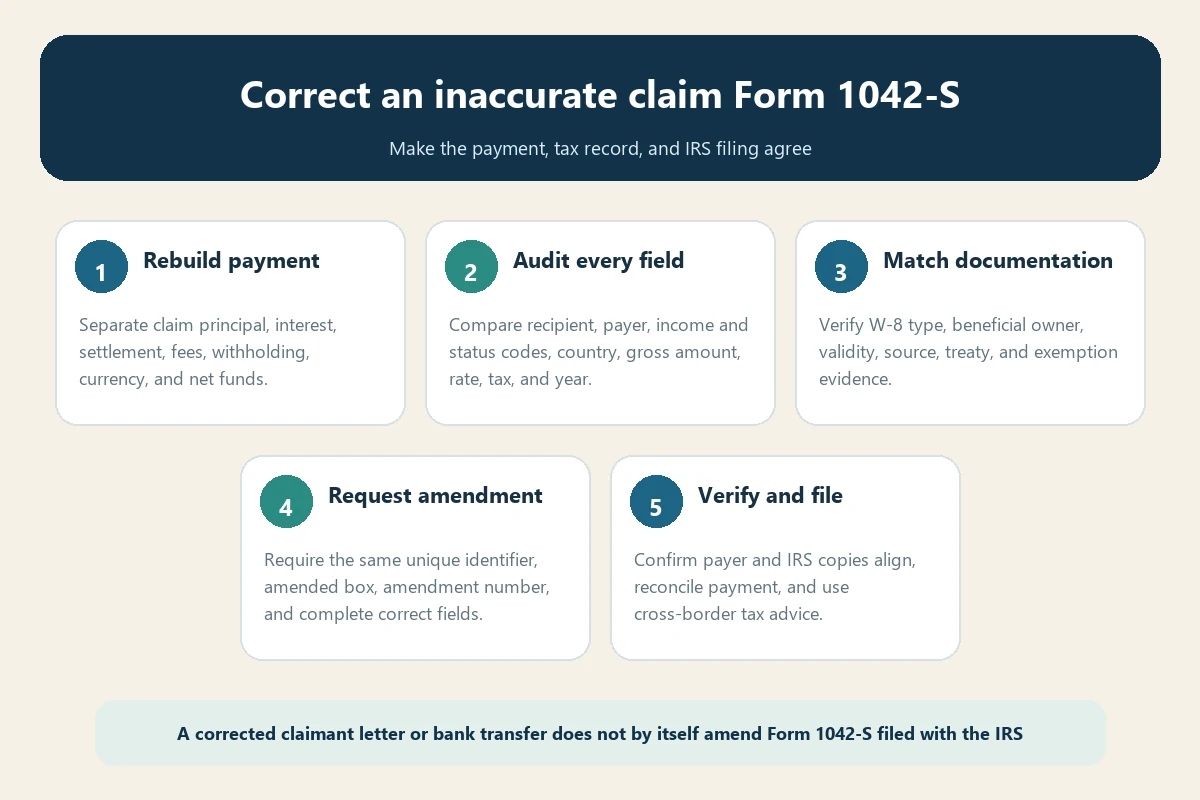
Rebuild the gross-to-net payment
List claim principal, fixed benefits, interest, settlement additions, provider or attorney payments, U.S. tax withholding, foreign or state tax, bank charges, currency conversion, and net funds received. Trace each item to a check, ACH, wire, card, or trust ledger.
The claim payment fee guide helps separate operational charges from tax. A net bank credit is not automatically Form 1042-S gross income.
Confirm whether Form 1042-S should apply
A foreign address, passport, or overseas bank alone does not establish that the payment is reportable on Form 1042-S. Review the legal recipient, beneficial owner, foreign status, payment type, source, withholding chapter, and documentation.
The travel claim Form 1042-S guide explains the form’s overall structure. An error review should begin by testing the payer’s reporting premise, not only arithmetic.
Check the withholding agent
The consumer-facing insurer, underwriter, third-party administrator, settlement company, payment vendor, intermediary, and withholding agent may use different legal names. Compare the form with policy and payment records.
Ask which entity controlled or made the reportable payment and which entity deposited withholding. A mismatched withholding-agent name or EIN can impair verification and requires payer correction.
Verify the recipient and beneficial owner
Compare recipient legal name, country code, permanent address, U.S. TIN, foreign TIN, date of birth, account number, and chapter 3 and 4 status codes with the valid W-8 documentation.
The claimant, traveler, policyholder, beneficiary, provider, attorney, estate, entity, intermediary, and bank-account owner can differ. Do not alter the owner to match the payee line without analyzing who beneficially owned the payment.
Joint owners need a documented allocation
The current IRS Instructions for Form 1042-S state that only one joint owner can be listed as the recipient on a form. Ask the payer how it selected the recipient and allocated the gross amount.
Do not split the tax statement informally. Obtain owner documents, the claim allocation, payment endorsement, and cross-border advice about any reporting duties between owners.
Review the income code against the payment
Box 1 should use the code that reflects the type of income the payer reports. A code for interest, services, other income, or another category should trace to a specific claim component.
The claim interest guide helps isolate delayed-payment interest. Ask the withholding agent to explain why its chosen code applies and why other claim proceeds are included or excluded.
Test the gross income amount
Compare box 2 with the claim ledger before deductions. Determine whether the payer included principal, interest, attorney proceeds, tax, or a returned or reissued payment. Ask for the calculation in the form’s reporting currency.
If the payment was reported twice or on more than one form, compare unique identifiers and income codes. Similar amounts can represent separate reportable components or a genuine duplicate.
Check chapter and exemption codes
Review the chapter indicator, chapter 3 exemption code, chapter 4 exemption code, tax rates, and recipient status codes as a connected set. A treaty exemption code should align with the treaty country and valid documentation.
Do not guess corrected codes. Ask the payer to state its source, chapter, exemption, treaty, and recipient analysis, then have a qualified adviser review it.
Recalculate withholding
Multiply the stated withholding base by the applicable rate and compare it with federal tax withheld. Distinguish amounts withheld by the current agent from amounts withheld by a primary withholding agent.
The claim tax withholding guide helps separate gross payment, tax, fees, and net receipt. The form should report actual withheld tax accurately even when the correct rate is disputed.
Match the W-8 certificate
Compare Form 1042-S with the exact W-8BEN, W-8BEN-E, W-8ECI, W-8EXP, or W-8IMY that the payer relied on. Check beneficial owner, status, address, country, TINs, treaty claim, signature, validity, and changes in circumstances. The IRS requester instructions for Forms W-8 explain the withholding agent’s documentation framework.
The expired claim W-8BEN guide covers validity and replacement. A new certificate does not automatically rewrite a prior payment’s facts or amend an already filed form.
Distinguish pre-filing correction from amendment
If the payer furnished a recipient copy but has not yet filed Form 1042-S with the IRS, the IRS instructions say the payer should file an original with correct information and provide the corrected recipient copy without marking it amended.
If the payer already filed the erroneous form with the IRS, it must use the amended procedure. Ask for the original filing date rather than relying on the date the claimant downloaded the statement.
The unique form identifier must stay connected
An amended Form 1042-S must use the same unique form identifier as the original it changes. That identifier tells the IRS which record the filer intends to overwrite.
Compare the original and amended identifier exactly. A new unrelated identifier may create another record instead of correcting the intended one, depending on the filing sequence.
Track the amendment number
The payer must mark the form amended and use the required single-digit numeric amendment number, starting with 1 and increasing for later amendments to the same unique form identifier.
Keep every version in sequence. Do not discard amendment 1 when amendment 2 arrives because the history can explain changed codes, tax, and refund processing.
All corrected fields should be complete
An amended form should contain the complete correct information, not only a handwritten note about one changed box. Compare recipient, agent, income, codes, amounts, rates, tax, account, and year again.
The recipient copies should match the information filed with the IRS. The IRS warns that differences can delay return processing and claims for refund or credit.
Ask whether Form 1042 also changes
If corrected Forms 1042-S change information previously reported on the withholding agent’s Form 1042, the payer may also need to amend Form 1042. The official IRS Instructions for Form 1042 describe the amended-return process. This is the payer’s filing responsibility, but it can affect reconciliation.
Ask the agent to confirm whether its annual withholding return and deposits remain consistent with the corrected recipient statement. Do not attempt to amend the payer’s return yourself.
Send a field-specific correction request
Ask the international tax-reporting team to confirm:
- legal withholding agent and primary agent;
- payment component and source determination;
- beneficial owner, recipient, and W-8 record;
- income, chapter, exemption, status, and country codes;
- gross income, rate, and actual tax withheld;
- original filing date and unique form identifier;
- amendment number and expected recipient copy;
- whether Form 1042 must also change; and
- case number and completion date.
Protect the tax filing and refund deadline
Give a cross-border tax professional the claim ledger, payment proof, W-8 forms, original and amended Forms 1042-S, payer correspondence, and prior returns. Incorrect withholding does not by itself prove an immediate refund entitlement.
Do not wait indefinitely for correction. Obtain advice on accurate filing, extension or refund procedures, required TINs, supporting documents, and amendment if a later form changes a filed return.
Watch for fake correction services
A scammer may promise to amend Form 1042-S or release a withholding refund for an upfront fee, passport copy, bank login, remote access, gift card, wire, or cryptocurrency. Verify the payer independently.
The claim payment scam guide covers fake tax demands and changed instructions. A legitimate amendment comes from the withholding agent and preserves a traceable identifier.
Keep one permanent correction file
Retain the policy, decision, settlement, payment ledger, bank record, W-8 documentation, original form, every amended form, unique identifier and amendment sequence, payer confirmations, returns, and professional workpapers.
The final file should prove what was paid, who owned it, how it was classified, what tax was actually withheld, which IRS record was amended, and how the final form reconciled.
Bottom line
For an incorrect Form 1042-S after a travel insurance claim, audit every payment, recipient, code, amount, rate, tax, and identifier. Make the withholding agent file the proper amendment when required, ensure the recipient and IRS copies agree, and protect cross-border filing deadlines with qualified advice.
