

To challenge a travel insurance arbitration award in the United States, a party usually must identify a narrow defect authorized by the governing arbitration law. A court does not ordinarily rehear the insurance claim, reweigh medical records, or replace the arbitrator’s contract interpretation merely because the result seems wrong.
Act immediately after delivery. Preserve the complete record, identify the governing agreement and law, match the alleged defect to the correct route, confirm which court has jurisdiction, and satisfy every filing and service requirement. This guide is general information, not legal advice. Post-award rights are fact-specific and deadlines can expire quickly.
Start with the award-processing file
Before choosing a challenge, complete the review in the travel insurance arbitration award guide. Save the original award, transmittal, delivery date, signatures, attachments, operative relief, calculation, and performance deadline.
Build an issue map showing what was submitted, what was decided, what was reserved, and what remedy was granted. A supposed omission may be an express denial; an apparent merits error may be a clerical calculation; and a partial award may not yet be the final award under the applicable framework.
Do not call every challenge an appeal
An ordinary appeal asks a higher court to review alleged legal or factual error. A motion to vacate or modify an arbitration award is narrower. Its purpose is to test specified defects in the arbitration or award, not to rerun the underlying coverage dispute.
Use precise language in the case file. Label a provider-rule clarification request, statutory modification motion, vacatur motion, opposition to confirmation, or contractual appellate procedure according to what it actually is.
Identify the controlling legal framework
Collect the issued policy, arbitration clause, later agreement, provider rules, applicable-law clause, place of arbitration, case orders, and award. Determine whether the Federal Arbitration Act, a state arbitration statute, another federal statute, or a contract-specific procedure governs each issue.
The FAA does not automatically displace every state rule or create a federal courthouse for every dispute. Choice of law, interstate commerce, forum, prior litigation, citizenship, amount in controversy, and subject matter can affect the route.
Separate provider clarification from court relief
Current AAA Consumer Arbitration Rules allow a time-limited request through AAA to clarify an award or correct clerical, typographical, technical, or computational errors. That procedure does not empower the arbitrator to redetermine the merits.
A provider request is not a court motion. Do not assume it extends or pauses a statutory filing or service deadline. Calendar the routes independently and obtain advice before relying on tolling.
Read the four federal vacatur grounds
9 U.S.C. § 10 identifies four principal grounds in ordinary FAA cases:
- The award was procured by corruption, fraud, or undue means.
- There was evident partiality or corruption in the arbitrator.
- The arbitrator committed specified prejudicial misconduct or misbehavior.
- The arbitrator exceeded the granted powers or failed to make a mutual, final, and definite award on the submitted subject matter.
These labels are legal standards, not conclusions created by disappointment. The governing court’s precedent determines what each ground requires and what proof is sufficient.
Corruption, fraud, or undue means requires a factual record
Identify the exact representation, concealment, act, actor, date, evidence, discovery date, and connection to the award. Preserve original documents, metadata, testimony, and prior inconsistent statements lawfully.
Do not accuse a witness, insurer, administrator, or neutral of fraud because evidence was rejected or believed differently. Serious allegations require specific facts, legal analysis, and compliance with pleading and evidentiary rules.
Evident partiality is not an unfavorable ruling
An adverse award does not prove bias. Review the arbitrator questionnaire, disclosures, supplemental disclosures, party research, administrator correspondence, objections, waiver issues, and the relevant jurisdiction’s standard.
The arbitrator selection and conflicts guide explains why disclosure concerns should be investigated and raised through the authorized process when known. Waiting until after a loss can create waiver disputes.
Misconduct must be tied to prejudice
Section 10 refers to misconduct such as refusing a postponement despite sufficient cause or refusing to hear pertinent and material evidence, plus other prejudicial misbehavior. Preserve the request, supporting facts, opposition, ruling, objection, proffer, and effect on the party’s ability to present the case.
Arbitrators generally control evidence and procedure. Excluding cumulative, late, privileged, irrelevant, or unauthorized material is not automatically misconduct. The arbitration hearing preparation guide shows how to preserve an exhibit ruling and make a clear record without disrupting the hearing.
Exceeding powers focuses on delegated authority
Compare the award with the arbitration clause, submission agreement, claims and counterclaims, amendments, requested remedies, governing limitations, and orders defining the dispute. Identify what authority the arbitrator allegedly lacked and where the award crossed that boundary.
A court may distinguish an arbitrator’s arguable interpretation from acting outside the submitted authority. A claimed contract error is not automatically an excess-of-powers case.
Use modification for the defects it covers
9 U.S.C. § 11 permits federal modification or correction in defined circumstances, including an evident material miscalculation, an evident material description mistake, an award on a matter not submitted that does not affect the submitted merits, or an imperfection in form not affecting the merits.
Show the defect from the award and established record. A request to change how the arbitrator valued the claim, weighed credibility, or interpreted coverage is not transformed into modification by calling the result a “miscalculation.”
Preserve objections before and during the hearing
Keep written objections to procedure, authority, disclosure, evidence, postponement, service, and scope. Save the ruling, renewal of the objection, offer of proof, and requested remedy. Current AAA rules also contain a waiver provision for proceeding after knowing a rule was not followed without stating an objection in writing.
The post-hearing brief guide explains how to cite preserved objections without introducing new evidence after the record closes.
Freeze a challenge-ready record
- Policy, arbitration clause, submission, amendments, and governing rules.
- Demand, answer, counterclaims, defenses, and requested relief.
- Arbitrator disclosures, research, objections, and rulings.
- Scheduling orders, postponement requests, and procedural notices.
- Exhibit list, admitted and excluded evidence, proffers, and transcript.
- Briefs, citations, service proof, and record-closing notice.
- Award, transmittal, delivery evidence, and any clarification request.
- A dated chronology of the alleged defect and resulting prejudice.
Do not supplement the record casually
Ask counsel what materials a reviewing court may consider and how each item must be authenticated or introduced. A post-award declaration that simply reframes losing testimony may be ineffective or improper.
If genuinely new evidence reveals an alleged disclosure or fraud issue, preserve how and when it was discovered. Do not alter files, contact represented parties directly, or obtain information unlawfully.
Calendar the FAA service deadline
9 U.S.C. § 12 states that notice of a motion to vacate, modify, or correct must be served on the adverse party or attorney within three months after the award is filed or delivered. The statute also contains service provisions.
Determine the legally relevant starting event and method. Do not convert months into a guessed number of days, and do not assume filing alone equals service. State law or another governing regime can use a different period.
Analyze subject-matter jurisdiction separately
The Supreme Court’s official decision in Badgerow v. Walters explains that the FAA’s authorization to confirm or vacate does not itself create federal jurisdiction. The procedural history of a prior federal action and later Supreme Court developments may also matter.
Document the proposed court, jurisdictional basis, citizenship and amount facts if relevant, prior case and stay status, place where the award was made, agreement language, and requested relief. Do not file in federal court solely because the FAA is cited.
Confirm venue, parties, standing, and service
Identify every party to the arbitration, successor, representative, and person against whom relief is sought. Confirm who may challenge, where the motion belongs, which local rules apply, how process or motion notice must be served, and whether the administrator or arbitrator is a proper party.
Use the exact award caption and case identifiers. Preserve summons, waiver, affidavit, receipt, tracking, electronic notice, or other permitted proof of service.
Prepare for a competing confirmation request
The prevailing party may seek confirmation while another party seeks vacatur or modification. Coordinate claims and defenses in the correct proceeding. Do not assume a correction request prevents confirmation or that a challenge automatically stays enforcement.
Ask whether a stay, bond, security, expedited schedule, or response deadline applies. Track voluntary performance and court deadlines separately.
Protect confidential medical and financial records
A court filing can make award language and exhibits more accessible than the private arbitration file. Review the arbitration confidentiality guide before attaching medical records, passports, bank data, policy applications, or settlement communications.
Follow the court’s redaction and sealing rules. File only what is necessary and authorized. A confidentiality agreement does not automatically override public-access law.
Use a ground-to-proof matrix
| Potential route | Core question | Record to preserve |
|---|---|---|
| Provider correction | Is there a permitted clerical, technical, or computational defect? | Award, calculation, transmission, timely request |
| FAA modification | Does §11 fit without revisiting the merits? | Submitted scope, award text, evident error |
| FAA vacatur | Can a §10 ground and required prejudice be proved? | Clause, orders, objections, transcript, disclosures |
| Confirmation response | What defenses and deadlines apply in the pending court? | Petition, notice, service, award, challenge papers |
| State procedure | Which statute, court, ground, and period govern? | Choice-of-law facts and state-law analysis |
A first-week action sequence
- Preserve the untouched award and delivery evidence.
- Obtain the full agreement, governing rules, orders, and record.
- Write the alleged defect as a factual statement, not a conclusion.
- Separate merits disagreement from possible correction, modification, or vacatur.
- Calendar every provider, federal, state, contract, and court deadline.
- Ask qualified counsel to analyze governing law, jurisdiction, venue, service, waiver, and proof.
- Preserve confidentiality and avoid unauthorized communications.
- File and serve through the correct route, then retain proof.
Bottom line
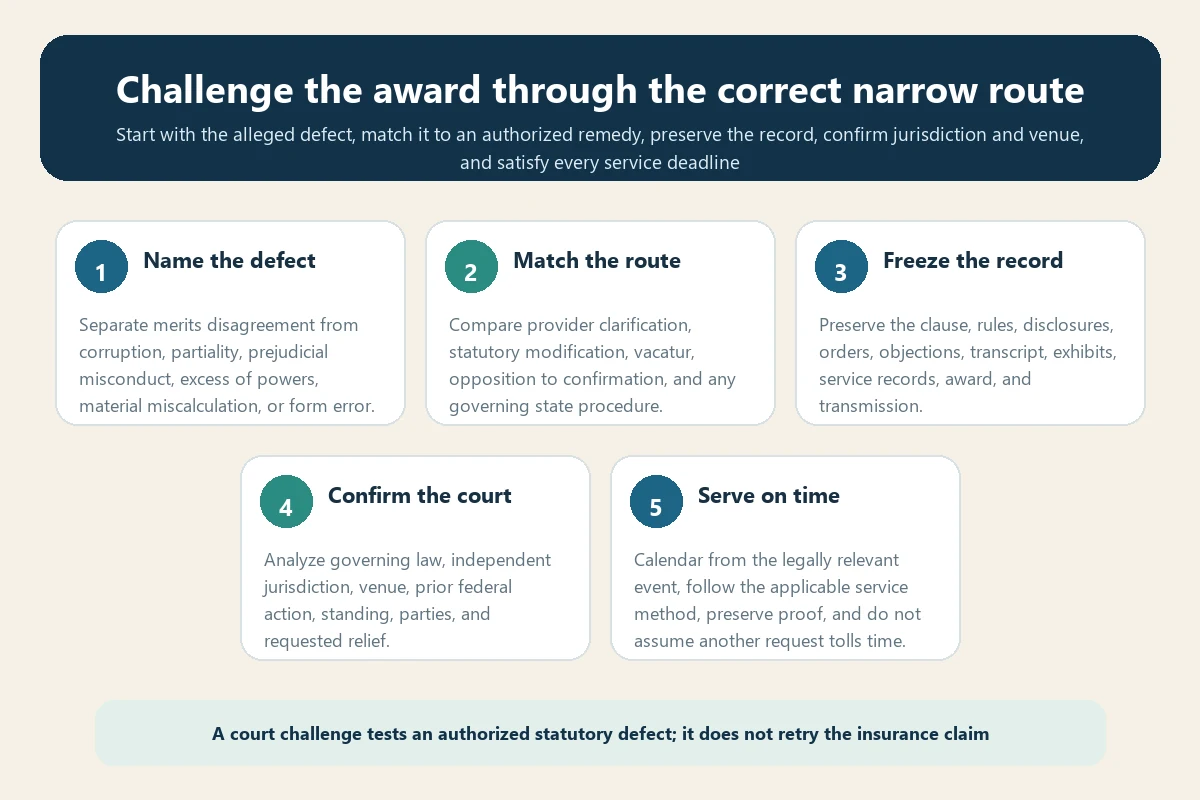
To challenge a travel insurance arbitration award, begin with a provable authorized defect—not the desired result. Match the facts to provider correction, statutory modification, vacatur, confirmation defenses, or an applicable state procedure.
Preserve objections and the complete record, confirm jurisdiction and venue independently, and complete service before the governing deadline. A focused challenge tests the integrity and authority of the arbitration process; it does not retry the insurance claim.