

A travel insurance arbitration hearing transcript can preserve testimony, rulings, objections, exhibit references, and closing arguments, but it is not automatically created in every case. A platform recording, a reporter’s rough feed, a certified transcript, and the official hearing record may be different materials with different authority and access rules.
Read the arbitration agreement, incorporated rule version, scheduling order, hearing protocol, and later directions before arranging any recording or transcription. Obtain required permission and provide required notice. This U.S. consumer guide provides general information, not legal advice.
First decide why a transcript is needed
Identify the intended use: accurate citation in a post-hearing brief, review of multi-day testimony, preservation of oral rulings, preparation for a continued hearing, correction of an exhibit reference, accessibility, translation, or a possible court proceeding.
Balance that use against cost, delay, privacy, and the length of the dispute. A short consumer hearing with a simple record may not justify expedited stenographic service. A complex hearing with multiple witnesses, technical testimony, or written briefing may benefit substantially.
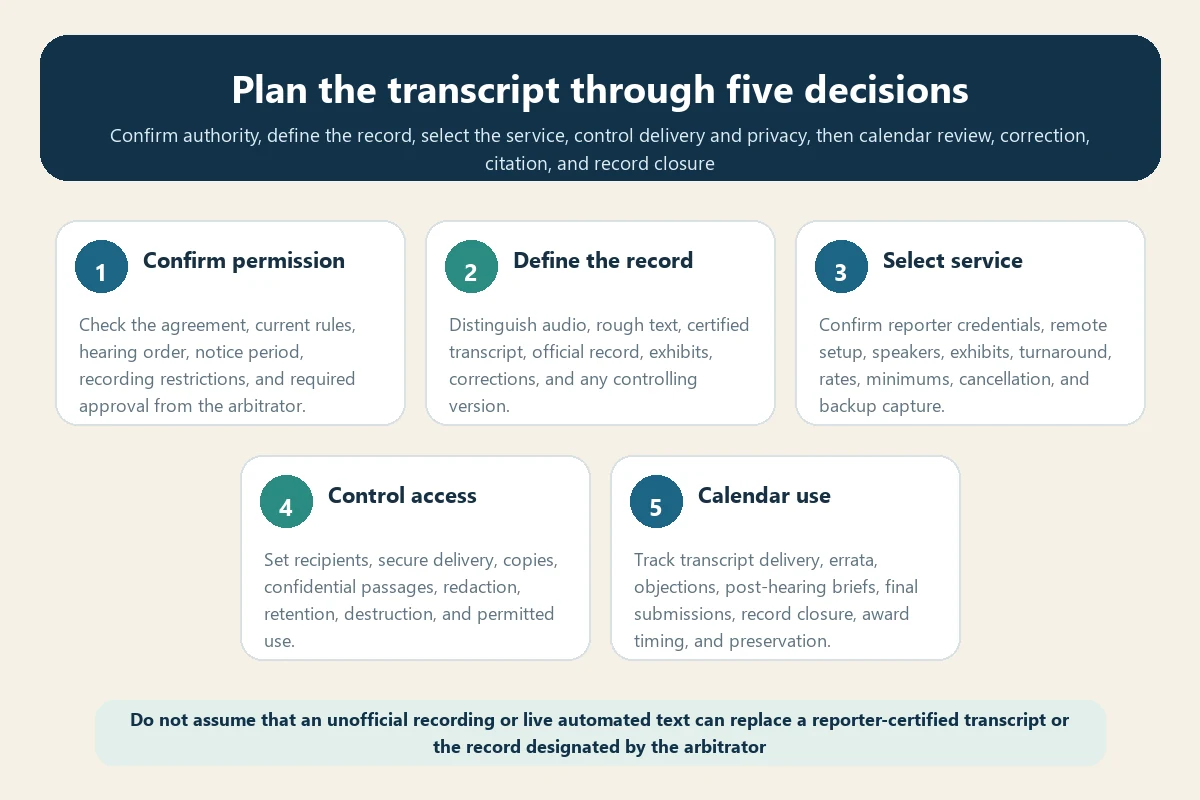
Do not equate recording, transcript, and official record
| Material | Typical function | Question to resolve |
|---|---|---|
| Platform or forum audio | Captures sound | Who controls and may access it? |
| Live automated text | Navigation or rough reference | Is it human-verified or citable? |
| Reporter rough draft | Fast working copy | What limits and corrections apply? |
| Certified transcript | Verbatim written record | Who ordered, receives, and pays? |
| Official record | Controlling hearing record | Who designated it and what is included? |
Ask the arbitrator to state which material controls if versions differ. Do not cite an automated caption feed as a certified transcript unless the governing procedure permits it.
Check the governing consumer rules
Use AAA’s current consumer rules, forms, and fees page to retrieve the rule version governing the case. Confirm written-record provisions, notice, payment, recording restrictions, official-record designation, distribution, and the arbitrator’s authority to resolve cost disputes.
Older rules, another provider’s rules, or a web summary may not control. Save the applicable PDF and record its effective date in the case file.
Raise the issue before the final scheduling order
At the preliminary hearing, address whether testimony will be recorded, whether a stenographic or digital reporter may attend, who arranges the service, how much notice is required, whether remote participants must consent, and how the transcript affects later deadlines.
Use the arbitration preliminary hearing checklist to place these decisions in the written order. Waiting until hearing week can limit reporter availability and increase expedited rates.
Obtain permission before recording
Do not start a phone, screen, platform, or separate audio recording without authorization. The provider’s rules or hearing order may prohibit other forms of recording unless the parties agree or the arbitrator directs otherwise.
Request permission through the case administrator or authorized filing channel, copy all parties as required, and preserve the written ruling. Clarify whether only the selected reporter or forum host may record.
Select the right reporting service
Compare reporter credentials, arbitration experience, remote and hybrid capability, real-time feed, rough draft, standard and expedited turnaround, certification, exhibit handling, interpreter coordination, backup capture, security, and support.
AAA’s official hearing services page describes traditional stenographic reporting and human-verified AI-powered transcription options. Availability of a service does not decide whether it is authorized or official in a particular case.
Get a complete written estimate
Ask about appearance fees, hourly or session minimums, original-page rate, copy-page rate, real-time feed, rough draft, certification, expedited delivery, remote platform, technical support, exhibits, travel, cancellation, overtime, storage, and taxes.
State who orders the original and who may purchase copies. Confirm whether the arbitrator, administrator, and other parties require copies and who pays for them.
Do not assume costs will be reallocated
The requesting party may initially bear the reporter and transcript cost, subject to the governing rule, agreement, order, or later allocation. Obtain any cost-sharing agreement in writing.
Separate reporter cost from forum fees, arbitrator compensation, interpretation, exhibit presentation, and attorney fees. The arbitration cost guide helps build a dated budget without treating every expense as recoverable.
Define the scope of transcription
Specify dates, sessions, opening statements, testimony, objections, rulings, breaks, side discussions, closing arguments, and any read-back. Confirm whether confidential sessions or settlement discussions are excluded.
For a multi-day hearing, decide whether daily copy is needed for every session or only key testimony. Partial transcripts can save money but may omit necessary context.
Prepare names and terminology
Provide a neutral spelling list containing party names, witnesses, clinicians, suppliers, medications, destinations, policy terms, acronyms, and exhibit labels. Do not give the reporter private merits commentary.
Update the list when a new witness or technical term appears. Correct spelling support improves accuracy without changing testimony.
Coordinate exhibits and speaker identification
Confirm how the reporter will identify each speaker and mark references to exhibits, pages, timestamps, demonstratives, and screen-shared documents. Use stable exhibit numbers from the final exchange.
The document exchange checklist helps ensure the reporter, arbitrator, and parties refer to the same version. A transcript reference is less useful when “that email” could mean several files.
Test remote and hybrid logistics
Confirm the reporter’s platform access, display name, audio channel, breakout-room restrictions, backup telephone, time zone, start time, and ability to hear every participant. Test microphones and prohibit people from speaking over one another.
Ask how off-record discussions will be announced and how the reporter will signal an inaudible answer. The hearing host, not an individual participant, should control any authorized platform recording.
Protect medical and financial information
Travel insurance hearings can include diagnoses, treatment, passport information, payment data, booking identifiers, addresses, and other travelers’ records. Define secure delivery, recipient authentication, encryption, link expiration, storage, redaction, and retention.
Use the arbitration confidentiality guide to distinguish private administration from an unlimited secrecy guarantee. Clarify permitted use of the transcript in the arbitration and any later legal process.
Set the delivery and distribution rule
Record who receives the original, certified copy, rough draft, audio, and exhibits. If the transcript is designated as the official record, confirm delivery to the arbitrator, access for all parties, and the administrator’s requirements.
Do not send a transcript privately to the arbitrator. Use the authorized channel and serve all parties as directed.
Review the transcript systematically
On receipt, verify case name, date, session, appearances, witness names, oath, exhibit numbers, page sequence, certification, and file integrity. Compare critical testimony with contemporaneous notes and the reporter’s audio if the process allows.
Search for “inaudible,” “indiscernible,” phonetic spellings, uncertain names, incorrect dollar amounts, dates, policy sections, and medical terms. Record proposed corrections with page and line references.
Use the authorized correction process
A correction should address transcription accuracy, not rewrite testimony. Confirm who may propose an erratum, the deadline, required form, notice to other parties, objection process, reporter role, and whether the arbitrator must approve.
Preserve the original and correction record. Do not silently replace a file or change quoted language in a brief.
Coordinate the transcript with witness testimony
Index each witness’s direct examination, opposing questions, arbitrator questions, exhibit identifications, concessions, and stated limits of knowledge. Cite complete passages rather than isolated fragments that alter meaning.
The witness testimony guide helps connect transcript citations to personal knowledge and the matching contemporaneous record.
Use transcript citations in closing or briefing
Follow the arbitrator’s citation format. A useful reference identifies witness, transcript date or volume, page and line, and related exhibit. Quote only what matters and explain how it supports a policy element or requested finding.
A rough transcript may carry restrictions and later pagination changes. Confirm whether it may be cited or wait for the certified version.
Distinguish forum practices
FINRA’s official arbitration process page says its panel records hearings, the recording is the official record, and a party seeking a transcript or stenographer needs panel permission and generally bears the cost. That is useful comparative guidance, not the rule for an AAA case.
Never import another forum’s recording practice without checking the agreement and assigned rules.
Calendar record closure carefully
Current AAA consumer rules address closing when post-hearing submissions or a hearing transcript remain outstanding. Record the last transcript delivery, authorized briefs, responses, errata, supplemental documents, and the date the arbitrator declares the record complete.
Link these events to the arbitration timeline. The last day of live testimony may not be the formal record-closure date or the start of the award clock.
Preserve the final transcript package
Keep the certified transcript, reporter certification, original delivery message, authorized errata, rulings on corrections, exhibit index, relevant audio-access information, confidentiality order, and proof of distribution.
Use clear filenames with case, date, volume, status, and version. Restrict access and follow the retention schedule rather than storing sensitive files indefinitely on personal devices.
Common transcript mistakes
- Assuming the forum automatically provides a free transcript.
- Recording the hearing without permission.
- Confusing automated captions or a rough feed with a certified record.
- Hiring a reporter before confirming notice, access, and official-record rules.
- Failing to budget originals, copies, expedited delivery, or cancellation.
- Sending a transcript privately to the arbitrator.
- Trying to use errata to change sworn testimony.
- Missing the way transcript delivery affects briefing and record closure.
Final transcript checklist
- Define why the transcript is needed and whether the value justifies cost.
- Confirm governing rules, permission, notice, and recording restrictions.
- Specify service, scope, official-record status, recipients, and payment.
- Prepare speaker names, terminology, exhibits, technology, and privacy controls.
- Calendar delivery, review, corrections, citations, briefs, and record closure.
- Preserve the certified final version and every authorized correction.
Coordinate transcript planning with the arbitration hearing preparation checklist and any authorized post-hearing brief. A useful transcript is not merely text—it is an authorized, accurate, secure, and consistently cited part of the case record.
