

Travel insurance arbitration motion practice is the process for asking the arbitrator to decide a defined procedural or merits issue before the ordinary next step in the case. A motion should solve a real problem efficiently. It should not copy court paperwork, bypass a required conference, or assume a written submission is allowed without permission.
The arbitration clause, incorporated rules, administrator instructions, preliminary order, and later rulings govern every request. This U.S. consumer guide provides general information, not legal advice. Procedures, authority, deadlines, and available relief can vary by agreement, provider, seat, and applicable law.
Identify whether a ruling is actually needed
Start with the decision you want and why it is needed now. A scheduling clarification, agreed extension, corrected exhibit label, or narrow information exchange issue may be resolved by consent or a short case-management request. A contested request affecting claims, evidence, confidentiality, witnesses, or hearing dates may require an arbitrator’s ruling.
Do not label every letter a motion. Ask whether the case administrator can address an administrative issue, whether the parties must confer first, and whether the arbitrator has ordered a specific escalation method.
Read the governing motion rule before writing
Current AAA Consumer Arbitration Rules give the arbitrator sole discretion to allow or deny a written motion. For a dispositive motion, the arbitrator considers whether it is likely to succeed and dispose of or narrow issues, as well as the time and cost of briefing.
Verify the rule edition applicable to the filed case. Then check the arbitration preliminary hearing checklist for any order on permission, meet-and-confer, letter requests, pages, attachments, briefing dates, oral argument, and decision timing.
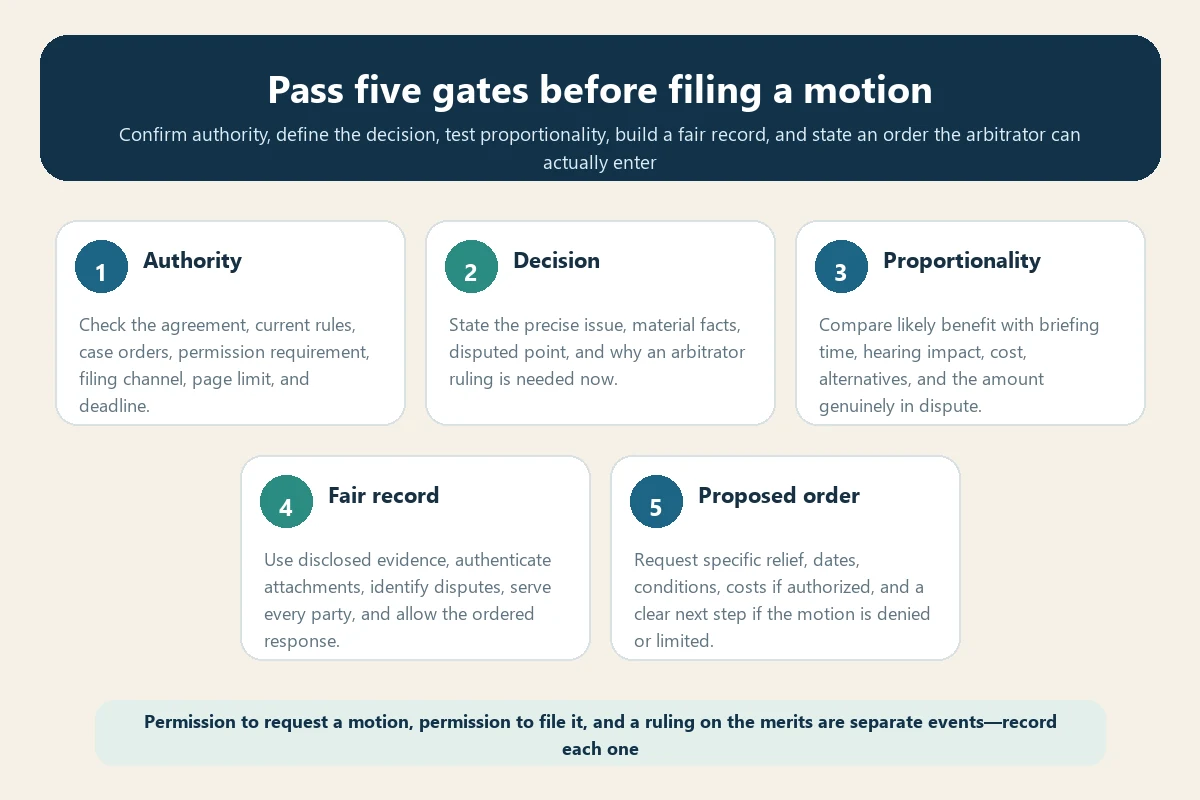
Separate three different approvals
A request for permission to file is not the motion itself. Permission to file is not a decision on the merits. A merits ruling may also grant only part of the requested relief or impose conditions. Track these as separate events:
- Permission request, response, and permission decision.
- Authorized motion, opposition, reply if allowed, and hearing.
- Final ruling, conditions, deadlines, and effect on the case schedule.
Do not attach a full unapproved brief to a short permission request unless the order permits it. Doing so can defeat the purpose of screening motion cost and complexity.
Choose the narrowest useful motion
| Possible request | Question to test | Narrower alternative |
|---|---|---|
| Clarify order | Is a direction genuinely ambiguous? | Joint clarification request |
| Compel exchange | Is material information overdue after a focused request? | Conference and narrowed production |
| Protect information | Is privilege, privacy, burden, or confidentiality at risk? | Redaction or limited access |
| Exclude or limit | Can the evidence concern be resolved at the hearing? | Written objection or limited use |
| Postpone | Is there sufficient cause and no workable cure? | Short extension or remote appearance |
| Dispose or narrow | Can an authorized ruling truly end or reduce issues? | Stipulated fact or issue sequence |
The correct label matters less than the authority, decision, record, and requested relief. Do not combine unrelated disputes into one oversized filing.
Use a permission request that permits efficient screening
If advance permission is required, identify the proposed motion, exact issue, rule or order, essential undisputed facts, disputed facts, requested relief, expected pages and attachments, proposed schedule, likely hearing impact, and prior efforts to resolve the issue.
Explain why the request cannot wait for the hearing or another scheduled conference. For a potentially dispositive motion, explain specifically what claim, defense, element, or amount would be resolved or narrowed and why the motion is likely to succeed under the controlling standard.
Confer without turning negotiation into evidence
When required, contact the other party through the authorized channel, describe the request accurately, and allow a reasonable opportunity to respond. Record date, participants, proposals, agreements, and unresolved points. Do not mischaracterize silence as consent unless the governing procedure says so.
Keep protected settlement communications separate from the motion record. A meet-and-confer can narrow logistics without waiving privilege, confidentiality, objections, or the merits of the claim.
Build a concise motion record
Organize the filing around the decision, not the history of every claim communication. A usable structure includes:
- Exact relief requested.
- Authority under the agreement, rules, and case orders.
- Short material-fact statement with precise record citations.
- Controlling issue and reason the standard is met.
- Response to the strongest known contrary point.
- Proposed order with dates and conditions.
Use the arbitration document exchange guide to identify produced versions and preserve attachments. Do not submit a different edition, cropped screenshot, incomplete thread, or undisclosed declaration without explaining its source and authorized use.
Distinguish facts, argument, and requested findings
A fact statement should cite evidence available for the motion. Argument explains why the authority and facts support the requested ruling. A proposed finding tells the arbitrator exactly what decision is requested. Mixing them makes disputes difficult to isolate.
Identify which facts are undisputed, which are disputed, and why any dispute does or does not prevent the requested ruling. Never claim the absence of evidence when the relevant material is still subject to an unresolved exchange request.
Handle attachments as controlled exhibits
Create an attachment index with file name, description, date, source, production reference, page labels, confidentiality status, and cited pages. Use stable searchable files and include complete attachments when context matters.
Coordinate numbering with the arbitration exhibit list guide. A motion attachment does not automatically become a hearing exhibit or admitted evidence. Record its status separately.
Request protection without overreaching
A protective request should identify the precise material, threatened harm, governing protection, prior narrowing effort, and workable alternative. Possible relief includes redaction, restricted recipients, secure transfer, limited purpose, staged exchange, different format, or a defined retention and deletion process.
Use the arbitration confidentiality guide to distinguish privilege, privacy, security, contractual confidentiality, and provider procedure. “Confidential” alone does not explain why requested protection is authorized or proportional.
Frame information-exchange disputes around material need
For a motion to compel or limit exchange, identify each request, response, remaining deficiency, material issue, date range, source, burden, and proposed cure. Attach the actual request and response rather than paraphrasing them selectively.
Offer narrowing by custodian, policy version, claim period, document type, keyword, or representative sample. Explain why less burdensome sources are insufficient. The goal is access to information needed for a fair decision, not court-style discovery for its own sake.
Treat evidence-limiting motions cautiously
Formal evidence rules may not apply, and the arbitrator may prefer to hear material and assign weight. Before filing a motion to exclude, ask whether a timely written objection, focused foundation question, redaction, limiting instruction, or ruling at the hearing can solve the issue more efficiently.
The evidence objections guide provides a precise workflow for relevance, duplication, privilege, source, completeness, translation, privacy, and late disclosure concerns.
Show sufficient cause for scheduling relief
A postponement or extension request should state the existing deadline, event causing the problem, when it became known, prior diligence, length requested, affected dates, other party’s position, alternatives considered, and proposed revised schedule. Supply support appropriate to the order without exposing unnecessary private details.
Update the arbitration timeline only after the arbitrator or administrator confirms a new date. Filing a request does not suspend the current deadline unless the governing procedure says so.
Respond issue by issue
Begin with the requested disposition: deny, grant in part, defer, or impose a narrower condition. Then answer authority, material facts, disputed facts, standard, proportionality, and relief in the movant’s order when practical.
Do not answer an overbroad motion with an equally overbroad case narrative. Identify missing proof, incorrect version, unresolved fact, unavailable authority, procedural defect, or better alternative. Include a proposed order reflecting the response.
File a reply only when authorized
A reply should answer new points in the opposition, not repeat the opening motion or introduce evidence that could have been supplied earlier. Confirm whether a reply is permitted, its scope, deadline, pages, and service method. If permission is unclear, ask before filing.
Likewise, do not send an uninvited “sur-reply,” extra declaration, or letter to the arbitrator. Follow the authorized communication channel and copy every party as required.
Prepare for oral argument or a motion conference
Build a short decision outline: the exact order requested, governing authority, three material facts, central dispute, best opposing point, narrower alternative, and effect on the schedule. Bring stable page citations and the proposed order.
Answer the arbitrator’s question directly. Do not use a motion conference to present surprise testimony. If a factual hearing is ordered, confirm witness disclosure, examination sequence, exhibits, oath, recording, objections, and time limits through the hearing preparation checklist.
Understand the administrator’s neutral role
The AAA self-represented administration sheet explains that the administrator handles administrative matters, while the arbitrator makes rulings. It also emphasizes written communication, sharing communications with other parties unless directed otherwise, and prompt attention to deadlines.
Do not ask the administrator to advise which motion to file, choose evidence, or overrule the arbitrator. Ask neutral process questions such as the authorized channel, received-file confirmation, fee status, or how an order was transmitted.
Do not borrow another forum’s motion rules
For comparison, FINRA Regulatory Notice 17-02 discusses specific restrictions on motions to dismiss in FINRA arbitration. Those securities rules do not govern an AAA travel insurance matter merely because both processes use arbitration.
Similarly, court rules for summary judgment, discovery sanctions, or motions in limine do not automatically transfer into arbitration. Use only the authority incorporated into or legally applicable to the particular case.
Track the ruling and every downstream change
Record the motion name, permission status, filed versions, service, opposition, reply, conference, ruling date, granted and denied relief, conditions, revised deadlines, costs if authorized, and preserved objections. Save the operative order separately from drafts.
If the decision narrows claims or evidence, update the issue map, witness plan, exhibit index, damages calculation, and opening statement. If it changes hearing logistics, update invitations, vendors, interpreters, and technology tests.
Avoid common motion-practice mistakes
- Filing before obtaining required permission.
- Confusing a permission decision with a merits ruling.
- Using court templates without checking arbitration authority.
- Skipping a required meet-and-confer.
- Combining unrelated requests into one filing.
- Attaching unverified, incomplete, or undisclosed evidence.
- Requesting exclusion when a narrower hearing ruling would work.
- Assuming a pending extension pauses the original deadline.
- Sending unauthorized replies or private merits communications.
- Failing to update the case plan after the ruling.
Final motion practice checklist
- Confirm authority, current rules, orders, and filing channel.
- Identify the exact decision and why it is needed now.
- Complete the required conference and record unresolved points.
- Request permission before briefing when required.
- Test cost, time, proportionality, and narrower alternatives.
- Separate facts, argument, evidence, and proposed findings.
- Authenticate attachments and control confidential material.
- Serve every party and follow the ordered response sequence.
- Propose specific relief, dates, conditions, and next steps.
- Record the ruling and update every affected case document.
Effective travel insurance arbitration motion practice is disciplined decision design. Confirm permission, define one solvable issue, support it with a fair record, test proportionality, offer narrower alternatives, and give the arbitrator a clear proposed order.
