
A travel insurance arbitration inspection allows the arbitrator to examine property or conduct a case-related investigation when direct observation is necessary to understand a material issue. It should be a controlled, noticed, and reviewable part of the record—not an informal private tour or a substitute for missing proof.
The arbitration agreement, current provider rules, case orders, property rights, privacy obligations, and applicable law control. This U.S. consumer guide provides general information, not legal advice. An arbitrator inspection differs from an insurer’s claim investigation, independent medical examination, expert test, document exchange, or ordinary site visit by a party.
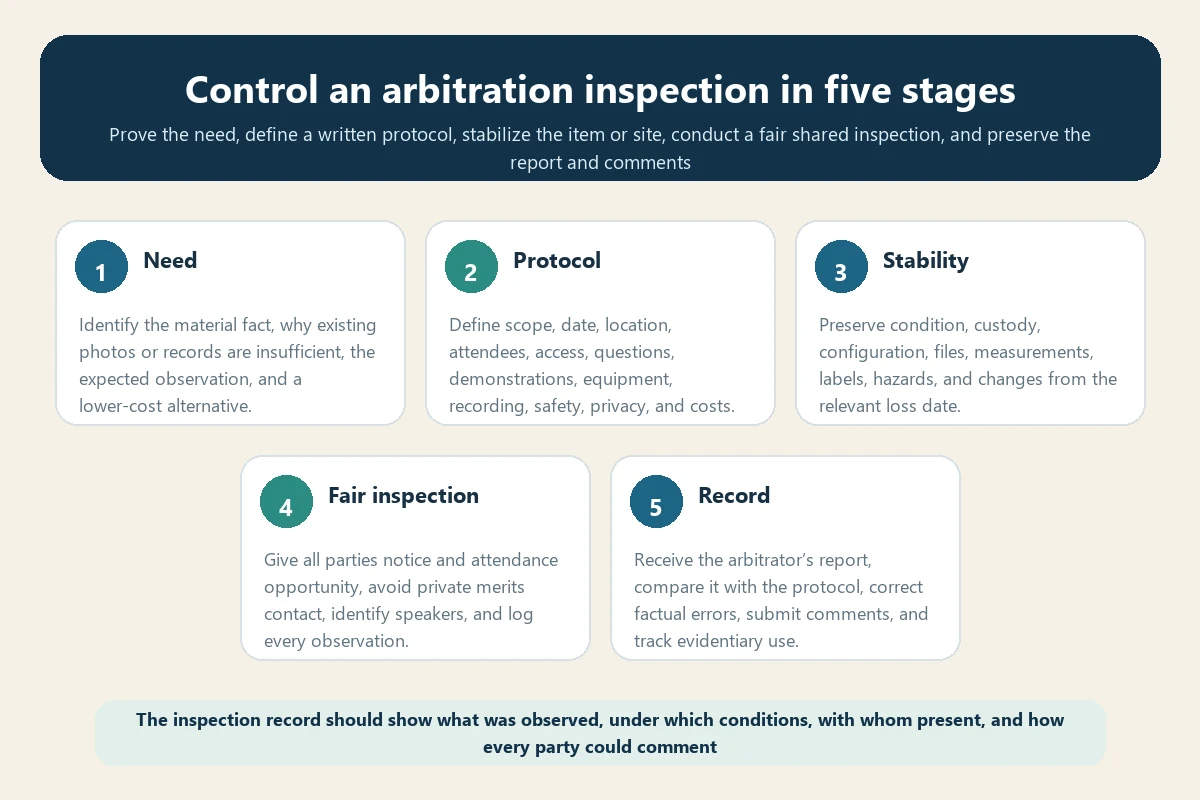
Identify the material fact that requires direct observation
State what the arbitrator needs to see and why existing photographs, video, measurements, records, declarations, or expert analysis are insufficient. Connect the observation to a policy element, excluded cause, condition, valuation, authenticity issue, or disputed damage fact.
Travel insurance claims are often document-based, so an inspection should not be requested automatically. It may be relevant to particular baggage, equipment, damaged property, device records, physical documentation, or another tangible issue only when the governing claim and evidence make it material.
Read the current inspection rule
Under current AAA Consumer Arbitration Rule R-34, an arbitrator who finds it necessary to inspect property or conduct an investigation asks the AAA to inform the parties. The arbitrator sets the date and time, and the AAA notifies the parties.
The rule permits any party who wants to be present to attend. If one or all parties are absent, the arbitrator makes an oral or written report and allows the parties an opportunity to comment. Verify the applicable rule edition and any more detailed case order.
Separate the arbitrator’s role from a party expert
The arbitrator observes and decides under the governing process. A party expert may test, measure, interpret, and offer an opinion subject to disclosure and examination. A custodian may explain operation or history. Do not blur these roles.
If specialized testing or destructive examination is requested, identify who will perform it, qualifications, method, standards, sample handling, calibration, repeatability, damage risk, and access for the other party. An arbitrator’s presence does not convert every statement into reliable expert evidence.
Request inspection through the authorized channel
State the precise item or location, material issue, reason direct observation is necessary, current condition, controller, proposed dates, attendees, estimated duration, safety requirements, recording method, costs, and alternatives. Attach photographs or diagrams only as needed to explain the request.
Use the arbitration motion practice guide if permission, briefing, response, or a proposed order is required. Do not contact the arbitrator privately to arrange a visit.
Test lower-cost and less intrusive alternatives
Consider a joint video tour, synchronized screen share, 360-degree images, agreed measurements, neutral custodian demonstration, representative sample, expert report, certified copy, or shared data export. Explain whether each alternative would preserve context and permit questions.
A virtual method may reduce travel and access burdens but can hide scale, texture, surrounding conditions, metadata, off-camera changes, or operational behavior. Choose based on the disputed fact rather than convenience alone.
Create a written inspection protocol
| Protocol field | Question to resolve | Record control |
|---|---|---|
| Scope | Which item, area, system, or file is included? | Map or inventory |
| Condition | What must remain unchanged? | Pre-inspection photos and hash |
| Attendance | Who may attend and in what role? | Named attendance list |
| Questions | Who may speak, demonstrate, or object? | Communication protocol |
| Recording | What photos, video, audio, or notes are allowed? | Shared official record |
| Safety and privacy | What restrictions, credentials, or redactions apply? | Access and protection plan |
| Costs | Who advances travel, vendor, or testing expense? | Written allocation |
Include start and end time, time zone, meeting point, equipment, clothing, accessibility, interpretation, breaks, prohibited areas, emergency contact, and procedure for unexpected evidence.
Stabilize the property or data before inspection
Record custody, location, serial number, identifiers, current configuration, damage, repairs, maintenance, software version, connected devices, and changes since the loss date. Preserve source files and metadata when digital material is involved.
Do not repair, clean, update, reset, disassemble, relabel, move, discard, or alter the subject without documenting authority and necessity. If a safety or preservation action cannot wait, record the condition before and after and notify parties promptly.
Document the chain of custody
For movable baggage, equipment, media, or samples, log every transfer, handler, date, seal, package, storage condition, opening, test, and return. Use tamper-evident controls when proportionate.
Coordinate identifiers with the arbitration exhibit list. The physical item, photographs, test results, and inspection report may be separate evidence with different foundations.
Provide fair notice and attendance access
Confirm the AAA notice, date, time, location, access method, parties, representatives, interpreter, expert, custodian, and any remote link. Check travel permissions, building security, accessibility, and required identification early.
If attendance becomes impossible, request instructions promptly. Do not assume absence prevents the inspection or waives the right to comment. Use the postponement request guide when good cause may require a schedule change.
Avoid ex parte merits communication
No party, owner, employee, guide, technician, or expert should privately explain the dispute to the arbitrator. Identify every speaker and keep substantive communication within the shared protocol.
If the arbitrator arrives, leaves, or moves between areas with only one party present, log the circumstance and prevent case discussion. Transportation and hospitality arrangements should avoid creating private merits access or an appearance of favoritism.
Control demonstrations and testing
Define operating steps, inputs, tools, settings, test sequence, environmental conditions, safety limits, repeated trials, expected outputs, and who controls the equipment. Preserve raw results rather than only a selected summary.
If a demonstration differs from ordinary use or the condition on the loss date, disclose the difference. Do not stage a scene, preload a result, or hide a failed trial.
Handle questions, testimony, and objections
Clarify whether statements at the inspection are testimony, informal orientation, or later subject to confirmation under oath. A custodian’s description should not quietly become uncontested evidence because everyone is standing at the site.
Use the witness testimony guide for oath, personal knowledge, examination, interpretation, and corrections. Use the evidence objections guide for relevance, source, completeness, privilege, and unfair surprise.
Create one authorized inspection record
Decide who photographs, records video, takes measurements, prepares minutes, and stores files. Use a synchronized clock, descriptive filenames, stable page or frame references, and a manifest. Preserve originals and record edits used for orientation.
Do not make a private audio or video recording without permission. If multiple recordings are allowed, specify which is official and how every party obtains it.
Protect privacy and confidential information
Limit the inspection to authorized areas, accounts, records, and data fields. Shield unrelated travelers, employees, medical details, payment information, credentials, trade secrets, and security systems. Use test accounts or redacted views when they still answer the material question.
The arbitration confidentiality guide helps define access, secure transfer, recording, retention, and deletion controls.
Plan safety, accessibility, and interpretation
Identify physical hazards, protective equipment, mobility access, lighting, noise, weather, restricted areas, emergency procedures, and insurance requirements. No evidentiary objective justifies an unsafe inspection.
Arrange a qualified interpreter when required and define how interpretation pauses questions and demonstrations. Confirm accessible alternatives for a participant who cannot enter a particular area.
Address cost before the visit
Estimate arbitrator time, travel, facility, technician, expert, security, recording, storage, interpretation, equipment, testing, and restoration. Identify who advances each cost and whether later allocation is reserved.
Compare expense with the amount and issue in dispute. A focused virtual demonstration may be more proportionate than cross-country travel when it preserves the necessary observation.
Respond to an unexpected observation
If the inspection reveals a new object, condition, file, person, or safety issue, pause and ask the arbitrator for instructions. Record what was seen without launching an unplanned merits investigation.
Possible responses include photographs, a preserved sample, supplemental exchange, expert review, written comments, limited testimony, or a later session. Give every party a fair opportunity to address material new information.
Review the arbitrator’s report
Current AAA Rule R-34 requires an oral or written report and opportunity to comment when one or all parties are not present. Even when everyone attends, ask how observations enter the record and whether minutes or a report will be circulated.
Compare the report with the protocol, attendance log, recordings, measurements, and chronology. Identify factual transcription errors separately from disagreement about inference or weight.
Submit focused comments
Cite the report page or statement, state the correction or context, reference supporting evidence, and explain material effect. Do not use comments as an unauthorized new brief or document dump.
If additional evidence is necessary, request permission, scope, response time, and record-closing treatment through the authorized channel.
Use comparative guidance carefully
The ICSID site-visit overview describes detailed protocols for scope, logistics, presentations, objections, recording, and evidentiary value in international investment arbitration. It does not govern a U.S. consumer travel insurance case.
Likewise, UNCITRAL procedural guidance discusses physical and virtual inspections, attendance, costs, private communications, and explanations at a site. Use these as planning comparisons only when consistent with the actual agreement and rules.
Avoid common inspection mistakes
- Requesting inspection without a material fact it can resolve.
- Using inspection to replace available documents or expert proof.
- Failing to stabilize condition and chain of custody.
- Allowing private merits communication with the arbitrator.
- Letting demonstrations proceed without defined inputs and settings.
- Treating informal explanations as sworn testimony.
- Making unauthorized recordings.
- Exposing unrelated private or protected information.
- Ignoring safety, accessibility, interpretation, or cost.
- Failing to review and comment on the inspection report.
Final inspection checklist
- Identify the material issue and why direct observation is necessary.
- Confirm the current rule, authority, and motion procedure.
- Test a virtual or documentary alternative.
- Obtain a written scope, attendance, question, and recording protocol.
- Stabilize the item, site, data, and chain of custody.
- Provide notice and equal attendance opportunity.
- Control demonstrations, testimony, objections, and unexpected evidence.
- Protect safety, privacy, accessibility, and confidential information.
- Preserve the authorized record and arbitrator’s report.
- Submit precise corrections or comments within the ordered process.
A useful arbitration inspection is a transparent evidentiary procedure. Define the question, preserve the condition, give equal notice and access, prevent private merits communication, document observations under a written protocol, and ensure every party can review and comment on the resulting record.
