

A travel insurance arbitration appeal process is an internal arbitral review that exists only when the parties’ governing agreement provides for it. It is not a general right attached to every arbitration award, and it is not the same as asking a court to vacate, modify, correct, confirm, or review a judgment.
The contract, policy, endorsements, applicable AAA Consumer Rules, administrator directions, Consumer Due Process Protocol, fee schedule, and governing law control. This U.S. consumer guide is general information, not legal advice. Appeal and court deadlines can be short, and one process may not pause another.
Start with the exact appeal clause
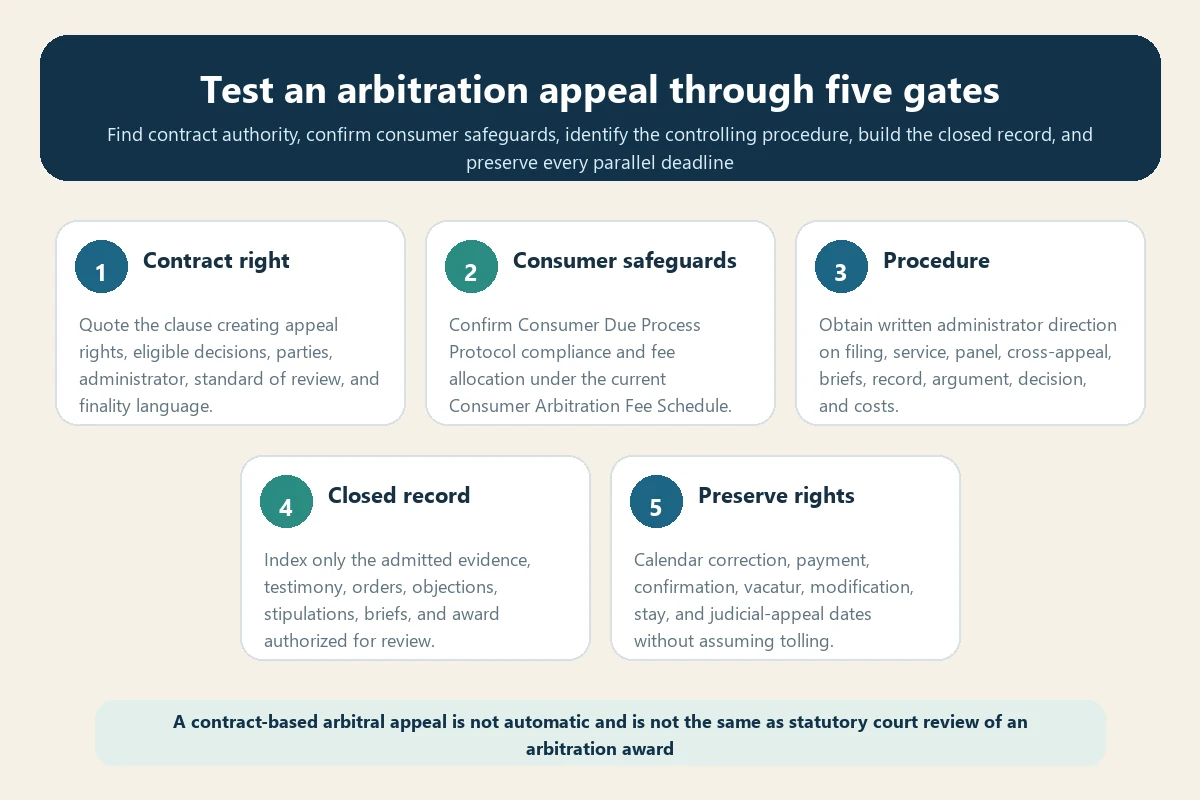
Locate the complete arbitration provision and every incorporated document. Quote the language that creates an appeal, identifies the eligible award, names the administrator, defines the standard of review, allocates fees, sets deadlines, and states when the award becomes final.
Do not infer an appeal right from words such as “binding arbitration,” “final award,” or “judgment may be entered.” If the agreement contains no appeal provision, a disappointed party cannot create one unilaterally after the award.
Apply the current consumer rule
Current AAA Consumer Arbitration Rule R-58 states that when the parties’ arbitration agreement provides for appeal of an award, the AAA will administer the appellate arbitration process only if it complies with the Consumer Due Process Protocol and the filing fees and arbitrator compensation are borne and allocated under the Consumer Arbitration Fee Schedule.
R-58 also says that in such cases the AAA administers the appellate process under the Consumer Rules. It does not supply a universal appeal clause, deadline, record, or standard of review for every travel insurance dispute.
Recognize that R-58 is a 2025 addition
AAA’s official comparison of revised Consumer Rules identifies R-58 as a new appeals rule. This matters when older templates, articles, or correspondence say the Consumer Rules contain no appeal provision.
Still, the applicable rule edition must be determined for the actual case. A new rule does not automatically rewrite the parties’ underlying contract or settle enforceability questions.
Separate four different review routes
Use four columns so terminology does not collapse:
- Provider correction or clarification: a limited request concerning an ambiguity or specified mechanical error.
- Contract-based arbitral appeal: review by another arbitrator or panel because the agreement creates that route.
- Trial-court award challenge: a motion under applicable federal or state arbitration law on limited grounds.
- Judicial appeal: appellate review of a court order or final decision when authorized.
Each route has its own authority, decision-maker, standard, deadline, record, fee, and available relief.
Do not import the commercial appellate rules automatically
AAA publishes Optional Appellate Arbitration Rules for agreed appellate arbitration. Their Rule A-1 includes an express note excluding disputes arising from standardized, primarily non-negotiable consumer agreements between individuals and businesses.
Therefore, do not assume those Optional Appellate Rules govern a consumer travel insurance dispute merely because they appear on AAA’s website. R-58, the actual contract, administrator determination, protocol, fee schedule, and written case directions must be reconciled.
Ask the administrator for written direction
Before filing, ask through the authorized channel which appeal provision and procedural rules AAA will administer. Request written confirmation of:
- eligible award or ruling;
- notice and filing deadline;
- service method;
- filing requirements and fee allocation;
- panel selection and conflicts process;
- cross-appeal procedure;
- record and briefing schedule;
- oral argument policy;
- standard of review;
- available dispositions;
- effect on finality and court proceedings.
Do not contact the merits arbitrator or a potential appellate arbitrator privately.
Test Consumer Due Process Protocol compliance
R-58 conditions AAA administration on protocol compliance. Review notice, access to information, neutral selection, hearing opportunity, remedies, reasoned decision, cost, location, representation, and other applicable fairness protections.
Document the precise clause and process rather than stating broadly that an appeal “feels unfair.” Ask the administrator how any noncompliant feature will be handled and preserve written responses.
Verify fee allocation before filing
Obtain the current Consumer Arbitration Fee Schedule and a written estimate for administrative fees and appellate-arbitrator compensation. Identify the consumer share, business share, deposit dates, waiver or hardship process, and consequences of nonpayment.
The arbitration cost guide helps distinguish filing fees, arbitrator compensation, expenses, attorney fees, and party costs. Do not use the commercial appellate fee schedule when R-58 requires consumer allocation.
Identify the review standard
Quote the contract or approved procedure defining what the appellate decision-maker may review. Possible formulations can distinguish legal error, factual error, abuse of discretion, procedural fairness, or another standard.
Do not argue under a standard taken from court litigation or commercial appellate rules unless it governs. For each issue, state the standard, preserved ruling, record citation, prejudice, and precise requested disposition.
Preserve issues in the underlying arbitration
An appellate process usually depends on what was raised and preserved below. Maintain an issue log showing the objection, motion, evidence, ruling, requested relief, and transcript or order citation.
The evidence objections guide and motion practice guide help create a traceable record. Do not save a new theory for appeal and assume it will be considered.
Preserve the award and delivery evidence
Save the original award, administrator transmittal, portal metadata, email headers, and any corrected or clarified version. Record the exact delivery date, time zone, and recipient.
The arbitration award guide helps inventory claims, findings, relief, costs, interest, and deadlines. An appeal timeline must begin from the event specified in the governing procedure, not from when a party later opened the file.
Decide whether correction comes first
A transposed figure, missing word, ambiguity, or computational error may belong in a limited correction process rather than an appeal. Determine whether a correction request is required, optional, appealable, or independent.
The award correction guide explains current AAA R-49 and court modification concepts. Do not assume filing one request pauses the other deadline.
Build the authorized record on appeal
Create an indexed record containing only materials the governing process permits: pleadings, orders, admitted exhibits, stipulations, transcript excerpts, expert material admitted below, objections, briefs, and the award. Mark each item’s status and source.
The hearing transcript guide explains ordering, correction, privacy, and citation. Do not attach material that was exchanged but never admitted unless the appellate rules expressly authorize it.
Create an appeal issue matrix
For every proposed issue, record:
- short issue statement;
- contract or policy provision;
- governing standard of review;
- where the issue was raised;
- underlying ruling;
- record citations;
- material prejudice;
- requested appellate relief;
- effect on damages or nonmonetary duties.
Remove arguments that merely express disappointment without satisfying the contractual standard.
Draft a focused notice of appeal
Use the case caption, award date, clause, appeal authority, eligible issues, requested relief, filing date, service proof, and required attachments. Avoid turning the notice into an oversized merits brief unless the procedure requires full argument at filing.
Confirm whether an appellee must file a separate cross-appeal to seek affirmative changes. A response defending the award may not preserve a request to enlarge it.
Write the brief to the review standard
Begin each section with the issue and standard. State the preserved ruling, cite the closed record, explain why the error meets the standard, show material prejudice, and specify the permitted remedy.
The post-hearing brief guide can help with record-based organization, but an appeal brief has a different purpose: reviewing identified rulings rather than asking the original arbitrator to decide the case.
Protect confidential information
Follow the existing protective order and any appellate direction. Redact medical identifiers, account numbers, travel documents, minors’ information, and confidential business material as required.
The confidentiality guide distinguishes administrator confidentiality, party obligations, protective orders, publication, and later court filings. A private arbitral record may become part of a public court dispute.
Do not assume oral argument
Ask whether review is documents-only and whether oral argument requires a timely request. If argument is permitted, confirm length, platform, panel questions, demonstratives, recording, and whether new evidence is prohibited.
Prepare a short answer for the standard, record location, prejudice, and requested remedy for each issue. Do not use argument to introduce facts outside the approved record.
Track finality and payment
Determine whether filing an authorized appeal affects the underlying award’s finality, payment deadline, interest, or confirmation. Obtain the governing text and administrator direction rather than assuming an automatic stay.
The award payment guide helps track operative amounts and satisfaction. Maintain alternate ledgers for the original and any modified result until the appeal is complete.
Separate court challenge deadlines
The award challenge guide covers limited court review under federal and state law. A contract-based appeal may have broader review but does not automatically replace statutory procedures.
Calendar service and filing dates for correction, vacatur, modification, confirmation, stay, and enforcement independently. Seek jurisdiction-specific advice on tolling and finality.
Understand judicial appeals under FAA Section 16
FAA Section 16 identifies certain appealable court orders and final decisions concerning arbitration, while limiting appeals from specified interlocutory orders that direct arbitration to proceed or refuse to enjoin it.
Section 16 concerns appellate review of judicial action. It does not create an internal arbitral appeal from the merits award and should not be cited as the contract authority required by R-58.
Audit the appellate decision
When the decision arrives, verify signatures, date, parties, issues reviewed, standard applied, disposition, remand or modification instructions, costs, interest, payment, and finality language. Compare every operative term against the underlying award.
If the result changes, create a consolidated obligation table rather than editing the original award. Preserve both decisions and delivery evidence.
Avoid common appeal mistakes
- Assuming every arbitration award is appealable.
- Confusing R-58 with statutory court review.
- Importing commercial Optional Appellate Rules into a consumer case.
- Ignoring due-process and consumer-fee conditions.
- Using the wrong standard of review.
- Missing a notice or cross-appeal deadline.
- Adding issues or evidence not preserved below.
- Assuming appeal automatically stays payment or court deadlines.
- Failing to protect confidential record material.
- Discarding the underlying award after a new decision.
Final arbitration appeal checklist
- Quote the contract clause creating appeal rights.
- Confirm current Consumer Rule R-58 applies.
- Verify protocol compliance and consumer fee allocation.
- Obtain written administrator procedure.
- Calendar appeal, cross-appeal, correction, and court dates.
- Identify the governing review standard.
- Build a closed, indexed, privacy-controlled record.
- Connect every issue to preservation and prejudice.
- Track finality, payment, and any stay separately.
- Audit and preserve the underlying and appellate decisions.
A valid consumer arbitration appeal begins with contract language, not disappointment with the result. The strongest process confirms AAA’s authority, protects consumer due process and fee allocation, uses the correct standard and closed record, and preserves every independent correction, payment, and court deadline.
