

Travel insurance arbitration due process asks whether a consumer receives a fundamentally fair dispute-resolution procedure: understandable notice, independent administration, a qualified neutral, reasonable cost and location, access to information, a meaningful hearing, available remedies, and an intelligible award.
The policy, arbitration clause, current provider rules, AAA Consumer Due Process Protocol, case orders, and applicable law all matter. This U.S. consumer guide is general information, not legal advice. AAA’s administrative review is important, but it is not a court ruling that a clause is legally enforceable.
Use the official Protocol as the baseline
The official AAA Consumer Due Process Protocol begins with a fundamentally fair process and sets principles for information, neutral independence, competence, small claims, reasonable cost, convenient location, time, representation, mediation, arbitration agreements, hearings, access to information, remedies, and awards.
Use those principles as an audit framework. Do not cite “due process” as a slogan without identifying the clause, procedural event, requested safeguard, supporting evidence, and decision-maker.
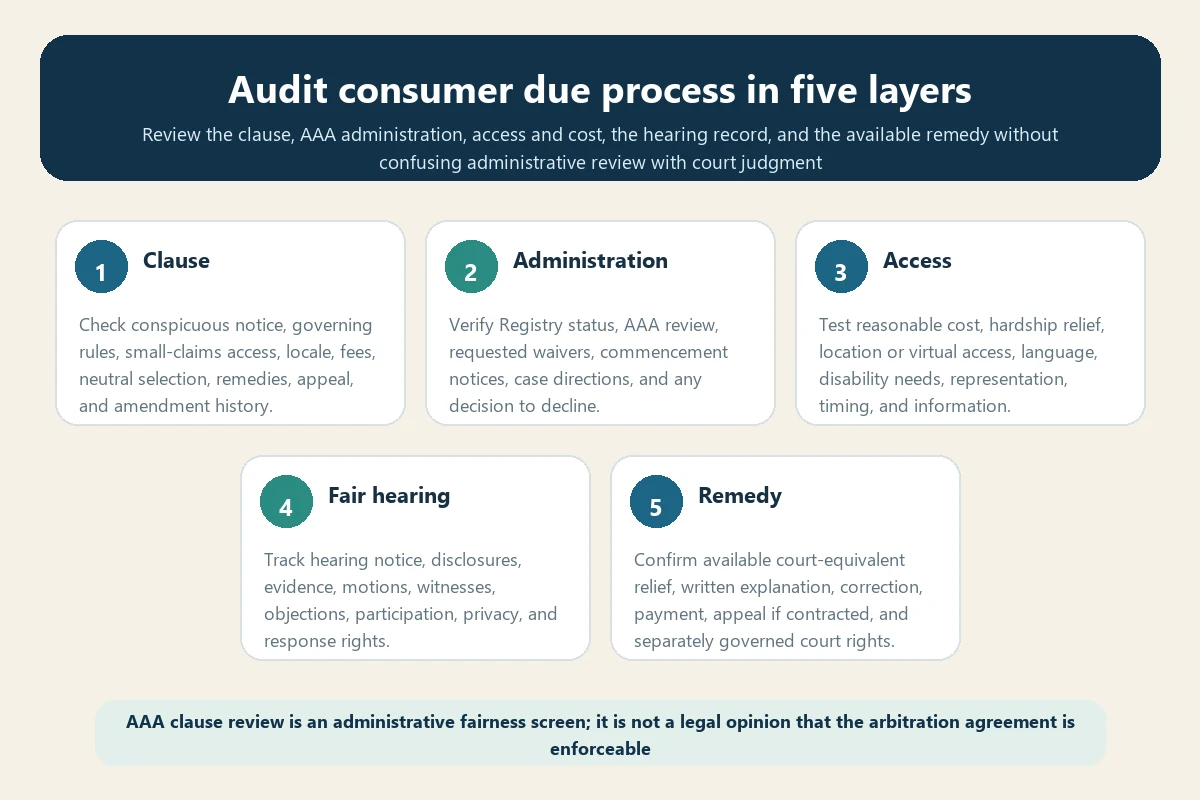
Separate three kinds of review
Keep these questions distinct:
- AAA administrative review: whether the clause substantially and materially complies for AAA administration.
- Arbitrator determination: disputes within the arbitrator’s authority about jurisdiction, rules, or case procedure.
- Court determination: legal questions about formation, enforceability, confirmation, vacatur, modification, or other relief under applicable law.
A favorable registry entry does not answer every legal issue. A court ruling does not replace day-to-day compliance with the administrator’s rules.
Review the current Consumer Rules
Current AAA Consumer Rule R-1 says AAA accepts cases after reviewing the agreement for substantial and material compliance with the Protocol and Consumer Rules. If AAA proceeds and a party disagrees, the issue can be brought to the arbitrator for a final decision under the rule.
Use the rule edition in effect for the actual filing and preserve the complete agreement. A travel protection package can contain insurance, assistance, supplier-waiver, and sales terms; identify which document contains the arbitration clause.
Search the Consumer Clause Registry
AAA’s official consumer dispute resolution page explains that the Consumer Clause Registry lists businesses whose submitted clauses were found to substantially comply. Search by the insurer’s exact legal name and related business names, then preserve the result date and clause version.
A missing entry does not itself decide enforceability or prove AAA will never administer. Under current rules, an unregistered clause can be reviewed when a case is filed, with applicable business fees.
Compare the registered and issued clauses
Compare the registry text with the policy or certificate issued to the traveler. Record differences in administrator, rules, governing law, locale, number of arbitrators, costs, small-claims option, appeal, remedies, time limits, and amendments.
AAA’s official guide to the Protocol and Consumer Rules explains that registry review is an administrative determination, not legal advice. Submit a changed clause for the review process rather than relying on an older version.
Audit notice and access to information
Check whether the arbitration provision was conspicuous and whether the consumer could obtain the applicable rules, fee information, administrator contact, and basic differences between arbitration and court. Preserve the checkout screen, policy delivery email, declarations, certificate, endorsements, and version history.
After a dispute arises, request the full clause, rules, fee schedule, filing instructions, roster information, and case contacts. The complaint versus arbitration guide helps compare the relevant pathways and documents.
Protect the small-claims option
Protocol Principle 5 says consumer agreements should make clear that parties retain access to small-claims court for claims within its jurisdiction. Current Consumer Rule R-9 describes small-claims pathways.
Check the court’s actual monetary, geographic, party, and subject-matter limits. Do not assume a claim qualifies because the unpaid benefit is small; related relief or party status can matter.
Test reasonable consumer cost
Protocol Principle 6 addresses reasonable cost based on the dispute and the consumer’s ability to pay. Obtain the current fee schedule and identify filing fee, case-management fee, hearing fee, arbitrator compensation, expenses, deposits, hardship waiver, and business responsibility.
The arbitration cost guide separates administrator charges from attorney fees, evidence expenses, and claim damages. Challenge a clause term with exact numbers rather than a general assertion that arbitration is expensive.
Audit location and hearing method
Protocol Principle 7 calls for a reasonably convenient location for face-to-face proceedings. Current Consumer Rules use virtual hearings by default subject to agreement or an arbitrator’s decision on an in-person request.
Document travel distance, health, disability, caregiving, time zone, internet access, privacy, equipment, interpreter needs, witnesses, and evidence handling. The virtual hearing guide helps turn access concerns into a concrete protocol.
Request accommodations early
Identify disability, language, hearing, vision, technology, scheduling, or caregiving barriers promptly. State the functional need and requested accommodation without disclosing more medical information than necessary.
For language access, use the interpreter guide to address qualifications, neutrality, documents, remote setup, costs, and the record. Preserve the request and decision.
Track reasonable time limits
Protocol Principle 8 favors proceedings without undue delay and rules with reasonable time periods. Build a calendar from demand through answer, preliminary hearing, exchange, motions, hearing, closure, award, and post-award deadlines.
The arbitration timeline guide provides a control ledger. For any extension or postponement, document the reason, prejudice, proposed new dates, and response.
Preserve the right to representation
Protocol Principle 9 recognizes a party’s right, at that party’s expense, to a chosen spokesperson, subject to applicable law. Current Consumer Rules allow self-representation, counsel, or another chosen representative unless prohibited.
Follow notice requirements and clarify the representative’s scope. Do not assume a family member, public adjuster, translator, or nonlawyer may perform every legal function in every jurisdiction.
Consider mediation without losing the schedule
Protocol Principle 10 encourages mediation as an informal means of party-driven resolution. Current rules permit mediation during arbitration and generally do not let it delay the case absent agreement.
An arbitration settlement plan should preserve deadlines while the parties negotiate. Keep mediation communications separate from the merits record as required.
Audit neutral independence and selection
Protocol Principles 3 and 4 address independent administration, impartial neutral selection, disclosure, disqualification, competence, and standards. Review the candidate list, resume, conflicts, prior relationships, financial interests, repeat appointments, and subject expertise.
The arbitrator selection guide helps create objective criteria and a disclosure log. Continue monitoring conflicts throughout the appointment.
Make information exchange sufficient and proportional
A fair opportunity to present a claim requires access to relevant and material information, but consumer arbitration is not automatically full civil discovery. Identify the policy version, claim file categories, payment logs, medical-review material, supplier communications, recordings, and calculation inputs actually needed.
The document exchange checklist helps define custody, date range, search, format, privilege, privacy, and missing-item follow-up. Tie each request to a disputed issue.
Build a fundamentally fair hearing record
Protocol Principle 12 calls for adequate notice, an opportunity to be heard, relevant evidence, impartial decision-making, and appropriate hearing access. Maintain a hearing notice, attendance list, exhibit log, witness list, objections, rulings, technical incidents, time allocations, and closing record.
The hearing preparation checklist helps confirm that both parties can present material claims and defenses. Raise access problems promptly and propose a workable cure.
Preserve response rights
No party should submit material evidence privately or after closure without authorized notice and a fair response opportunity. Serve written communications as required and identify any permitted ex parte administrative contact.
If new evidence arises, distinguish an open post-hearing schedule from a closed record. Use the reopening guide for pre-award timing, materiality, diligence, scope, and response safeguards.
Confirm available remedies
Consumer due process generally seeks access to relief available in court, subject to applicable law and the submitted dispute. Identify unpaid benefits, declaratory or nonmonetary relief, interest, fees, costs, and any claimed statutory remedy separately.
Do not treat the Protocol itself as proof that a specific remedy must be awarded. The arbitrator applies the governing agreement and law within their authority.
Require an intelligible award
Current Consumer Rule R-45 requires a brief written explanation unless all parties agree otherwise. Verify that the award is written, signed, identifies the parties and obligations, addresses submitted issues sufficiently, and can be implemented.
The reasoned award guide explains form, issue mapping, record citations, relief reconciliation, privacy, and review. A brief explanation is not necessarily full judicial findings.
Document a protocol concern precisely
Create a concern log with the Protocol principle, clause or procedural event, evidence, date raised, requested cure, governing rule, response, ruling, prejudice, and whether the issue remains open. Use neutral factual language.
Send the concern through the authorized AAA channel and serve other parties as required. Preserve the administrator’s review, requested waiver, business response, and arbitrator ruling.
Understand what happens if AAA declines
Current Rule R-10 allows AAA to decline, stop, or decline future administration in specified circumstances, including a consumer agreement that does not comply with the Protocol. The rule says parties may choose to submit the dispute to the appropriate court after such a decision.
Obtain the written decision and analyze the clause, governing law, limitations period, court jurisdiction, service, and available claims. Do not assume the underlying insurance dispute is automatically won or lost.
Do not confuse due process with a merits appeal
A party can receive a fair procedure and still lose. Conversely, a favorable result does not prove every safeguard was followed. Separate outcome disagreement from notice, neutrality, evidence, hearing, authority, and award-form concerns.
A contract-based consumer appeal may differ from a court challenge. Court challenges remain limited and separately governed.
Avoid common due-process audit mistakes
- Treating AAA registry review as a legal enforceability opinion.
- Reviewing an outdated clause or rule edition.
- Ignoring the small-claims option.
- Combining consumer fees with all party expenses.
- Raising access or accommodation needs too late.
- Objecting to a neutral without specific disclosure evidence.
- Requesting disproportionate information without issue mapping.
- Failing to preserve notice, rulings, and prejudice.
- Using outcome disagreement as the only fairness argument.
- Assuming AAA refusal decides the insurance merits.
Final consumer due process checklist
- Preserve the issued clause, policy, endorsements, and rule edition.
- Search the Registry and compare clause versions.
- Audit notice, information, small claims, costs, and location.
- Verify neutral independence, competence, and disclosures.
- Request timely accommodations and representation access.
- Build proportional information exchange.
- Preserve hearing notice, evidence, objections, and response rights.
- Confirm remedies and award form.
- Document each concern, cure request, response, and ruling.
- Separate AAA administration, arbitrator authority, and court law.
A strong due-process audit is specific and chronological. It compares the actual clause with the current Protocol and Rules, tests practical access at every stage, documents requested cures, and distinguishes administrative fairness review from the legal and merits decisions reserved for the arbitrator or court.