
Medicare can cover certain medically necessary ambulance services, but it is not general travel medical evacuation insurance. Inside the United States, Medicare Part B may pay for ground or air ambulance transport when the medical-necessity, origin, destination, and nearest-appropriate-facility rules are met. Outside the United States, Medicare coverage is usually absent except for narrow statutory situations. A flight to a preferred hospital or transport home after stabilization should never be assumed covered.
This article is educational, not medical, legal, insurance, or financial advice. A clinician’s recommendation does not by itself guarantee payment. Medicare, a Medicare Advantage plan, a Medigap carrier, or a travel insurer applies its own current rules to the actual facts.
Key takeaways
- Medicare ambulance coverage is based on medically necessary transport to an appropriate covered destination, not a traveler’s preference.
- Air ambulance may qualify when rapid transport is medically necessary and ground transport cannot safely or practically provide it.
- Original Medicare generally does not cover care abroad, with only limited border, Alaska-through-Canada, residence, and cruise situations.
- Medicare’s limited foreign coverage generally does not provide a return ambulance home after a covered foreign hospital stay.
- International evacuation, interfacility transfer, medical escort, hospital-of-choice transport, and repatriation should be tested as separate routes.
Reviewed: August 16, 2026.
Start by naming the transport
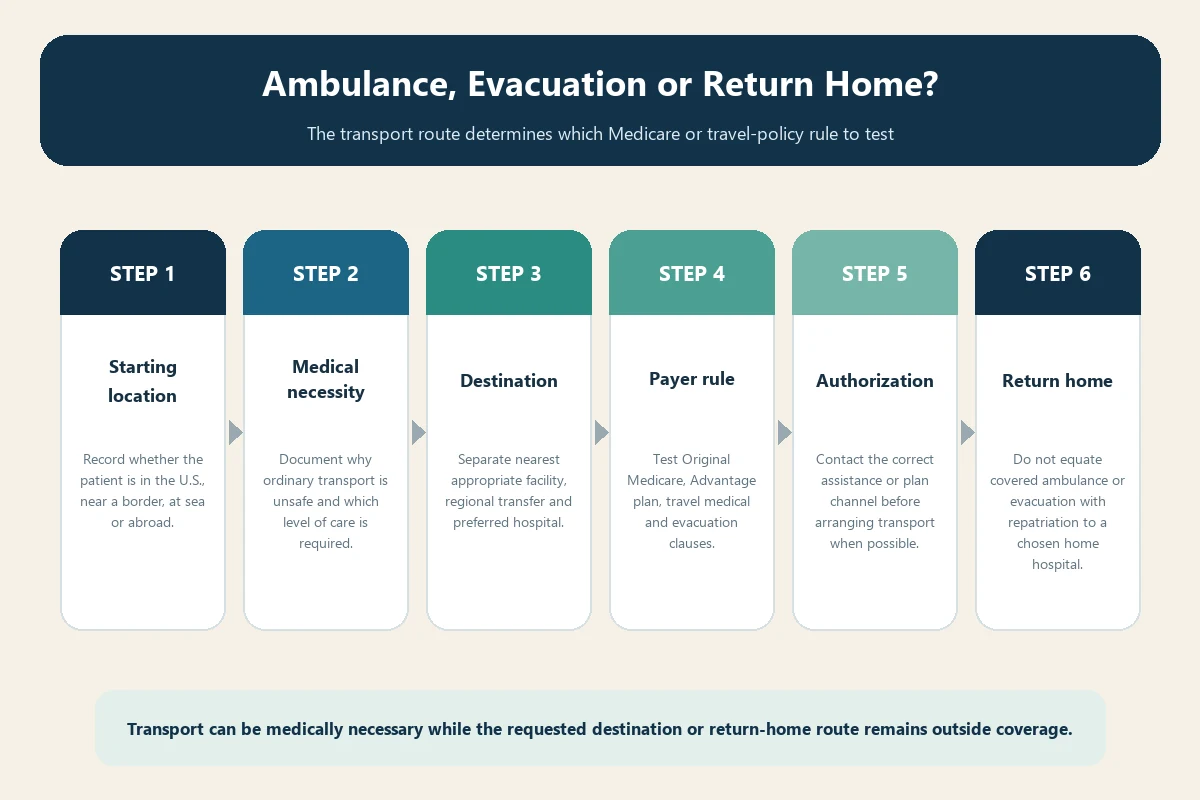
“Medical evacuation” can describe very different events. It might mean a 10-mile ground ambulance to an emergency department, a helicopter from a highway crash, an air ambulance from an island to a regional hospital, a transfer between foreign hospitals, or a medically escorted commercial flight home. Medicare does not evaluate those as one benefit.
Write the route as:
origin → transport mode → clinical reason → destination → decision-maker.
Then ask which policy provision applies to that exact segment. This method prevents a covered local ambulance from being mistaken for a promise to cross a country or return to the United States.
When Original Medicare may cover a domestic ambulance
Medicare’s ambulance booklet says Part B covers ambulance services to or from certain facilities when traveling in another vehicle could endanger the person’s health. Covered destinations can include a hospital, critical access hospital, rural emergency hospital, or skilled nursing facility, depending on the circumstances. The service must meet Medicare’s rules and be furnished by an eligible supplier.
Medical necessity involves the traveler’s condition at the time of transport. Convenience, lack of a car, unfamiliarity with the area, or a desire to reach a particular specialist is not enough. Documentation should explain why another means of transport was unsafe.
The nearest appropriate facility rule
Medicare generally pays only for transport to the nearest appropriate facility able to provide the needed care. If the person chooses a farther hospital, Medicare may base payment on the distance to the closest appropriate facility, leaving additional mileage or charges to the beneficiary.
“Appropriate” depends on capability, not necessarily proximity alone. A small emergency department may stabilize a condition but lack a required specialty. The record should identify why a farther facility was medically necessary and available. Our travel medical ambulance guide explains how dispatch, stabilization, and facility capability affect the route.
When air ambulance may qualify
Medicare may cover airplane or helicopter ambulance transport when immediate and rapid transport is medically necessary and ground transportation cannot provide it. Examples in Medicare guidance focus on circumstances such as great distance, inaccessible location, or heavy traffic that would endanger the patient’s health if ground travel were used.
The fact that a helicopter was dispatched does not prove coverage. Review the clinical urgency, origin and destination eligibility, supplier status, nearest appropriate facility, and whether ground transport would have been unsafe. Separate any rescue operation before the patient reaches an ambulance; search and rescue can fall outside ordinary medical-transport coverage.
Original Medicare outside the United States
Medicare defines the United States to include the 50 states, District of Columbia, Puerto Rico, U.S. Virgin Islands, Guam, American Samoa, and Northern Mariana Islands. Outside those places, coverage is generally limited.
Medicare’s April 2026 publication identifies three foreign hospital situations:
- A person has a medical emergency in the United States, and a foreign hospital is closer or easier to reach than the nearest U.S. hospital able to treat the condition.
- A person is traveling without unreasonable delay by the most direct route between Alaska and another state through Canada, an emergency occurs, and the Canadian hospital is closer or easier to reach.
- A person lives in the United States and a foreign hospital is closer to the home than the nearest U.S. hospital able to treat the condition; the qualifying care may be emergency or non-emergency.
When Medicare covers a qualifying foreign inpatient hospital stay, Part B can cover certain ambulance and professional services furnished immediately before and during that stay. These are narrow exceptions, not a worldwide evacuation program. See our Medicare in Europe guide for a broader foreign-care explanation.
The return-home gap
Medicare specifically warns that it generally does not pay for an ambulance to return a person home after a covered foreign hospital stay. This illustrates a central distinction: transport necessary to reach appropriate treatment can be different from later transport selected to continue recovery near family or a preferred physician.
A return may require an air ambulance, stretcher on a commercial aircraft, medical escort, oxygen, ground transfers at both ends, fit-to-fly clearance, and receiving-facility acceptance. Our commercial-flight medical repatriation guide maps those components. Each must be authorized under the relevant travel policy or paid another way.
Cruise ships have a separate proximity rule
Medicare may cover medically necessary shipboard services when the ship is in a U.S. port or no more than six hours away from a U.S. port when the service is provided, assuming the physician meets Medicare requirements. Medicare says it does not cover shipboard services when the ship is more than six hours from a U.S. port, regardless of whether an emergency exists.
A cruise evacuation adds more layers: ship-to-shore movement, local ambulance, coastal hospital, later transfer, and possible return home. Test them one at a time. The cruise-ship evacuation guide provides a segment checklist.
Medicare Advantage can be different
Medicare Advantage plans must provide Medicare-covered services and may offer additional international benefits. CMS reporting specifications treat worldwide emergency coverage, worldwide urgent care, and worldwide emergency transportation as separate supplemental categories. A plan with foreign emergency care may or may not include the transportation route a traveler wants.
Check the current Evidence of Coverage for the exact plan and year. Ask about local ambulance, air ambulance, interfacility transfer, post-stabilization care, international evacuation, and return home separately. Confirm cost sharing, maximums, preauthorization, assistance vendor, direct payment, reimbursement, and whether foreign amounts count toward the plan’s maximum out-of-pocket limit.
Medigap is not automatically evacuation insurance
Certain standardized Medigap plans offer foreign travel emergency coverage with a $50,000 lifetime limit, 80% payment after a $250 calendar-year deductible, and a requirement that emergency care begin during the first 60 days of the trip. That medical benefit should not be translated automatically into air evacuation or repatriation coverage.
Ask the Medigap carrier how ambulance services are treated under the specific policy and whether transport is limited to a local medically necessary service. The remaining lifetime balance and exclusions matter. A separate evacuation benefit may still be needed.
How travel medical evacuation coverage differs
A travel insurance evacuation provision commonly focuses on transport arranged or approved by the assistance company when local care is inadequate. The covered endpoint may be the nearest appropriate facility, not the traveler’s home or chosen hospital. Some memberships use different eligibility and hospital-of-choice language.
Read who makes the medical decision, what “adequate” means, whether preauthorization is required when reasonably possible, who selects the receiving hospital, and whether bed acceptance is required. Our guide to evacuation approval shows why a treating doctor’s recommendation may be necessary but not sufficient.
Build a route budget, not a headline-limit guess
Evacuation exposure depends on geography, aircraft, clinical team, airport access, weather, permits, ground ambulances, receiving facility, and timing. A broad national estimate can be misleading. Build a plausible route from the actual itinerary, then test the policy maximum against each segment.
The medical evacuation route-cost guide provides a structured worksheet. Do not assume a larger headline limit fixes an excluded activity, an unauthorized transfer, an ineligible destination, or a clinically unnecessary route.
Emergency workflow
- Seek emergency care; do not delay lifesaving treatment for an insurance call.
- Contact the plan or travel-assistance number as soon as reasonably possible.
- Describe the current facility’s capability and the clinical reason for transfer.
- Ask who must authorize the route and which destination qualifies.
- Confirm whether the payer arranges transport or reimburses it.
- Obtain the receiving facility’s acceptance when required.
- Record names, timestamps, reference numbers, and written decisions.
- Keep medical records, itemized bills, proof of payment, and transport logs.
For a complex claim, use the medical evacuation document checklist. Clinical records should establish why ordinary transportation was unsafe and why the selected facility was appropriate.
Questions to ask before travel
- What domestic ambulance services does Original Medicare or the exact Medicare Advantage plan cover?
- What is the nearest-appropriate-facility rule?
- When can an airplane or helicopter qualify?
- Does the itinerary enter a place Medicare treats as outside the United States?
- Does the plan add worldwide emergency transportation?
- Is that benefit local ambulance, regional transfer, international evacuation, or return home?
- Who decides that local care is inadequate?
- Which endpoint is covered?
- Are preauthorization and assistance-company arrangements required?
- What deductible, coinsurance, mileage rule, and maximum apply?
- Must the traveler pay first?
- What happens after stabilization?
Three scenarios to rehearse
Remote U.S. road trip
A traveler needs rapid transport from a rural accident scene. Test medical necessity, ground-versus-air feasibility, supplier eligibility, and the nearest capable hospital. Trip insurance may address interruption even if Medicare covers eligible ambulance care.
Foreign island emergency
A clinic can stabilize the traveler but recommends a flight to a regional center. Original Medicare is usually not the payer. Test the travel policy’s adequacy standard, authorization, aircraft, receiving hospital, and route limit.
Stable traveler wants to recover near home
The hospital can provide adequate care, but family wants a U.S. transfer. Medicare ambulance rules and a nearest-appropriate-facility evacuation policy may not pay. Review hospital-of-choice language with the hospital-of-choice membership guide.
FAQ
Does Medicare cover a helicopter after an accident?
It may when rapid air transport is medically necessary and ground transport cannot safely or practically provide it, subject to all Medicare rules. Dispatch alone does not guarantee payment.
Does Medicare pay to evacuate a traveler from another country?
Original Medicare generally does not provide worldwide evacuation coverage. Narrow foreign hospital and related ambulance exceptions exist, but they should not be treated as a general international benefit.
Will Medicare pay to fly someone home?
Do not assume so. Medicare generally does not cover return-home ambulance transportation after a foreign hospital stay, and domestic rules focus on medically necessary transport to an appropriate facility.
Does Medicare Advantage cover evacuation abroad?
Some plans may add worldwide emergency transportation, but the scope is plan-specific. Read the current Evidence of Coverage and verify the route and endpoint.
Bottom line
Medicare covers certain ambulance services, not the general idea of “evacuation.” Define the origin, mode, medical necessity, nearest appropriate destination, and decision-maker for every segment. Then compare Original Medicare, the exact Medicare Advantage or Medigap contract, and any travel evacuation benefit. The uncovered segment is the risk that needs a plan.
Sources
- Medicare — Coverage of Ambulance Services
- Medicare — Coverage Outside the United States (April 2026)
- Medicare — Ambulance Services Coverage
- CMS — Part C Reporting Requirements Technical Specifications
- CDC Yellow Book — Travel Insurance, Travel Health Insurance, and Medical Evacuation Insurance
- U.S. Department of State — Insurance Coverage Overseas
