

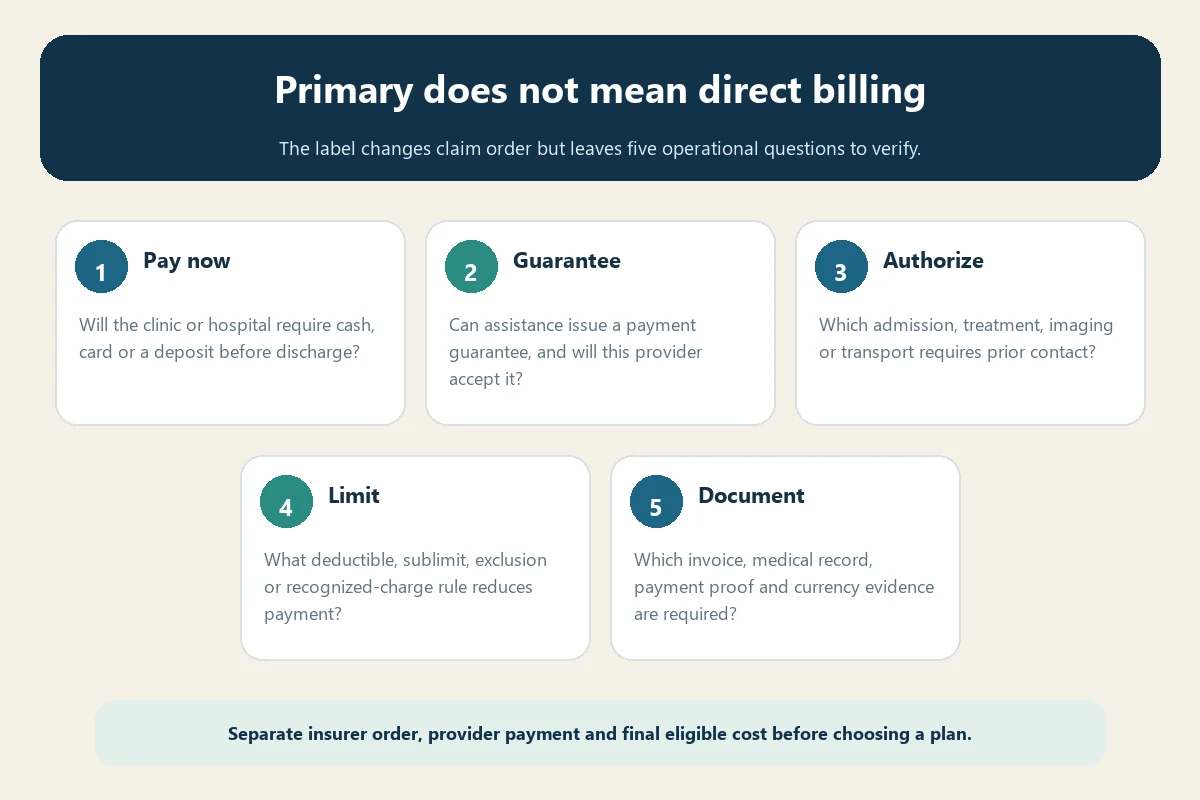
Europe travel insurance with primary medical coverage changes the claim order, but it does not guarantee cashless treatment. The travel insurer can evaluate an eligible bill without first waiting for a US health-plan decision. A European clinic or hospital may still require payment upfront unless the assistance company arranges an accepted guarantee of payment.
Key takeaways
- “Primary” describes coordination between insurers, not the hospital’s billing method.
- Direct billing depends on the provider, assistance network and authorization.
- Outpatient care is more likely to require payment at the point of service.
- Medical limits, deductibles, exclusions and evacuation remain separate decisions.
- A test scenario sent before purchase can expose gaps hidden by the primary label.
Begin with the coordination clause
Primary medical coverage normally means the travel insurer handles the claim under its own policy before requiring another health insurer to pay. Secondary or excess coverage can require the traveler to submit the bill to other valid insurance first.
Our existing guide to primary versus secondary travel medical cover explains that distinction and the other-insurance clause. This page does not repeat that comparison. It focuses on the European care and payment workflow after a primary plan is selected.
Find the coordination-of-benefits or other-insurance provision in the certificate. Marketing labels are useful for filtering, but the issued wording controls. Our guide to reading a travel policy shows how definitions, benefits and exclusions interact.
Primary does not mean cashless
The CDC Yellow Book insurance guidance says travelers should be prepared to pay at the point of service and, in some situations, before care. It also lists a provider’s ability to arrange a hospital guarantee of direct payment as a feature worth checking.
Three separate questions are often collapsed into one:
- Who assesses the claim first? This is the primary-versus-secondary question.
- Who pays the provider now? This is the direct-billing or guarantee question.
- Who ultimately bears the eligible cost? This depends on benefits, limits, deductibles and exclusions.
A primary plan can still reimburse the traveler after payment. A secondary plan’s assistance company might still help arrange care. Do not infer the hospital transaction from the coordination label.
Map the four possible payment paths
Traveler pays and claims reimbursement
The provider takes cash or card, supplies an itemized bill and medical record, and the traveler submits the claim. This can happen under a primary policy. Keep proof that the invoice was paid, not only a balance-due statement.
Assistance issues a guarantee of payment
For eligible inpatient or expensive care, the assistance company may contact the facility and promise payment under agreed conditions. The hospital must accept the arrangement. A guarantee is not automatic approval of every charge, and the traveler may remain responsible for excluded or excess amounts.
Insurer reimburses the provider
Some networks can settle directly with participating providers after documentation and authorization. Ask whether the advertised network is a referral list, a discounted network or an actual direct-settlement arrangement.
Traveler uses domestic insurance first
This is normally the secondary route, but a primary travel insurer can still seek recovery from another payer after it pays. The traveler should disclose other insurance accurately even when no prior submission is required.
Check the US health plan before buying
Ask the domestic insurer whether it covers emergency and non-emergency care in each destination, whether foreign providers are out of network, what authorization is required and how foreign bills are submitted. Get the answer in writing when possible.
Our US health insurance abroad guide explains why an American insurance card may not create direct billing in Europe. Knowing the real domestic coverage also shows whether paying more for a primary travel plan removes a meaningful administrative step.
If the domestic plan has usable overseas coverage, compare its deductible, coinsurance, network and emergency definition with the travel plan. Primary status alone does not tell which plan has the broader eligible services.
Medicare needs its own coverage check
The official Medicare travel coverage page says Medicare generally has limited coverage outside the United States, with specific exceptions. A Medigap or Medicare Advantage arrangement can have different foreign-emergency provisions.
A traveler should verify every plan held rather than writing “Medicare” in one box. If no other valid coverage applies, some secondary policies may respond as primary under their wording. Paying extra for a primary label without reading that clause can buy less additional value than expected.
Test the plan with a European hospital scenario
Before purchase, send the insurer a concrete scenario:
If I am admitted to a hospital in my destination and the facility asks for a deposit, whom do I call, can assistance issue a guarantee of payment, what requires preauthorization, and what must I pay myself?
Then ask follow-up questions:
- Is the response available 24 hours a day?
- Does a physician-backed assistance team participate?
- Must the hospital be in a particular network?
- What if the provider refuses the guarantee?
- Which deposit or credit-card authorization remains the traveler’s responsibility?
- How are language, currency and medical records handled?
Save the response with the certificate. A useful answer describes a process and conditions rather than promising that every European provider accepts direct payment.
Test the published assistance number before departure without opening a false emergency case. Confirm international dialing, language support, relay or accessibility options, and how a companion can be authorized. Save an offline copy of the policy number and call instructions; a dead phone should not break the payment workflow.
Compare limits and deductibles after payment order
A fast primary claim can still leave a large balance if the medical limit is low, the deductible is high or a sublimit applies. Use the Europe coverage-limits guide to separate medical care, evacuation, dental treatment and companion benefits.
Check whether the deductible applies per policy, traveler, incident or claim. The Europe travel insurance deductible guide shows how the same headline limit can produce different out-of-pocket results.
Also record whether provider charges above a recognized or customary amount are eligible, how exchange rates are chosen and whether taxes or administrative fees are included. These details affect reimbursement without changing primary status.
Preauthorization and notification still matter
Primary coverage does not remove assistance conditions. The policy may require notification for admission, surgery, advanced imaging, extended treatment or evacuation. An emergency should receive urgent care first, but the traveler or companion should contact assistance as soon as reasonably possible.
The CDC guidance on illness abroad recommends checking coverage in advance and notes that travel-specific plans vary in medical, evacuation and itinerary benefits. Keep the assistance number available outside the phone and authorize a companion to communicate when the traveler cannot.
Outpatient and inpatient claims behave differently
A clinic, pharmacy or emergency department may expect immediate payment for a smaller bill. An inpatient admission can create enough financial exposure for the facility and assistance company to discuss a guarantee. Neither outcome is certain, and urgency should guide care rather than an insurance label.
At registration, present the policy information and ask for an itemized invoice, diagnosis or treatment summary, proof of payment and the provider’s contact details. Do not surrender original documents if a copy is accepted.
For a serious admission, follow our guide on what to do when hospitalized abroad. It separates treatment, assistance, family communication and financial documentation.
Evacuation is not part of the primary label
Emergency medical evacuation has its own trigger, limit and authorization process. A primary medical benefit can pay eligible local treatment while the evacuation benefit remains excluded, too low or controlled by different wording.
Ask who chooses the receiving facility, whether transport is to the nearest appropriate facility or home, and how a companion is handled. The medical evacuation coverage guide provides a separate worksheet for those decisions.
Build a primary-claim document set
A primary plan can remove the domestic Explanation of Benefits from the first submission, but it does not remove proof requirements. Collect:
- policy number and assistance case number;
- itemized provider invoice;
- medical report and prescriptions;
- proof of payment or deposit;
- authorization and guarantee correspondence;
- refunds or adjustments from the provider;
- currency conversion evidence; and
- the insurer’s completed claim form.
If another insurer later pays, disclose the recovery. The policy may have subrogation or reimbursement rights. Our travel insurance claim guide explains how to preserve deadlines while documents are still arriving.
Primary medical coverage checklist
- Does the certificate state that medical expenses are primary?
- Can the assistance team issue a guarantee of payment in the destination?
- What happens when a provider accepts only traveler payment?
- Which services require notice or preauthorization?
- What medical limit, deductible and sublimits apply?
- How does the plan coordinate with the traveler’s actual US coverage?
- Are evacuation, repatriation and companion costs separate?
- Which records prove treatment, payment and the eligible balance?
The U.S. Department of State’s insurance guidance recommends checking overseas health and evacuation coverage. For a primary plan, add one more step: verify how the assistance company turns coverage into a workable payment process.
General information, not insurance or medical advice. Payment practices, provider relationships and policy terms vary by country, facility and issuer. Seek appropriate care and confirm personal coverage with the responsible insurers.
