

A travel insurance pre existing condition evacuation claim is not decided by the word “waiver” alone. A qualifying waiver may remove the policy’s pre-existing-medical-condition exclusion from an applicable benefit. The evacuation must still be covered, medically necessary, arranged or approved as required, and directed to the destination the contract permits.
This U.S.-focused guide explains the sequence before and during a medical transfer. It is educational, not medical, insurance, or legal advice. In an emergency, obtain appropriate care first. Once the patient is stable enough for coordination, contact the plan’s assistance administrator and follow the issued policy.
Key takeaways
- A pre-existing-condition waiver removes a named exclusion; it does not erase every benefit rule.
- Emergency evacuation usually means medically necessary transportation to an appropriate facility, not an automatic flight home.
- The assistance administrator may have to approve and arrange the transport.
- The attending physician, assistance medical team, receiving facility, and carrier can have separate roles.
- Preserve the waiver proof, clinical record, authorization trail, and every transport invoice.
Reviewed August 16, 2026. Definitions, state forms, waiver conditions, destinations, authorization rules, and benefit limits vary. The issued certificate, schedule, declarations, and endorsements control.
Start with two separate coverage questions
First ask whether the medical event is barred by the pre-existing-condition exclusion. Then ask whether the requested transportation satisfies the emergency evacuation benefit. A waiver can change the first answer without changing the second.
This separation prevents the most expensive misunderstanding: assuming that coverage for an acute flare also gives the traveler the right to choose an air ambulance, destination hospital, or return home. Those decisions often remain subject to medical-necessity and coordination language.
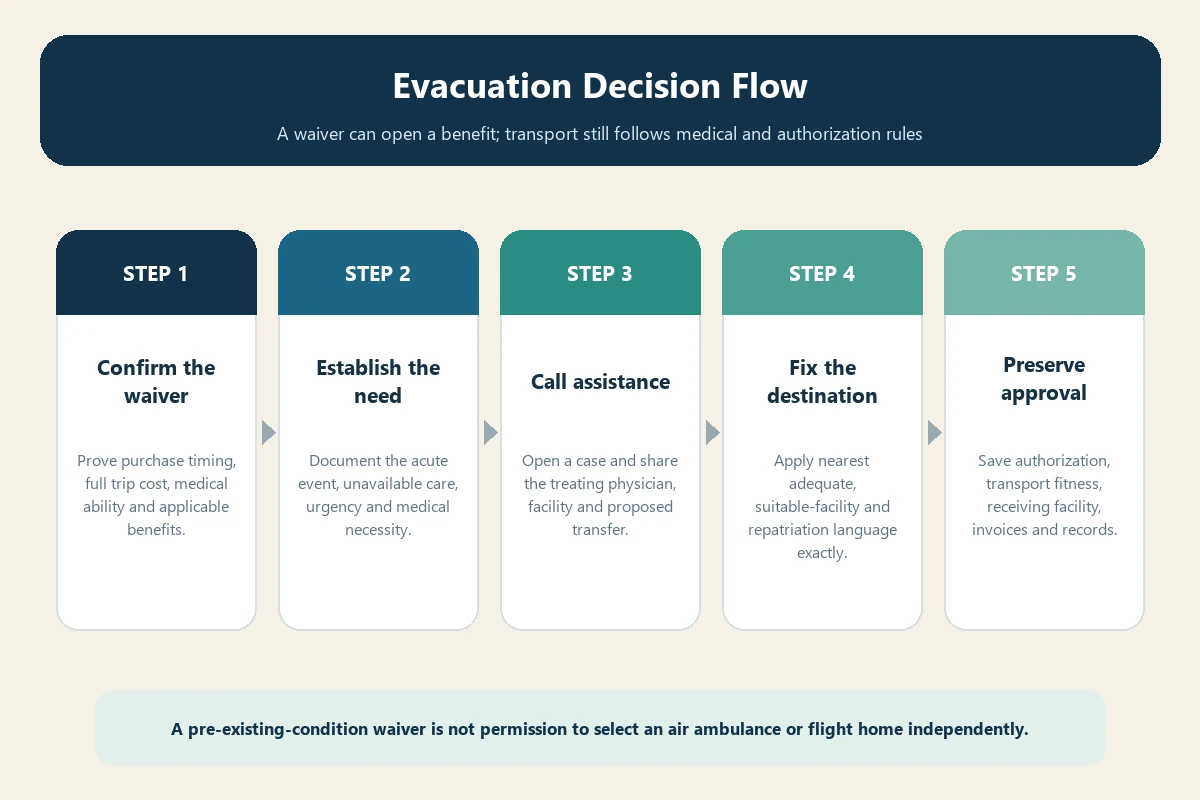
Step one: prove the waiver actually applies
Locate the pre-existing-condition definition, look-back period, exclusion, and waiver endorsement. Confirm the plan was bought inside its time-sensitive period, the traveler was medically able to travel at purchase, and every required prepaid nonrefundable trip cost was insured and updated on time.
The pre-existing-condition waiver checklist turns those requirements into dated evidence. The waiver purchase-deadline guide explains why “soon after booking” is too vague for a claim file.
Read which benefits receive the waiver
Some forms waive the exclusion for multiple coverages; others use narrower language. Find whether emergency medical expense, emergency evacuation, trip interruption, or another benefit is included. Do not infer scope from a sales-page headline.
Travel Guard’s current medical-condition guidance describes a waiver that can remove the exclusion from applicable coverages and lists emergency evacuation assistance among plan features. That is a useful example, not a universal promise. The state-specific contract must answer which benefits the traveler bought.
Step two: identify the immediate medical need
Emergency evacuation generally begins because the patient needs a level of care that is not safely available at the current location. The record should explain symptoms, diagnosis or working diagnosis, treatment already provided, the service that is unavailable, and the urgency of transfer.
A chronic diagnosis alone does not establish a need to move. An acute change may. The chronic-condition emergency test helps separate a sudden flare from routine, scheduled, or elective care.
Medical evacuation is different from ordinary transport
A local ambulance from an accident scene, transportation between hospitals, a medically staffed flight, and a commercial flight home with an escort can fall under different definitions or stages. Ask the administrator which benefit applies to each segment.
Do not bundle all transportation into one number. Keep separate orders and invoices for ground ambulance, air ambulance, escort, oxygen, stretcher, receiving-facility transfer, companion travel, and later return transportation.
Step three: contact the assistance team as soon as practical
After urgent stabilization, call the 24-hour number in the policy. Provide the policy number, patient location, treating facility, physician contact, diagnosis or symptoms, current condition, proposed transfer, and time constraints. Record the case number and the name and role of every person involved.
The U.S. Department of State’s travel insurance guidance says the U.S. government does not pay citizens’ medical costs abroad and recommends checking emergency medical care, medical transportation, current conditions, and a 24-hour help line. Its separate medicine and health guidance warns that many health plans do not pay to bring a traveler back to the United States.
Why prior authorization matters
An evacuation benefit may require the insurer or assistance administrator to authorize and arrange transportation. The administrator may obtain records, consult its medical team, confirm bed availability, select vendors, and negotiate direct payment.
If the traveler books a private aircraft independently, the plan can dispute necessity, destination, method, vendor, or price. If contact was impossible, document the emergency, every attempted call, who made the decision, and why delay was unsafe. Do not assume impossibility automatically cures a missed requirement.
Step four: apply the destination rule
Many evacuation benefits focus on the nearest adequate, appropriate, or suitable medical facility. Those words do not necessarily mean the traveler’s preferred hospital, a specialist near home, or repatriation to the United States.
Travel Guard’s current MedEvac plan description, for example, refers to transportation to the nearest adequate medical facility and then home if warranted. The phrase “if warranted” matters. Another plan may use different language.
Nearest, adequate, and home are three different tests
“Nearest” addresses geography. “Adequate” or “suitable” addresses clinical capability. “Home” addresses repatriation after stabilization or when continued care requires it. A hospital can be farther away yet clinically appropriate, or nearby and unable to provide the required service.
The medical evacuation limits guide explains how destination control, sublimits, and approval interact. Ask the administrator to identify the authorized destination and the contract language supporting it.
Step five: determine whether the patient can be transported
The patient may be too unstable to move immediately or may need a particular aircraft, cabin pressure, medical escort, oxygen supply, stretcher, or receiving specialist. The treating physician provides clinical information; the assistance medical team and transport provider may assess fitness and logistics under the plan.
A recommendation to “go home” is not the same as a formal order describing why transfer is medically necessary and safe. Ask for a clinical note that states the required level of care, urgency, risks of delay, transport restrictions, and the accepting facility when known.
A waiver does not cover planned treatment abroad
Routine monitoring, scheduled dialysis, planned surgery, elective treatment, or travel undertaken to obtain care may remain outside emergency benefits. The exclusion waiver usually does not convert expected care into an unforeseen covered event.
Travel Guard’s pre-existing-condition guidance says routine care, planned treatment, elective procedures, and prescription refills are not covered in its described plans. Travelers who need continuing services should use the continuation-of-treatment guide and confirm arrangements before departure.
Travel against medical advice can create another exclusion
Even when the waiver is satisfied, a form may exclude a trip taken against a physician’s advice or when the traveler was not medically able to travel at purchase. Preserve the pre-trip record and do not ask a clinician to guarantee insurance coverage.
The medically-able-to-travel guide distinguishes the clinician’s medical opinion from the insurer’s contractual decision. A waiver removes one barrier only if its eligibility conditions were met.
Check what the evacuation limit actually includes
A high headline limit may cover authorized transportation but not hospital treatment, companion lodging, a family visit, burial, search and rescue, security evacuation, or a later ticket change. These can be separate benefits with separate triggers and caps.
Read the schedule and definitions together. Ask whether ground legs, medical personnel, equipment, and return of dependent children are inside the evacuation limit or another section. Never treat the maximum as an estimate of what the insurer will approve.
Assistance is not always the payer
An assistance service may locate hospitals, speak with physicians, arrange transport, or help with translation. Those services do not necessarily mean the insurer will pay the related cost. Confirm the insurance benefit, authorization, and payment arrangement separately.
The assistance-line versus claims guide shows why a helpful case coordinator cannot promise the final claim outcome. Ask for written confirmation of what is authorized without demanding a coverage guarantee that the representative cannot provide.
Build one evacuation evidence packet
- Certificate, schedule, declarations, endorsements, and waiver wording.
- Initial trip payment, policy purchase, full trip-cost, and later-cost-update proof.
- Pre-trip medical baseline and evidence of ability to travel.
- Emergency, inpatient, diagnostic, and discharge records.
- Physician transfer order and statement of unavailable care.
- Assistance case log, emails, approvals, denials, and call notes.
- Accepting-facility confirmation and transport medical-clearance documents.
- Itemized vendor invoices, receipts, payment evidence, refunds, and other insurance responses.
The pre-existing-condition claim-document guide organizes the timeline so the waiver facts, acute event, and expense proof are not mixed together.
Questions to ask before relying on the plan
- Does this exact state form include a pre-existing-condition waiver?
- Which benefits receive the waiver?
- What purchase, trip-cost, and medical-ability conditions apply?
- Who must determine medical necessity and authorize transport?
- What facility destination does the evacuation benefit permit?
- When can transport home occur, if at all?
- What happens if prior contact is medically impossible?
- Which records and original invoices must be submitted?
Bottom line
For travel insurance pre existing condition evacuation coverage, use a five-step decision flow: establish the waiver, document the urgent clinical need, involve the assistance team, apply the destination rule, and prove that the chosen transport was medically appropriate and authorized. A waiver can open the door to a benefit, but the evacuation section still decides where, when, how, and how much.