
A travel insurance arbitration documents-only procedure asks the arbitrator to decide the dispute from an organized written record rather than a virtual, telephone, or in-person evidentiary hearing. It can reduce hearing logistics, but it increases the importance of complete exhibits, clear explanations, fair response opportunities, and precise requested findings.
The arbitration agreement, provider rules, administrator notice, preliminary order, and arbitrator’s directions control. This U.S. consumer guide provides general information, not legal advice. Always verify the rules and claim amounts applicable to the filed case.
Confirm whether the documents-only track applies
Under the current AAA Consumer Arbitration Rules, parties may agree in writing to waive virtual, in-person, and telephone evidentiary hearings regardless of claim size, with the agreement confirmed by the answer deadline. When no disclosed claim or counterclaim exceeds $25,000, the documents-submission procedures apply unless a party requests a hearing and the arbitrator decides one is necessary.
Do not calculate eligibility from the claimant’s original demand alone. Review amended claims, counterclaims, requested nonmonetary relief, and any rule addressing the disclosed amount. If applicability is disputed, the current procedure gives that decision to the arbitrator.
Distinguish agreement from rule-based placement
There are two different paths. Parties can agree to a documents-only process. Separately, the governing consumer rule can place a qualifying smaller dispute on that track, subject to a hearing request and arbitrator decision. Record which path applies because it affects deadlines and how a change is requested.
Use the arbitration demand guide to reconcile every requested remedy and the arbitration answer guide to identify counterclaims and defenses.
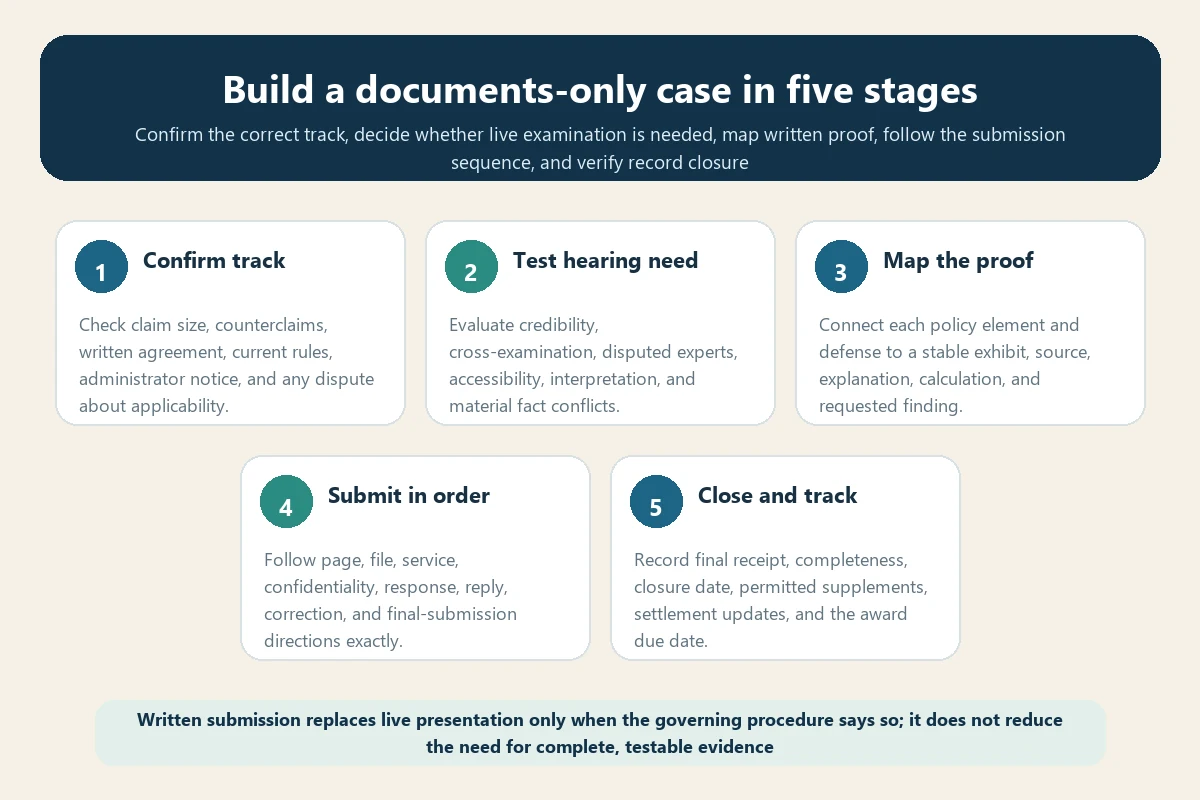
Evaluate whether a live hearing is necessary
A written record can work well when the dispute turns on a policy version, undisputed chronology, documentary payment proof, calculation, or narrow interpretation issue. A hearing may be more important when material credibility, oral conversations, disputed medical or technical opinion, authenticity, translation, accessibility, or cross-examination cannot be handled fairly on paper.
Ask whether the problem can be solved through a declaration, authenticated business record, agreed fact, written question, supplemental explanation, or limited conference. Do not request a hearing merely to repeat documents aloud.
Make a focused hearing request
If a hearing is needed, follow the required channel and deadline. Identify the material issue, witness or expert, disputed fact, reason written submissions are insufficient, proposed format, expected duration, accessibility needs, and narrower alternatives considered.
Do not assume the request itself changes the track. Continue meeting existing written deadlines unless the administrator or arbitrator confirms a change. The arbitration motion practice guide explains permission, briefing, proposed relief, and ruling controls.
Prepare for the preliminary hearing
The current AAA documents-submission procedure includes a preliminary hearing after required fees are received, ordinarily by telephone unless the arbitrator chooses videoconference. Prepare an issue map and proposed schedule rather than treating this as the merits presentation.
Address claim and counterclaim amounts, governing policy, issues, information exchange, written statements, exhibit format, page limits, sequence, response, reply, confidentiality, translations, accessibility, settlement reporting, final submissions, and record closure. The preliminary hearing checklist provides a broader agenda.
Build an issue-to-proof matrix
| Decision element | Written proof | Required explanation |
|---|---|---|
| Policy and insured | Certificate, declarations, issued form | Correct version and effective dates |
| Covered event | Carrier, provider, physician, or authority record | What happened, when, and why |
| Notice and compliance | Portal receipt, email, claim log | Deadline and method satisfied |
| Loss amount | Invoice, receipt, refund record, payment proof | Currency, ownership, nonrefundable amount |
| Defense | Denial letter and cited policy language | Why the defense does or does not apply |
| Requested award | Reconciled calculation | Exact relief and authority |
Each row should lead from a requested finding to stable evidence. If a necessary element has no proof, identify the gap before the submission deadline instead of hiding it in argument.
Freeze the correct policy record
Travel insurance disputes often fail at the policy-version level. Preserve the certificate, declarations, full wording, endorsements, purchase confirmation, applicable state form, and any version metadata. Cite section, page, defined term, and relevant exception.
Do not rely on a current marketing page or a generic sample when the issued contract differs. Explain any inconsistency and request clarification through the authorized process.
Create stable written exhibits
Use searchable PDFs, fixed page labels, complete attachments, descriptive filenames, readable scans, original-language records, and accurate translations. Preserve native files and metadata separately when authenticity may matter.
The document exchange checklist helps control production history, while the exhibit list guide separates exchange, identification, offer, and admission.
Use written witness statements carefully
A declaration or statement should identify the witness, personal knowledge, role, dates, facts, referenced exhibits, signature, and any required oath or affirmation. Separate observed facts from assumptions, policy argument, medical opinion, and technical opinion.
Confirm whether written testimony is permitted and whether the other party may submit questions or request examination. Do not have a witness adopt a lawyer’s or claim preparer’s conclusions without a truthful factual basis.
Explain evidence instead of uploading a document dump
The arbitrator should not have to guess why a receipt, medical note, weather report, or email matters. For every cited item, state the fact it supports, the page, the policy element, and any limitation. Remove duplicates unless different copies prove transmission, receipt, metadata, or another material point.
AAA’s answers to common arbitration questions describe a “desk” arbitration for cases under $25,000 and emphasize submission of relevant information. The current governing case rules—not a summary page—should control any conflict.
Organize the principal written submission
A practical structure is:
- Relief requested and amount.
- Short undisputed background.
- Governing policy provisions.
- Issue-by-issue requested findings.
- Evidence citations for every material fact.
- Response to the strongest defense.
- Reconciled damages or benefit calculation.
- Conclusion stating the exact award requested.
Stay within page, font, file, and attachment rules. A concise submission with precise citations is more usable than a long chronology that never connects facts to policy elements.
Reconcile the claimed amount line by line
Create a table for traveler, loss date, vendor, currency, original charge, refund, credit, third-party recovery, claimed balance, policy limit, deductible, and exhibit page. Explain exchange-rate source and date if relevant.
Remove refundable, refunded, duplicated, unsupported, or excluded amounts. If interest, fees, costs, or another remedy is requested, identify the agreement, rule, or applicable authority and show the calculation separately.
Answer the opposing submission fairly
Follow the ordered sequence. Identify each disputed fact, policy reading, exhibit, and calculation. State what is agreed, what is not, and why. Do not respond with a new claim or surprise theory after the authorized scope has closed.
Use the evidence objections guide for relevance, duplication, privilege, completeness, source, translation, privacy, and late-material concerns. Request a practical cure when possible.
Submit a reply only when allowed
A reply should answer new matters in the response, not repair proof that should have appeared in the opening submission. Confirm permission, deadline, pages, exhibits, and whether the other party may answer new material.
If a correction is necessary, identify the exact mistake, corrected text or exhibit, reason, effect, and service. Do not silently replace a previously submitted file.
Protect privacy, privilege, and security
Redact full payment numbers, passport identifiers, unrelated medical details, minors’ data, authentication secrets, and third-party information when permitted and not material. Keep an unredacted source securely if the arbitrator later requires review.
Use the arbitration confidentiality guide to distinguish confidentiality, privilege, privacy, and cybersecurity. Follow the actual portal or transfer instructions rather than emailing sensitive attachments informally.
Verify filing and service
Before the deadline, confirm the authorized destination, recipients, time zone, file limits, naming convention, upload completion, page counts, readable content, and proof of service. Save receipts and a local manifest of exactly what was sent.
Do not assume a portal draft, progress bar, or email outbox proves receipt. If a technical failure occurs, notify the administrator promptly through an available channel and preserve screenshots, timestamps, error messages, and files.
Understand record closure
Under current AAA D-3, the arbitrator establishes the final written-submission date and declares the hearing closed when satisfied that the record is complete, no later than seven calendar days after receiving final written submissions. Record the actual closure notice rather than estimating it from your upload.
After closure, do not submit a new receipt, argument, correction, or message to the arbitrator unless authorized. If a material update arises, request instructions and give every party notice as required.
Track the documents-only award period
The current procedure calls for an award within 14 calendar days after the hearing is closed, subject to other award provisions. This differs from the ordinary live-hearing period. The arbitration award guide explains receipt, interpretation, correction, payment, confidentiality, and next-step controls.
The AAA’s 2024–2025 rule-update summary confirms that the proposed increase in the consumer documents-only threshold was not adopted. Verify current rules again if the case begins later.
Avoid common documents-only mistakes
- Using the original demand amount without checking counterclaims or amendments.
- Assuming documents-only treatment means there is no preliminary hearing.
- Missing the deadline for a necessary hearing request.
- Uploading records without mapping them to policy elements.
- Using the wrong policy version or incomplete attachments.
- Submitting written testimony without confirming the procedure.
- Introducing a new claim or exhibit in an unauthorized reply.
- Sending private information without secure controls.
- Assuming upload completion equals record closure.
- Sending new material after closure without permission.
Final documents-only checklist
- Confirm eligibility, claim amounts, rule edition, and administrator notice.
- Decide promptly whether live examination is materially necessary.
- Prepare for the preliminary hearing and obtain a written schedule.
- Map every policy element, defense, and remedy to written proof.
- Freeze the issued policy and stable exhibit versions.
- Follow pages, files, sequence, service, and privacy directions.
- Reconcile the requested award line by line.
- Answer opposition precisely and reply only when authorized.
- Verify final receipt and preserve the submission manifest.
- Record closure and calculate the award period from the confirmed date.
A strong documents-only case is not simply shorter than a hearing. It is a complete, navigable decision record: the correct policy, testable evidence, fair responses, exact calculations, controlled submissions, and clear requested findings delivered in the ordered sequence.
