

A travel insurance chronic condition emergency can be both urgent and contractually complex. The word “emergency” does not automatically override a pre-existing-condition exclusion, while a chronic diagnosis does not automatically make every later event excluded. Coverage depends on waiver status, the sudden event, the benefit, medical necessity, other exclusions, and proof.
This U.S.-focused guide provides a five-gate framework for reviewing a claim after immediate medical needs are addressed. It is not medical, insurance, or legal advice. In an emergency, seek appropriate care first and follow local emergency instructions.
Key takeaways
- Urgency and insurance coverage are different questions.
- Apply the plan’s pre-existing definition and waiver before assuming a result.
- Separate a sudden flare from routine, scheduled, or elective care.
- Check the specific benefit and any assistance-company authorization rule.
- Preserve clinical, transport, communication, and financial records in real time.
Reviewed August 16, 2026. Chronic-condition, emergency, medical-necessity, and evacuation terms vary by state and plan. The issued certificate, schedule, declarations, and endorsements control.
Use five gates instead of one label
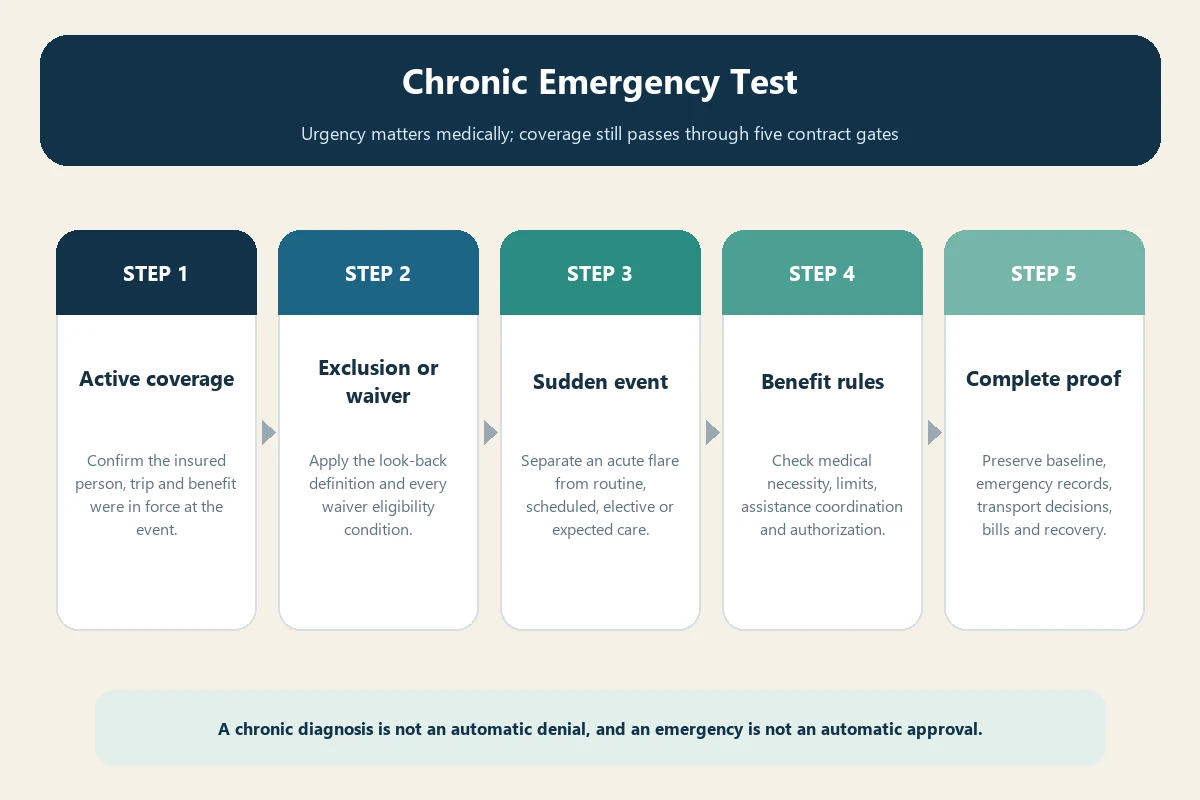
Gate one asks whether the policy and relevant benefit were in force. Gate two applies the pre-existing-condition exclusion and any waiver. Gate three asks what happened and whether it was sudden or expected. Gate four tests the specific benefit, limits, medical necessity, and authorization. Gate five proves the event and the net expense.
The framework prevents two common errors: “chronic means never covered” and “emergency means always covered.” Neither statement can replace the contract.
Gate one: confirm the policy and benefit dates
Verify the insured traveler, trip dates, destination, policy purchase, effective dates, and termination events. Trip cancellation can begin before departure while emergency medical coverage may begin later. A loss outside the benefit period does not move inside merely because treatment continues.
Save the declarations and itinerary. If travel dates changed, confirm that the insurer updated them. A valid policy number alone does not show that every benefit was active at the moment of the event.
Gate two: apply the pre-existing-condition definition
Find the look-back period and the exact triggers: symptoms, examination, diagnosis, care, treatment, recommended care, or medication changes. A chronic diagnosis may fall within the definition, but the analysis should follow the words in the form and the dated medical record.
The look-back period examples show how to map events without making a coverage promise. Do not assume a stable diagnosis disappears from the definition or that every old diagnosis automatically triggers it.
Then test the waiver conditions
If the plan includes a pre-existing-condition exclusion waiver, confirm timely purchase, medical ability to travel, required insured trip cost, later updates, maximums, and any other conditions. The waiver may remove the exclusion only from specified coverages; it does not rewrite the entire policy.
Use the waiver eligibility checklist and save proof for every row. A brochure that advertises coverage is not proof that a particular traveler qualified.
Gate three: separate a sudden flare from planned care
A sudden asthma attack, unexpected diabetic crisis, acute cardiac symptom, or abrupt blood-pressure complication may require emergency assessment. But the insurer will still examine whether the event fits covered sickness or injury terms and whether an exclusion applies.
Travel Guard’s current medical-condition page says a chronic condition that suddenly flares may be covered when waiver requirements are satisfied. The same summary says routine or scheduled care, prescription refills, planned treatment, and elective procedures are not covered. This illustrates the boundary; it does not decide another plan’s claim.
Routine management is not transformed by location
A regular checkup, monitoring appointment, planned infusion, expected dialysis, scheduled physical therapy, or routine refill does not become an unforeseen emergency merely because it occurs abroad. If the trip was taken to obtain treatment, a separate exclusion may also apply.
The continuation-of-treatment guide explains why ongoing care needs a different coverage strategy. Travelers who require planned services should confirm them before departure rather than rely on emergency benefits.
A medication shortage can involve several causes
Running out of a routine prescription is different from an unexpected adverse reaction or an acute condition that requires a new drug. Lost medication, trip delay, a prescribing restriction, and a medical emergency may fall under different benefits or none.
Carry an adequate legal supply, prescription information, and clinician contact details. The prescription medication guide separates replacement logistics from covered treatment.
A controlled condition can still worsen
“Controlled” describes a point in time, not immunity from future events. Preserve routine notes and medication history that show the baseline, then document the abrupt change. The clinical record should explain onset, symptoms, examination, tests, treatment, and outcome.
The controlled-condition guide explains how stability evidence and waiver rules interact. Avoid claiming that a normal checkup guarantees coverage for every later flare.
Gate four: identify the exact benefit
Emergency medical expense may pay eligible treatment costs. Trip interruption may address unused trip arrangements and additional return transportation. Emergency evacuation may arrange transport to an appropriate facility. These benefits have different triggers, limits, exclusions, and proof.
A hospitalization can involve more than one benefit, but expenses should not be duplicated. Build separate lines for clinical care, local ambulance, lodging, unused trip components, change fees, and evacuation.
Medical necessity is a contract standard
A treating clinician’s decision is important, but the policy may define medically necessary care and allow the administrator to review whether services, level of care, or duration meet that definition. Keep examination notes and orders that explain why the care could not safely wait.
Do not choose a more expensive provider or transport solely because the policy has a high limit. In an emergency, obtain care; once stable, coordinate further services with the assistance team when possible.
Emergency evacuation usually requires coordination
Evacuation coverage is not normally a self-selected flight home. The administrator may determine that transport is necessary and choose an appropriate receiving facility and method. Unapproved arrangements can create a dispute unless the policy recognizes circumstances in which prior contact was impossible.
The medical evacuation limits guide explains authorization, destination control, and sublimits. Save every case number, call, email, physician recommendation, and transport order.
Trip interruption requires more than hospital admission
Read the covered reasons and physician-certification requirements. The form may require a medically imposed restriction that prevents continuing the trip. A traveler who chooses to return home for comfort may have a different claim from one whose physician orders no further travel.
Ask the treating clinician to state the restriction and date, not to promise reimbursement. Preserve the original itinerary, unused bookings, new transportation, and supplier refunds.
Contact the assistance line as soon as practical
After urgent care is underway, notify the insurer or assistance administrator. Provide policy number, location, facility, diagnosis or symptoms, treating contact, and immediate needs. Ask whether direct billing, preauthorization, translation, monitoring, or transfer coordination is available.
The U.S. Department of State’s current travel insurance guidance says the U.S. government does not pay citizens’ medical costs abroad and recommends checking emergency medical care and medical transportation. It also advises finding out whether the insurer has a 24-hour help line.
Gate five: preserve the emergency record
Keep the emergency-room record, admission and discharge summaries, physician notes, test results, prescriptions, itemized bills, receipts, payment proof, and incident report if an injury occurred. Record when symptoms began and who called for help.
Travel Guard’s current claim document page lists treatment, ER, admission and discharge records, bills, invoices, receipts, statements, and injury reports for medical expense or evacuation claims. The travel insurance claim guide adds the policy, payment, refund, and submission evidence.
Show the baseline and the acute change
For a chronic condition, the most useful clinical file often has two parts: records showing the pre-trip baseline and records documenting the acute event. A claims reviewer can then see what was routine, what changed, and when.
Do not ask a clinician to erase the chronic diagnosis. Accurate baseline records can support the timeline just as much as the emergency record.
Other exclusions still apply after a waiver
A waiver may remove the pre-existing-condition exclusion from applicable benefits, but exclusions for intoxication, elective treatment, travel against physician advice, illegal activity, high-risk activities, or other events may remain. Benefit limits, deductibles, and coordination with primary health insurance can also affect payment.
The travel medical exclusions guide treats these as separate layers. Do not stop reading once the waiver appears satisfied.
A new condition after purchase follows a different path
If symptoms and treatment truly begin after the relevant look-back and purchase events, the condition may be analyzed as new rather than pre-existing. It still must fit a covered sickness or injury and satisfy the benefit’s other terms.
Travel Guard’s current summary distinguishes a brand-new condition after purchase from a pre-existing one. Preserve the first symptom, first contact, and first treatment dates so the record—not memory—supports that distinction.
What to do during an event
- Seek appropriate emergency care and follow local medical instructions.
- Notify the assistance administrator as soon as practical and record the case number.
- Ask before arranging nonurgent transfer, evacuation, or early return.
- Collect clinical records and itemized financial proof before leaving the facility.
- Reconcile refunds, primary insurance, and remaining expenses before filing.
If communication was impossible during the emergency, document why, when contact became possible, and what actions were medically necessary in the meantime.
Bottom line
A travel insurance chronic condition emergency should be tested through five gates: active coverage, exclusion or waiver, the sudden event, the specific benefit and authorization rules, and complete proof. Treat the medical emergency first. Then build an accurate timeline that separates chronic baseline, acute change, planned care, transport decisions, and net cost.
