
Travel insurance policy reformation arbitration disputes arise when someone argues that an issued policy, certificate, endorsement, or arbitration term does not express the agreement the parties actually made. The requested remedy is correction of the writing, not simply a favorable interpretation.
This U.S. consumer guide explains how to audit the alleged prior agreement, mistake, drafting history, evidence, third-party rights, arbitration formation, and defenses. It is not legal advice.
Start with the exact instrument
Identify the document someone wants changed: application, quote, binder, policy, certificate, schedule, endorsement, renewal, amendment, settlement, or arbitration agreement. Preserve every version and delivery record.
State the existing words and the proposed replacement words side by side. Avoid vague requests to “fix coverage.”
Distinguish reformation from interpretation
Interpretation asks what the existing policy language means. Reformation asks an authorized decision-maker to change the written instrument so it reflects a proven prior agreement.
Ambiguity may support interpretation without establishing the mistake and prior shared intent required for equitable reformation.
Distinguish reformation from rescission
Rescission seeks to unwind or avoid a contract. Reformation seeks to preserve the agreement while correcting its written expression. The remedies have different elements and consequences.
The policy rescission arbitration guide provides a separate application, materiality, underwriting, notice, premium-return, and severability analysis.
Identify the alleged prior agreement
Reformation ordinarily requires more than proof that the issued terms are undesirable. Identify what the parties allegedly agreed before or when the instrument was executed.
Preserve offers, applications, quotes, plan comparisons, negotiations, emails, recordings lawfully available, producer instructions, approvals, invoices, rates, and confirmations.
Map every contracting party
List the purchaser, each insured traveler, issuing insurer, producer, platform, administrator, assistance company, and any group policyholder. Record legal names and roles.
A travel advisor’s intention, claimant’s expectation, or administrator’s later explanation may not establish the insurer’s prior agreement without authority and evidence.
Determine governing law
Review choice-of-law clauses, residence, policy situs, place of contracting, forum rules, and state insurance law. Reformation elements, burdens, limitations periods, prejudice rules, and protected third-party interests vary.
Use current controlling authority from the applicable jurisdiction, not a general summary from another state.
Learn the mutual-mistake pattern
In an official Eleventh Circuit insurance reformation decision, the court described Florida’s rule that equity may reform a writing when mutual mistake causes it not to express the parties’ true agreement. The decision also noted a strong presumption that the written contract is accurate and a high evidentiary burden.
The case is an evidence model, not a national formula. Verify the governing state’s exact requirements.
Separate mutual from unilateral mistake
A mutual mistake generally concerns both parties sharing the same mistaken written expression of their agreement. A unilateral mistake concerns one party and may require additional facts, such as knowledge, inequitable conduct, or fraud by the other party.
State which theory is asserted and map every element separately.
Do not confuse later regret with earlier mistake
Reformation focuses on intent when the instrument was executed. A party’s later wish for higher limits, different coverage, a narrower exclusion, or a better forum is not proof of the original agreement.
Compare contemporaneous records with statements made only after the loss or dispute.
Audit scrivener’s errors
Record misspelled names, transposed dates, omitted digits, wrong plan codes, duplicated text, missing pages, inconsistent schedules, and references to nonexistent endorsements. Preserve source templates and metadata where lawfully available.
A visible clerical error may help identify a mistake, but the replacement term still requires reliable proof.
Investigate missing endorsements
Determine whether an endorsement was quoted, approved, filed, issued, attached, delivered, billed, and referenced in the declarations. Compare the insurer’s policy-management record with the customer’s package.
If the endorsement changes arbitration, exclusions, limits, or covered persons, analyze notice and formation separately.
Reconstruct online purchase evidence
Preserve screen captures, field values, plan selection, state selection, dates, traveler names, trip cost, linked documents, checkbox text, timestamps, confirmation, and delivered PDFs.
The clickwrap agreement guide helps audit online notice and assent without assuming a backend record proves what appeared onscreen.
Compare quote, binder, and issued policy
Create a field-by-field table for insurer, insureds, plan, premium, dates, destination, trip cost, limits, deductibles, optional upgrades, waivers, arbitration, and endorsements.
Identify when each difference arose and whether anyone accepted, rejected, corrected, or relied on it.
Audit renewal history
For annual travel plans or recurring arrangements, preserve each renewal, declarations page, endorsement set, notice of change, premium, and effective date. Do not assume the original policy controls every later term.
An official 2024 Eleventh Circuit insurance decision illustrates that reformation focuses on the instrument in force and the shared misconception at execution, even when the policy is a renewal.
Trace producer and agent communications
Preserve requests, recommendations, applications, authority agreements, appointments, follow-up questions, corrections, delivery records, and statements about coverage. Identify who represented whom under governing law.
Use the arbitration agency guide to separate actual authority, apparent authority, manifestations, and reliance.
Test proof of shared intent
Look for matching contemporaneous evidence from both sides: the same requested term, accepted quote, underwriting approval, premium calculation, endorsement instruction, binder, or confirmation.
One party’s uncommunicated intention ordinarily does not prove a shared bargain.
Evaluate the evidentiary burden
Some jurisdictions require clear and convincing, clear and decisive, or similarly strong evidence for reformation. Record the controlling formulation and how each exhibit supports it.
Do not count documents; assess whether they prove the same prior agreement and the writing’s failure to express it.
Preserve contrary evidence
Include rejected quotes, plan comparisons, disclaimers, superseding confirmations, correct premium calculations, explicit exclusions, delivery acknowledgments, complaints, and later inconsistent statements.
A professional analysis addresses evidence that the issued writing accurately reflected the deal.
Check integration and merger clauses
Read clauses stating that the policy and attached documents constitute the entire contract or that changes require an authorized endorsement. Determine their effect under governing law.
Such clauses may matter but do not automatically eliminate an equitable reformation claim in every jurisdiction.
Analyze course of performance cautiously
Record premium collection, claim handling, assistance, prior payments, renewals, corrections, and how both parties applied the disputed term before litigation.
Later conduct can support or contradict intent, but it should not replace proof of the agreement at execution.
Protect third-party rights
Identify beneficiaries, additional insureds, assignees, providers, lienholders, group members, successors, and others who acquired rights or relied on the written policy.
Some reformation rules protect good-faith third parties. Analyze prejudice and notice before proposing retroactive text.
Apply the Federal Arbitration Act carefully
Section 2 of the Federal Arbitration Act generally enforces written arbitration provisions involving commerce on ordinary contract footing. It does not supply a federal policy-reformation test.
State contract and insurance law ordinarily governs the equitable remedy, while federal arbitration doctrine may affect the decision-maker.
Prove arbitration formation first
In Granite Rock Co. v. International Brotherhood of Teamsters, the U.S. Supreme Court emphasized that courts must be satisfied that the parties formed the arbitration agreement before ordering arbitration.
If reformation would add, remove, or alter an arbitration clause, identify what arbitration agreement was actually formed before deciding its scope.
Separate policy reformation from clause reformation
A request to correct an insured name or benefit limit may leave the arbitration text untouched. A request to add a missing arbitration endorsement directly targets forum consent.
State exactly which words would change and why the asserted evidence proves those words.
Use severability correctly
Arbitration separability treats the arbitration provision distinctly for certain validity challenges. Contractual severability addresses whether invalid language can be removed while preserving the remainder. Reformation is a different remedy.
The arbitration severability guide helps target the plan, clause, delegation term, and remedy separately.
Address delegation separately
If a party says an arbitrator must decide reformation, identify the exact delegation language and incorporated rules. Determine whether the dispute concerns formation of the arbitration agreement, validity, scope, or the policy merits.
The arbitrability guide provides a decision-maker map.
Define the requested remedy operationally
Draft the proposed corrected language, effective date, affected claims, premium adjustment, refunds, limits, endorsements, notices, and third-party consequences. Explain what remains unchanged.
A remedy should express the proven prior bargain, not create a new post-loss contract.
Build a reformation evidence matrix
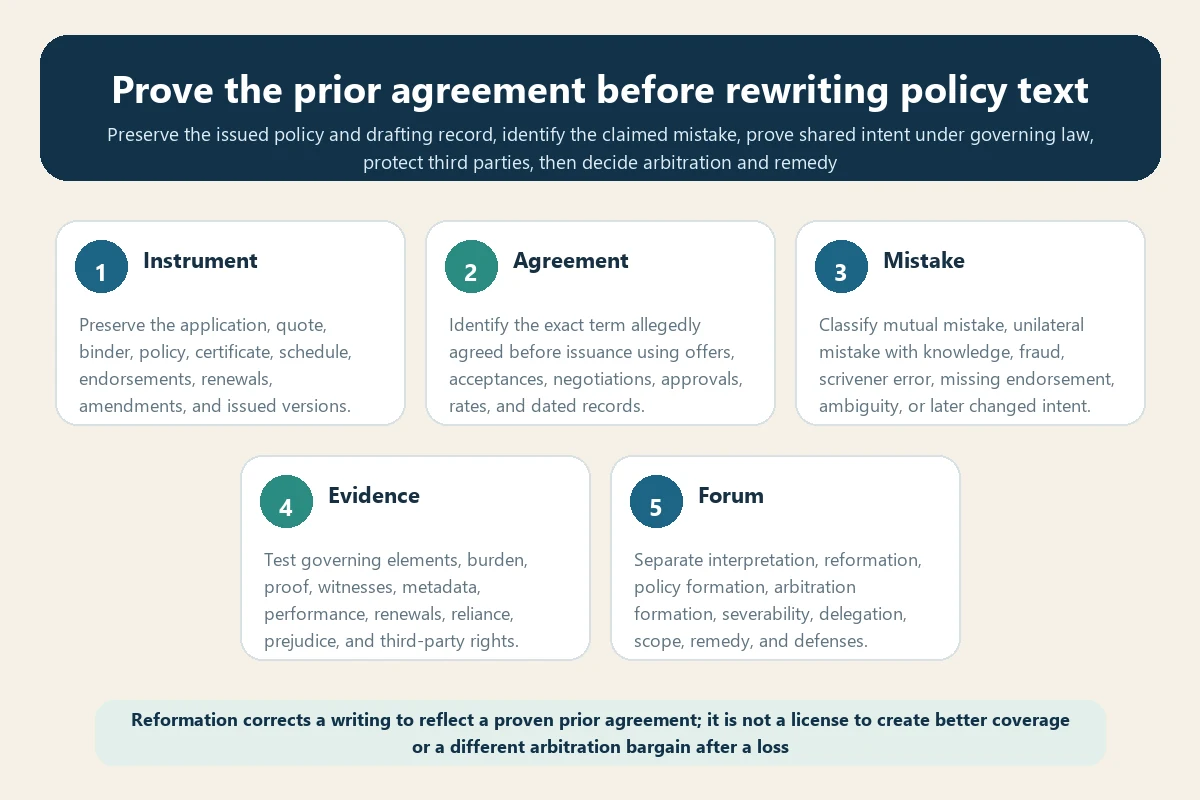
Create rows for instrument, existing text, proposed text, prior agreement, each party’s intent, alleged mistake, drafting source, burden, contemporaneous evidence, renewals, performance, reliance, third parties, arbitration formation, delegation, scope, and defenses.
For every row, cite supporting and contrary evidence, date, source, custodian, and authenticity.
Preserve reasonable defenses
Potential defenses include no prior agreement, no mutual mistake, unilateral uncommunicated intent, later regret, ambiguity instead of mistake, correct issued text, insufficient burden, integration language, untimeliness, waiver, laches, prejudice, protected third-party rights, no clause formation, invalid delegation, or claim outside scope.
A party seeking reformation should address conflicting quotes, premium evidence, delivery records, renewals, and post-loss changes in position.
Use a disciplined decision sequence
- Identify the exact instrument and proposed corrected words.
- Determine governing contract, equity, and insurance law.
- Prove the prior agreement with contemporaneous evidence.
- Classify mutual mistake, unilateral mistake, fraud, or clerical error.
- Test the required burden, timing, prejudice, and third-party rights.
- Separate interpretation, rescission, and reformation remedies.
- Analyze arbitration formation, severability, delegation, and scope.
Bottom line
Travel insurance policy reformation arbitration is not a general request for fairer coverage or a better forum. The party seeking correction must identify a proven prior agreement and show why the issued writing failed to express it under the governing jurisdiction’s demanding standard.
Only after that evidence audit should anyone decide whether the dispute belongs in court or arbitration and what policy language, if any, may be corrected.
Contra proferentem is usually a later interpretive rule, not a shortcut whenever a traveler and insurer disagree. Use this travel insurance contra proferentem arbitration guide to test genuine ambiguity, identify the drafter and governing law, and separate coverage construction from arbitration consent and procedure.
