

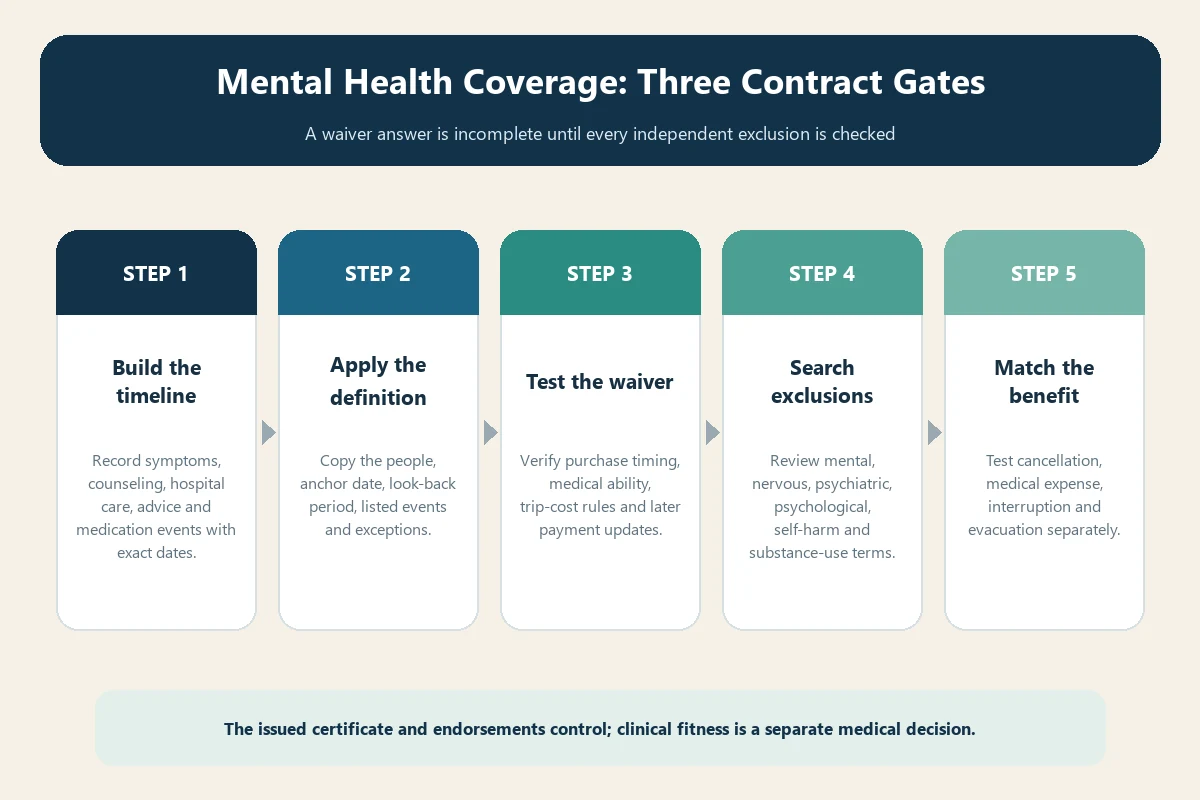
Travel insurance mental health pre existing condition questions require three separate contract tests. A prior diagnosis or treatment may enter a look-back definition, a waiver may remove that exclusion, and another mental-health exclusion may still apply. A yes-or-no answer that skips any gate is incomplete.
This U.S.-focused guide turns mental-health history into a dated certificate review. It is insurance education, not medical, legal, crisis, or coverage advice. Never stop treatment, change medication, or delay care to influence an insurance result. In an urgent situation, seek appropriate local emergency help.
Key takeaways
- Separate the pre-existing definition, waiver, mental-health exclusions, and covered benefit.
- Record symptoms, counseling, hospitalization, medical advice, and medication events by date.
- Do not assume a waiver overrides psychiatric, self-harm, or substance-use exclusions.
- Check cancellation, emergency medical expense, and evacuation as different benefits.
- Use a clinician for fitness and care decisions; use the certificate for coverage analysis.
Reviewed August 16, 2026. Mental-health provisions differ by insurer, product, state, and benefit. The issued certificate, schedule, and endorsements control.
Start with three gates, not a diagnosis label
Gate one asks whether facts inside the policy’s look-back period meet its definition of a pre-existing medical condition. Gate two asks whether every condition for a pre-existing-condition exclusion waiver was satisfied. Gate three searches for exclusions or limits that operate independently of the pre-existing exclusion.
Only after those gates should the reader test a particular loss. Trip cancellation before departure, emergency treatment during travel, trip interruption, and medical evacuation can use different triggers and exclusions. The site’s mental-health coverage guide compares services and settings; this article concentrates on prior medical facts and their contract treatment.
Gate one: build a neutral medical timeline
List facts without deciding coverage. Include the dates of symptoms, counseling or therapy, primary-care visits, psychiatric evaluations, urgent care, inpatient treatment, diagnoses, tests, treatment recommendations, work or travel restrictions, and prescription changes. Add the initial trip payment, policy purchase, coverage effective date, and departure.
Use records rather than memory when possible. A billing statement may show only a service date, while a clinical note can establish why the visit occurred and what was advised. Do not rewrite a clinician’s description into insurance terminology. The purpose is to compare authentic facts with the words in the certificate.
The look-back period guide explains how to identify the anchor date and count backward. The look-back does not always begin at departure, and the number of days is not universal.
A formal diagnosis is not the only possible fact
Some certificates use treatment or medical advice. Others also mention symptoms, manifestation, worsening, or a medication change. Under those forms, the absence of a formal diagnosis does not by itself finish the analysis. Equally, a minor feeling does not automatically become a pre-existing condition. The event must match the issued definition.
A current Travel Guard Vermont sample policy illustrates one wording pattern. Its definition looks to medical advice or treatment recommended or received during its stated 180-day period. Allianz’s current existing-condition explanation illustrates another plan pattern by referring to illness or injury that exhibited symptoms or was treated during a stated period. These are examples, not the reader’s contract.
Medication history needs its own line
Record starts, stops, dose changes, switches, substitutions, early refills, and unchanged refills. A medication event can be relevant under one definition and irrelevant under another. A change may also be administrative rather than clinical, so preserve the prescriber’s record and pharmacy information.
Do not alter treatment to create a longer stable period. The medication-change classifier separates clinical dose changes, substitutions, routine refills, and documentation. It is a record-organizing tool, not a coverage promise.
Gate two: test every waiver requirement
A pre-existing-condition exclusion waiver can matter when the timeline fits the definition. Requirements may include buying during a time-sensitive period, being medically able to travel on the purchase date, insuring required trip costs, and updating coverage after later payments. Missing one condition can change the result.
Use the waiver eligibility checklist to attach evidence to each requirement. Keep the initial deposit receipt, policy confirmation, declarations, later trip-payment notices, and any written plan response. Early purchase alone is not proof that the waiver applies.
A waiver removes only the exclusion identified by the form and only where the policy says it applies. It does not create a covered cancellation reason, make routine treatment an emergency, or raise a benefit maximum.
Gate three: search for independent exclusions
Search the entire certificate for mental, nervous, psychiatric, psychological, behavioral, emotional, counseling, psychotherapy, substance use, intoxication, self-inflicted injury, suicide, and attempted suicide. Review general exclusions, benefit-specific exclusions, definitions, limitations, and endorsements.
The five-layer exclusions guide helps prevent a summary page from standing in for the contract. A pre-existing waiver does not necessarily remove a separately written mental-health exclusion. Ask the insurer in writing how the exact form treats the scenario, but retain the certificate as the controlling document.
Separate cancellation from medical expense
For trip cancellation, identify a listed covered reason and every condition attached to it. Some forms require a sickness to produce physician-imposed travel restrictions; other wording can differ. The file also needs nonrefundable loss, supplier refunds or credits, and timely cancellation.
For emergency medical expense, identify the eligible service, covered sickness definition, deductible, limit, provider requirements, authorization rules, and exclusions. A cancellation benefit does not prove that outpatient therapy or psychiatric hospitalization is an eligible medical expense. Likewise, an eligible emergency service does not automatically create a cancellation reason.
The travel medical benefits guide separates treatment, evacuation, dental, and assistance features. Apply one benefit at a time.
Outpatient, inpatient, and crisis care can differ
A policy may treat an emergency-department evaluation, inpatient admission, outpatient counseling, telehealth, residential treatment, and routine medication management differently. Record the clinical setting, provider credentials, admission status, dates, diagnosis, medical necessity, and authorization.
Do not assume that assistance-center referrals are insured expenses. Assistance can locate care while reimbursement still depends on the certificate. Ask whether observation status counts as inpatient care, whether outpatient crisis evaluation is eligible, and whether continuing treatment is excluded as routine or planned care.
Psychiatric evacuation is a separate question
Psychiatric transport may require a clinical escort, a receiving facility, carrier approval, and coordination by the assistance center. The benefit may exclude mental or nervous disorders, psychiatric emergencies, or pre-existing conditions. A high displayed evacuation limit does not answer those eligibility questions.
The CDC Yellow Book’s mental health in travelers chapter advises readers to check whether international health and evacuation policies cover psychiatric emergencies and cautions that many policies exclude them or exclude pre-existing conditions. The evacuation limits guide explains destination control, authorization, and transport evidence.
Medical fitness and insurance coverage are different decisions
A clinician evaluates whether the itinerary is medically appropriate and how treatment should continue. An insurer applies contract language to a loss. A fitness letter can document health facts and advice, but it does not amend the certificate or guarantee a claim.
CDC guidance recommends discussing mental-health history, current treatment, medications, destination access, and prior serious episodes during pre-travel planning. Follow individualized professional advice. Do not rely on an insurance article to decide whether to travel.
Use a dated worksheet before purchase
Create columns for event date, person, symptom or service, provider, recommendation, medication action, source record, and possible certificate term. Add separate rows for the first trip payment, plan purchase, later nonrefundable costs, coverage effective date, and departure.
Then copy the definition beside the worksheet. Mark a possible match without declaring the outcome. Attach the waiver requirements and a list of independent exclusions. This record allows an insurer or licensed professional to answer a precise question rather than a vague one.
Work through four limited scenarios
Longstanding diagnosis with unchanged treatment
The traveler has a historical diagnosis and no recent visits or medication changes. That may matter, but the result depends on what events the definition lists, the look-back dates, any separate exclusion, and the benefit involved. History alone does not produce a universal answer.
Counseling visit before purchase
A recent session falls inside the look-back period. Record its purpose and any treatment or advice. Do not assume every counseling appointment is treated identically. Apply the form’s language and then test the waiver.
Medication adjusted after purchase
The plan was bought while the traveler was medically able to travel, then a clinician changed a prescription. Preserve the reason, date, and advice about travel. Review effective dates, known-loss provisions, waiver conditions, and any independent exclusion.
Unexpected crisis during the trip
Seek appropriate care first. For the claim, test the emergency medical benefit, pre-existing definition, waiver, mental-health exclusions, authorization, and eligible expenses. Contact the assistance center as soon as reasonably possible and keep the reference number.
Build a defensible claim file
Keep clinical notes, diagnosis and onset dates, medical-necessity statements, itemized bills, payment proof, medication records, discharge summaries, assistance-center communications, and plan documents. Submit sensitive records only through secure claim channels.
The claim documentation guide provides an evidence ledger. Do not omit prior events, change clinical wording, or submit an edited timeline as if it were a medical record.
Ask the insurer precise written questions
Provide the state, exact plan and form number, purchase dates, trip dates, and a limited hypothetical. Ask which look-back events apply, whether the waiver removes the pre-existing exclusion for the relevant benefit, which mental-health exclusions remain, how inpatient and outpatient care differ, whether psychiatric evacuation can be eligible, and what records are required.
NAIC’s current travel-insurance examination standard emphasizes disclosure of pre-existing exclusions, waiver circumstances, and clear definitions. Use that consumer principle to insist on the full fulfillment materials before relying on a plan.
Bottom line
A mental-health history is not answered by a diagnosis label or a waiver badge. Build the timeline, apply the issued definition, prove every waiver condition, search independent exclusions, and test the exact benefit. Pair that contract review with individualized clinical planning and secure documentation.
