

Medical evacuation insurance remote islands planning should begin with the handoffs, not the aircraft. A patient might travel from a beach or lodge to a small clinic, then to a dock or airstrip, across water to a regional hub, and finally to a hospital with the needed specialty. Each link can have different operators, safety limits, authorization rules, and bills.
Call local emergency services and obtain appropriate care first. This guide is educational, not medical, insurance, maritime, aviation, or legal advice. Island capability, rescue resources, weather, policy forms, and payment practices vary. Insurance cannot guarantee a boat, runway, helicopter, receiving bed, or safe departure time.
Key takeaways
- Separate field rescue from medical transportation.
- Map every ground, water, runway, and hospital handoff.
- Confirm what care the island clinic can and cannot provide.
- Build a weather and daylight fallback before choosing a limit.
- Preserve medical, operational, authorization, and payment records.
Reviewed August 16, 2026. “Remote island” is not a policy definition. Copy the actual wording for covered trip, rescue, ambulance, emergency evacuation, destination, approval, and activity eligibility.
Why a remote-island route needs a ladder
A map can make a mainland hospital look close. It does not show reef access, tide, road condition, dock hours, runway length, night operations, fuel, aircraft range, customs, ambulance availability, or whether a receiving specialist and bed are available.
The evacuation destination guide explains how adequate-facility language controls the endpoint. The island ladder tests whether the patient can reach that endpoint.
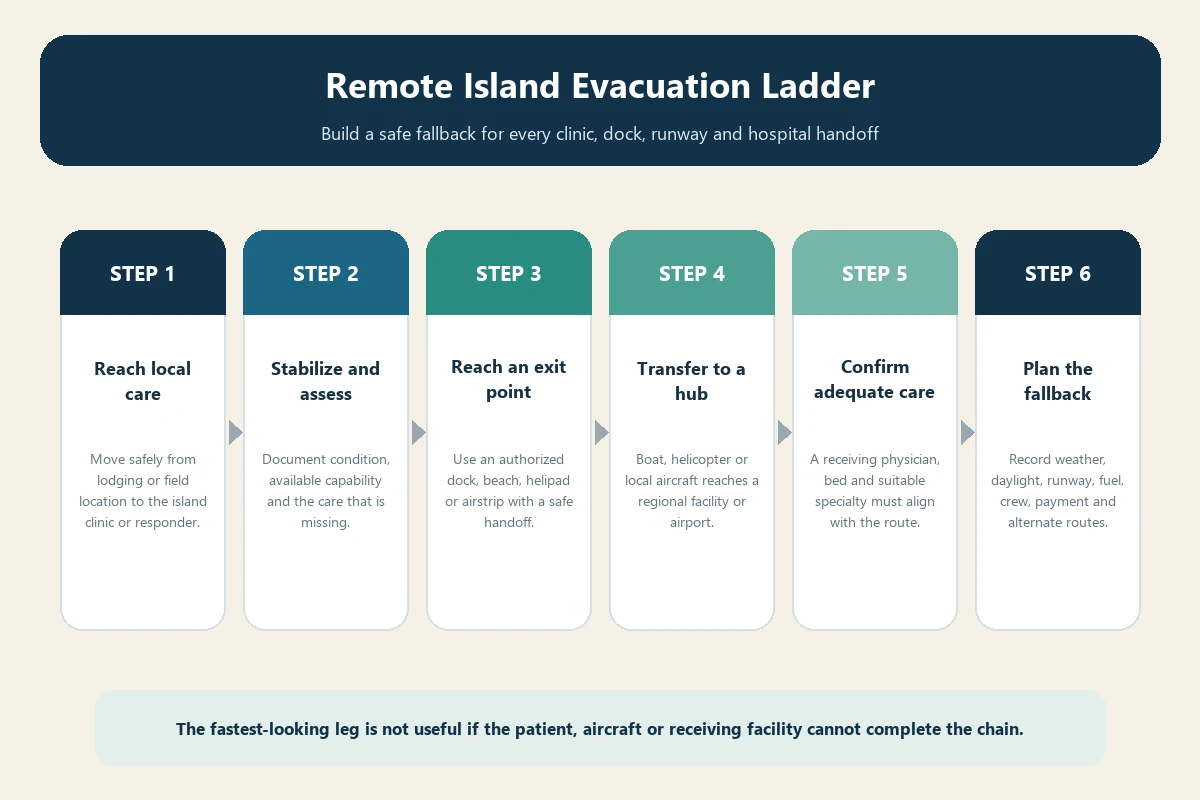
Stage 1: reach the island’s first medical contact
The first obstacle can be movement from a resort, boat, trail, village, or private island to a responder. A resort vehicle, local boat, ground ambulance, guide, or public rescue team may perform this stage.
Record who dispatched the movement, why the patient could not travel ordinarily, pickup and handoff points, time, mode, and charge. Do not label it “evacuation” before checking whether the policy treats it as rescue, ambulance, or a noncovered convenience.
Stage 2: document local capability
The clinic or clinician should record the diagnosis or working diagnosis, vital signs, stabilization, tests performed, treatment given, current risk, and care that is not available locally. A generic note saying “send to mainland” is weaker than a clinical explanation.
The CDC Yellow Book insurance chapter explains that evacuation can be needed when local care cannot provide definitive treatment. It also says evacuation decisions are generally controlled by the insurance company rather than traveler preference.
Medical need does not choose the entire route
A clinician may identify the required specialty without selecting the boat, aircraft, operator, airport, fuel stop, or insurer-covered destination. Assistance staff then match clinical needs with transport safety, available infrastructure, policy terms, and a receiving facility.
The approval-chain guide separates the treating clinician, assistance medical team, receiving hospital, transport operator, and benefit administrator.
Stage 3: reach a usable dock, beach, helipad, or runway
A clinic can be close to the sea but far from a dock that can safely load a stretcher. An airstrip can exist but lack night lighting, fire coverage, fuel, customs processing, or pavement suitable for the required aircraft.
Ask who controls the access point, what patient packaging is required, whether an ambulance can meet it, and which alternate exists if surf, tide, wind, runway, or visibility prevents use. Preserve the operational reason for any route change.
Use an exit-point checklist
| Exit point | Operational questions | Medical handoff |
|---|---|---|
| Dock or pier | Tide, surf, depth, loading, hours, vessel | Stretcher access, crew, oxygen, ambulance |
| Beach | Landing permission, sea state, daylight | Carry distance, packaging, receiving boat |
| Helipad | Surface, obstacles, wind, security, fuel | Patient weight, equipment, ground transfer |
| Airstrip | Length, pavement, lighting, weather, permits | Fitness, aircraft acceptance, airport ambulance |
Complete the table with the operator or assistance team rather than guessing from a tourist map. The usable exit can change by patient condition and transport configuration.
Boat transport is not automatically an ambulance
A government patrol boat, resort launch, ferry, fishing vessel, or medically equipped transfer boat can move a patient. Their clinical capability and billing status differ. Record the crew, onboard care, monitoring, oxygen, stretcher arrangement, departure authority, and destination.
The policy might cover a medically necessary water ambulance but exclude ordinary transport or privately arranged rescue. Obtain the exact benefit classification from the assistance team when time allows.
Helicopter access has a separate safety gate
A helicopter may land, hover, hoist, or meet the patient at another island. Weather, visibility, wind, daylight, landing-zone security, range, fuel, weight, and crew duty can stop the mission.
Use the helicopter rescue guide to distinguish field extraction, local delivery, and interfacility medical transport. An insurer’s willingness to consider a claim does not control flight safety.
Fixed-wing transport begins before takeoff
A local aircraft may carry the patient to a regional airport, or a dedicated air ambulance may position from another country. Ground ambulances must reach both airports. The patient must be stable for cabin conditions, the aircraft must accept the required equipment, and the receiving facility must remain available.
The route-cost breakdown explains positioning legs, medical crew, equipment, ground transfers, permits, and destination distance without treating a broad range as a quote.
Stage 4: the regional hub might be only an intermediate stop
The first flight can end at a regional hospital for stabilization. A second transfer might occur later if the needed surgery or specialty remains unavailable. Those legs can use different vendors, dates, authorizations, and benefit language.
Do not assume approval of the island leg includes the later international leg. Ask whether the authorization covers the entire named route or only transfer to the first adequate facility.
An island group can cross policy and border boundaries
Two nearby islands may belong to different countries or territories. The route can require immigration, customs, landing permission, controlled-medication documentation, or a different ambulance provider even when the flight is short.
Record the policy territory, citizenship and passport, planned entry point, receiving hospital, operator permits, and who will clear the patient and medical crew. An emergency can speed coordination, but it does not justify promising that border formalities disappear.
Weather delay changes care, not just scheduling
A patient who cannot depart may need additional monitoring, medication, oxygen, staffing, accommodation, or a revised treatment plan. The treating clinician should document changes in condition and whether waiting remains medically acceptable.
The CDC injury chapter warns that inadequate trauma care in remote locations and sudden weather changes can hamper rescue, delay care, and reduce survivability. That supports contingency planning, not a promise that evacuation is possible.
Build three route scenarios before purchase
- Local-only: clinic care and ground or boat movement within the island group.
- Regional hub: island exit plus transfer to the nearest facility with the needed specialty.
- Multi-stage: local stabilization, regional transfer, and later authorized international transport.
For each scenario, list access point, mode, crew, medical equipment, daylight or weather restriction, destination, receiving contact, advance-payment practice, and alternate route. Do not assign a universal price.
Adventure activities can change eligibility
Diving, surfing, sailing, climbing, backcountry travel, motorcycling, racing, or professional activity can require an option or fall within an exclusion. A remote location does not override the activity wording.
The CDC adventure-travel chapter says insurance does not guarantee rescue, may exclude wilderness rescue and adventure sports, and can depend on medical-control approval, maximums, and pre-existing conditions.
Audit the authorization and emergency exception
Ask when assistance must be called, who may arrange each mode, which records must be sent, whether an emergency exception exists when contact is impossible, and how soon notice must follow. Save failed call attempts and the reason immediate movement was necessary.
The pre-authorization guide separates medical recommendation, transport arrangement, benefit authorization, payment guarantee, and final claim review.
Build a communications fallback
Mobile coverage can end between the clinic, dock, and airstrip. Before travel, record the local emergency number, lodging desk, clinic, assistance center, tour operator, and a mainland contact. Store the policy number and contacts offline, not only in an email account that needs data service.
During an incident, assign one person to relay clinical and route updates. Note the time zone, callback number, satellite or radio contact, battery status, and the next planned check-in. A message such as “send a helicopter” is not enough for safe dispatch; the coordinator needs location, patient condition, hazards, available landing or loading point, and a reliable way to confirm changes.
Do not assume the government will pay
The U.S. Department of State’s insurance guidance says the U.S. government does not pay citizens’ medical costs abroad. Consular staff may provide information or limited assistance, but that is not a funded evacuation benefit.
Keep access to payment even with insurance. Local clinics, boats, aircraft, and hospitals may request deposits or guarantees before service.
Plan for the companion without delaying care
The patient’s medically configured aircraft might not accept a companion or luggage. The companion may need a separate boat or commercial flight, hotel, passport support, and onward travel to the receiving city.
Identify one case contact and keep the patient’s essential documents accessible. Submit companion expenses under the relevant interruption, bedside, family-transport, or unused-trip provisions rather than adding them to the medical mission invoice.
The remote-island evidence file
- Itinerary, island, coordinates, and time zone
- Emergency call, local authority, and case number
- Clinic record and unavailable-capability statement
- Assistance log and written authorization
- Dock, helipad, runway, and alternate-route notes
- Transport mission record for every leg
- Receiving physician and bed acceptance
- Itemized invoices, currency, receipts, and guarantees
- Weather or safety reason for delays and reroutes
- Other-insurance, refund, and interruption responses
Bottom line
Medical evacuation insurance remote islands coverage should be tested against a complete access ladder: first response, clinic capability, safe exit point, boat or aircraft, regional hub, adequate hospital, and a documented fallback. The strongest plan comparison is not the largest displayed number. It is the contract and assistance process that can address the actual route, activity, authorization, destination, and evidence requirements without assuming rescue is guaranteed.