
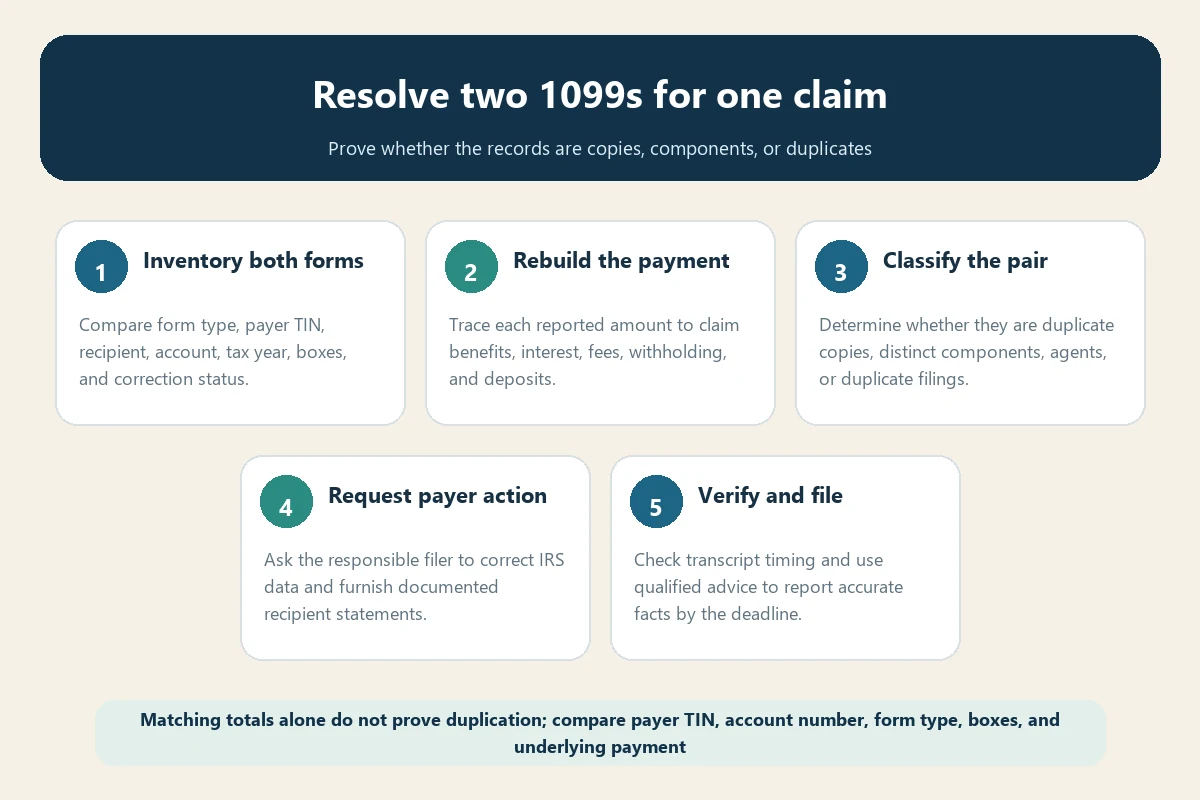
If you received a duplicate 1099 for a travel insurance claim, do not add or delete either amount until you establish what each form represents. Compare the form type, payer, recipient, account number, tax year, boxes, withholding, and correction status, then trace both statements to the actual claim payment.
Two documents can be duplicate copies of one filing, separate forms for distinct payment components, statements from an insurer and its agent, or true duplicate information returns. Tax treatment depends on the underlying transaction and recipient facts. This U.S.-focused guide is general information, not tax, legal, accounting, or insurance advice.
Place both forms side by side
Create a comparison before contacting anyone. Preserve the original files, envelopes, portal timestamps, and filenames. Record whether either statement is marked corrected, duplicate, reissued, void, or recipient copy.
| Field | Form A | Form B | Why it matters |
|---|---|---|---|
| Form type | 1099 series and revision | 1099 series and revision | Different forms can report different items |
| Payer | Legal name and TIN ending | Legal name and TIN ending | Brand names can hide different filers |
| Recipient | Name and masked TIN | Name and masked TIN | Joint or alternate payees may differ |
| Account | Account or claim reference | Account or claim reference | Helps identify the payer record |
| Amount | Every populated box | Every populated box | Equal totals do not prove equal purpose |
| Status | Original or corrected | Original or corrected | A correction can create a valid pair |
Rule out two copies of one statement
A paper copy, portal download, tax-software import, corrected-statement notification, and IRS transcript entry may all refer to one information return. If payer TIN, recipient TIN, account, form type, year, boxes, and amounts match exactly, determine whether you simply received the same recipient statement twice.
Do not count a transcript entry as an additional payment. A wage and income transcript reflects information reported to the IRS; it is not another distribution. Keep one copy in the working file and label the delivery source of each duplicate document.
Rebuild the underlying claim ledger
List the claimed loss, approved benefit lines, deductible, offsets, interest, settlement additions, attorney-related amounts, gross disbursement, tax withholding, fees, repayments, and net deposits. Assign each 1099 box to a specific ledger component if possible.
The claim payment fee guide helps separate bank and processing charges. The tax withholding guide helps reconcile gross payment, withheld tax, and net receipt.
Different form types may report different components
A travel claim settlement might include a policy benefit, interest, service payment, attorney-related amount, or other component. Two distinct information returns are not necessarily duplication merely because they connect to one claim number or share a similar amount.
Ask each payer to identify its payment category, form and box, gross amount, recipient, and authority for reporting. Do not assume that every insurance reimbursement is taxable or that the same return treatment applies across all Form 1099 types.
Different legal payers require a payer map
The insurer, underwriter, third-party administrator, settlement company, bank, attorney, or payment processor may appear under different legal names. One may act as an agent for another, or each may have paid a genuinely separate component.
Build a payer map showing brand, legal entity, payer TIN ending, role, payment channel, claim reference, and amount. Ask whether one filer reported on behalf of another and whether both records reached the IRS.
Check whether both forms report the same cash
Trace every reported amount to a check, ACH transfer, virtual card, wire, provider payment, or other disbursement. Matching form totals do not prove that only one payment occurred; conversely, two deposit entries can be a failed transfer and reissue rather than two successful payments.
If the insurer actually paid twice and seeks recovery, use the claim overpayment repayment guide. A true duplicate payment and duplicate tax reporting are related but separate problems.
Reissues and returned payments can look duplicated
A lost check, expired virtual card, rejected ACH, returned wire, or stop-payment may generate multiple transaction records while only one disbursement succeeds. Obtain the void, rejection, return, and reissue records from both payer and financial institution.
The lost claim check guide and expired check reissue guide show how to document payment status. Do not ask to remove a 1099 until the payer reconciles the final reporting event.
Joint and alternate payees can create two recipient records
A claimant and medical provider, two travelers, an attorney and client, an estate and beneficiary, or a business and owner may appear in one claim. Compare recipient names, TIN endings, policy rights, release terms, and allocation statements.
The two-payee claim check guide covers endorsement and deposit evidence. Tax ownership is separate; request a written allocation and obtain qualified advice rather than dividing an amount informally.
Original and corrected forms may form a valid sequence
A corrected statement does not always replace the original in a visually intuitive way. Certain correction types can require more than one information return to identify the wrong record and report the correct information.
The current IRS General Instructions for Certain Information Returns explain correction procedures and stress the importance of account numbers. Compare the sequence, correction marking, dates, payer, recipient, and values rather than treating every extra page as another payment.
Recognize true duplicate reporting
True duplicate reporting is more likely when two IRS-filed originals show the same payer, recipient, account, form type, tax year, box, and amount for one payment, with neither acting as a correction. It can also occur when an issuer retransmits an accepted file as original.
The IRS general instructions list duplicate filing as a common error and tell payers not to send the same information more than once. They also advise a payer that realizes duplicate reporting to contact the information-reporting customer service site for instructions. The filer—not the recipient—must address its filing system.
Send a field-specific correction request
Contact the legal filer shown on each form through a verified channel. Send a comparison table and claim ledger. State whether you believe the documents are duplicate recipient copies or two IRS-filed originals, and ask the payer to confirm its records.
Request:
- the legal payer and reporting agent for each form;
- the form type, tax year, recipient, and account number;
- the payment component behind every populated box;
- the IRS filing status and submission identifier;
- whether a correction or duplicate-reporting procedure is required;
- the corrected recipient statement and expected date; and
- written confirmation when payer and IRS records have been addressed.
Use the incorrect claim 1099 guide to distinguish amount, identity, year, and form-type errors. Do not edit either tax form yourself.
Use transcript data as a cross-check
An IRS wage and income transcript can show Form 1099 data reported under the taxpayer’s record. The official IRS Topic 159 explains transcript access.
Check whether one or two records appear and compare payer, form, year, and amount. Transcript timing can lag filings and corrections, so an early snapshot is not final proof. Preserve dated copies before and after the payer’s promised correction.
Do not use Form 1099-K instructions for every duplicate
The IRS provides form-specific guidance for an incorrect Form 1099-K, including contacting the filer and retaining correspondence. See the official Form 1099-K FAQ.
Its return-entry method is specific to the facts and form described there. Do not apply that method automatically to a 1099-MISC, 1099-NEC, 1099-INT, or another form. Obtain advice for the actual information return and underlying claim payment.
Protect the filing deadline
Request correction promptly but do not wait indefinitely past a tax filing deadline. Give a tax professional the two forms, payment ledger, payer correspondence, transcript, and correction timeline so the return can reflect accurate facts and preserve the dispute.
Do not simply omit both forms, report both totals, or average the amounts. If a correction arrives after filing and changes the return, obtain advice about an amended federal or state filing. Keep evidence of when the payer acknowledged the duplicate.
Watch for duplicate-document scams
An unsolicited caller may offer to “delete” an IRS record for a fee or request a full TIN, bank login, remote access, gift card, wire, or cryptocurrency payment. Verify each payer independently and transmit identity data only through a secure route.
The travel claim payment scam guide covers fake tax-release demands and changed payment instructions. A legitimate information-return correction does not require paying an individual to unlock insurance funds.
Escalate the correct dispute
Duplicate tax reporting belongs with the filer’s information-return, tax, compliance, or legal team. An actual duplicate claim payment belongs with claims accounting and recovery. A disagreement about tax treatment needs qualified tax advice.
If the insurer will not explain the underlying claim payment, the NAIC state insurance department directory links to official regulators. An insurance regulator generally cannot edit the payer’s IRS submission or prepare the recipient’s return.
Keep one permanent reconciliation file
Retain both original statements, delivery records, claim decision, gross-to-net ledger, bank proof, payer map, correction requests, acknowledgments, corrected forms, transcripts, and tax workpapers. Label each document by source and date.
The final file should prove whether the pair represented duplicate copies, separate components, two payers, an original-correction sequence, or true duplicate reporting—and show how the payer and tax return resolved it.
Bottom line
When two 1099 forms appear for one travel insurance claim, compare every field and trace each amount to the actual disbursement before drawing a conclusion. Make the responsible filer explain and correct duplicate reporting, verify the updated record, and protect the filing deadline with complete evidence and qualified advice.
