
A travel insurance arbitration timeline begins when the filing requirements are satisfied, but its total length depends on the agreement, provider, rule set, fees, arbitrator selection, scheduling order, information exchange, motions, hearing format, settlement activity, and record closure. There is no reliable universal promise that every case ends in a fixed number of months.
Build one live calendar from controlling documents. Separate deadlines fixed by rules from dates set by the administrator and dates ordered by the arbitrator. This guide uses the current AAA individual consumer process as an example and provides general information, not legal advice.
Start with the governing documents
Collect the issued policy, arbitration clause, incorporated rules, amendments, pre-arbitration notice, court order if any, demand, filing receipt, fee schedule, and every administrator communication. Record the rule version and filing date.
The official AAA Consumer Arbitration Rules control many procedural points in an AAA consumer case. Use AAA’s current consumer rules, forms, and fees page to confirm that the cited rule set and forms remain current. The agreement and applicable law can alter or add requirements.
Do not start the clock from an incomplete submission
Under current AAA Rule R-4, a filing under an agreement naming AAA requires the demand, administrative filing fee, and applicable arbitration agreement. A case that does not meet filing requirements can be returned and is not considered filed.
The travel insurance arbitration demand guide explains the complete filing package. Save the date AAA confirms that requirements were satisfied; it may differ from the date a draft was emailed or uploaded.
Complete required notice and preserve proof
The claimant must notify the respondent in writing and provide the demand and supporting documents through an authorized method. Record recipient, address, method, transmission, delivery, attachments, and any agreement to electronic service.
Do not assume AAA’s administrative notice replaces a claimant obligation. If the parties dispute the filing date or service, preserve every record for the arbitrator or court.
Day zero is a documented event
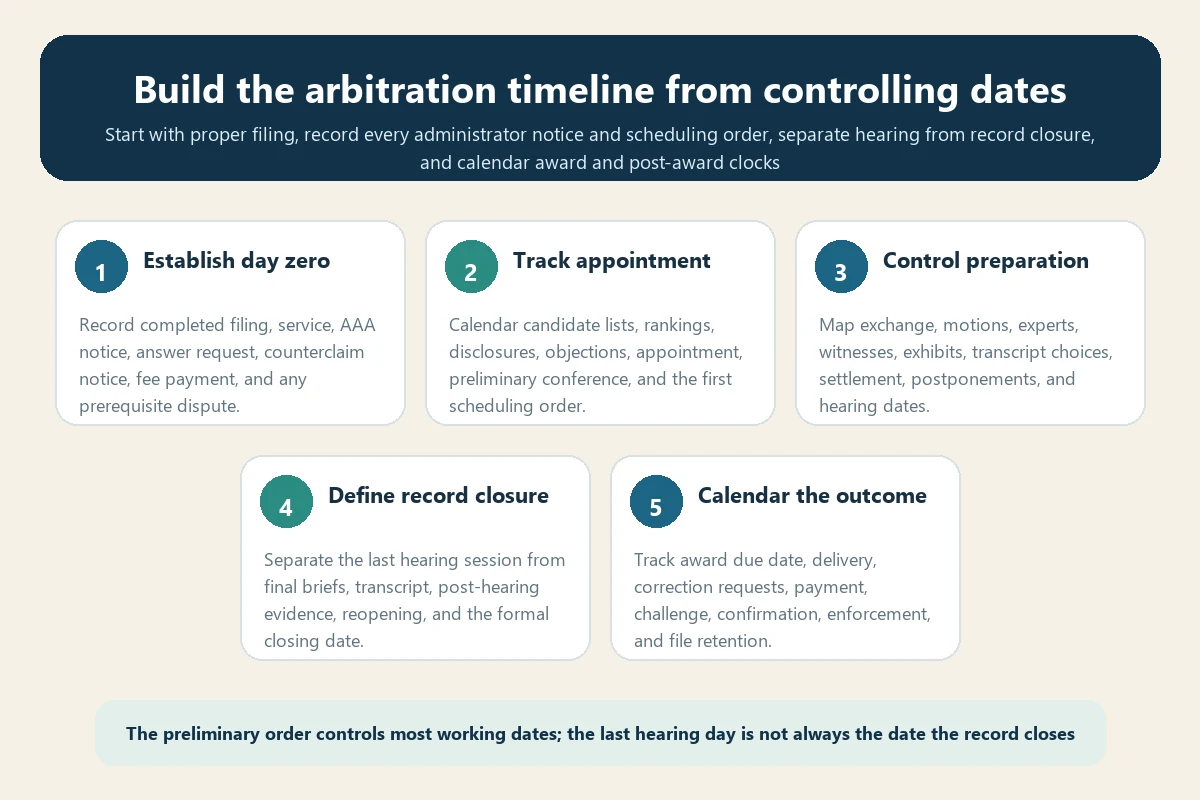
Create a row for submission date, fee date, completed-filing date, claimant notice, respondent receipt, AAA acknowledgment, answer request, and any condition-precedent dispute. Label which event starts each deadline.
A calendar entry should cite the source: rule, agreement paragraph, administrator email, case order, statute, or court rule. Avoid a single unlabeled “arbitration started” date.
The answer window
Current AAA consumer Rule R-5 allows the respondent to submit an answer within 14 calendar days of being requested by AAA. If no answer is filed, AAA assumes the respondent disagrees and the case moves forward after the period.
The arbitration answer guide explains how to map admissions, denials, defenses, jurisdictional issues, and requested relief. The absence of an answer is not an automatic claimant victory.
Counterclaim and reply timing
If the respondent files a counterclaim, the claimant may answer or reply within 14 calendar days after AAA sends notice of the counterclaim under the current rule. Record the administrator’s transmission date and the due date separately.
Check whether the counterclaim changes the amount, fees, arbitrator selection, evidence, or hearing plan. Calendar any response to an amended claim under the applicable order.
Administrative review can add time
AAA may review filing requirements, consumer-clause compliance, fees, locale issues, rule applicability, and other administrative matters. A business’s failure to submit or pay for clause review can affect administration.
Track every deficiency, cure request, payment assessment, response, and decision. The rejected arbitration demand guide distinguishes a returned filing from a final merits decision.
Arbitrator selection has its own mini-timeline
Record the candidate-list date, ranking or strike deadline, party-appointed candidate if any, disclosures, supplemental disclosures, objection deadline, administrator decision, appointment, and confirmation. Do not compress these into one “arbitrator chosen” date.
Conflicts can require questions, objections, replacement, or a new list. The selection phase can be short or expand depending on agreement, panel size, availability, and disclosure issues.
Calendar disclosures as continuing events
The initial disclosure is not the last possible disclosure. Save every update and record when the underlying relationship became known. Ask how quickly an objection must be raised under the rule, order, and governing law.
Late silence can create waiver arguments. Keep the disclosure calendar linked to the arbitrator selection and conflict guide.
The preliminary hearing creates the working schedule
The official AAA consumer process roadmap places the preliminary conference after appointment. The conference typically sets the hearing date, document-exchange schedule, and written scheduling order.
Do not rely on an informal recap. Save the signed or issued order and enter every date into the master calendar with owner, deliverable, service method, and dependency.
Build the preliminary-order calendar by workstream
| Workstream | Typical date | Dependency |
|---|---|---|
| Claims and defenses | Amendment cutoff | Permission and prejudice |
| Information exchange | Requests, responses, disputes | Scope and production format |
| Motions | Request, briefing, decision | Authorization and hearing date |
| Experts | Reports, rebuttal, testimony | Records and inspection |
| Final hearing | Witnesses, exhibits, technology | Exchange and rulings |
| Post-hearing | Transcript, briefs, closure | Arbitrator direction |
Information exchange dates are case-specific
The rules authorize proportional exchange, while the arbitrator’s order defines actual requests, response dates, custodians, format, privilege process, and dispute procedure. Record rolling-production dates and final completion separately.
The arbitration document exchange checklist explains production logs, deficiency notices, confidentiality, metadata, and motion practice.
Calendar dependencies, not only due dates
An expert report may require complete medical records. A witness list may depend on a supplier response. A hearing exhibit can depend on a ruling. Add “needed by” dates before the formal deadline.
Use status fields such as requested, received, deficient, disputed, ordered, produced, admitted, and closed. A green due date does not prove the underlying work is complete.
Motions can reshape the schedule
Record permission to file, opening brief, opposition, reply, hearing, decision, reconsideration limits, and downstream date changes. Do not assume a pending motion pauses exchange or hearing preparation.
If a ruling narrows claims, update the issue list, witnesses, exhibits, damages, and settlement range. Preserve the prior order and the superseding schedule.
Mediation usually runs concurrently
Current AAA consumer rules allow AAA to offer mediation or the parties to request it. Unless the parties agree otherwise, mediation proceeds concurrently and does not delay arbitration.
Continue complying with the case schedule until an authorized extension, stay, or settlement closure occurs. Record mediation dates in a restricted calendar without exposing confidential positions.
Settlement can occur before the award
Parties may settle at any stage before the award. The arbitration settlement guide explains private dismissal, conditional withdrawal, partial settlement, and consent-award choices.
Do not cancel deadlines based on an unsigned term sheet. Calendar signatures, conditions, payment, administrator notice, hearing cancellation, dismissal, and default remedies.
Final-hearing preparation needs backward planning
Work backward from the hearing date for exhibit exchange, witness availability, subpoenas if authorized, expert preparation, objections, demonstratives, technology tests, interpreter arrangements, transcript decision, and opening outline.
The arbitration hearing preparation checklist converts each requested finding into a proof path. Add internal review dates before every external deadline.
Postponement changes more than one date
A postponed hearing can affect witness availability, expert fees, reporter booking, travel, exhibit cutoffs, briefing, and award timing. Obtain the written decision and revised order.
Do not move dates by assumption. Mark superseded deadlines but retain them for the procedural history.
The last hearing day is not always record closure
The arbitrator closes the hearing when satisfied the record is complete. Authorized briefs, transcript delivery, post-hearing evidence, responses, or reopened proceedings can place closure after the final live session.
Under current AAA Rule R-37, when briefs or other documentation are due, closure occurs when the arbitrator is satisfied the record is complete and no later than seven calendar days after receipt of the last submissions or transcript. Confirm the actual closure notice.
Calendar post-hearing submissions separately
Record authorization, issues, page limit, transcript availability, opening brief, response, reply, attachments, service, and record-closing status. Do not add new evidence without permission.
Use a dependency line from final transcript to brief due date and from last authorized submission to formal closure. This prevents the award clock from being calculated from the wrong event.
Award timing after closure
Current AAA Rule R-44 generally requires the award within 30 calendar days after the hearing closes, unless the parties agree otherwise or law specifies another period. For a documents-only procedure, the period is 14 calendar days.
The administrator may extend the award time only in unusual and extreme circumstances under the rule. Record any extension notice and updated due date.
Documents-only cases have a distinct sequence
Current procedures generally apply documents-only resolution when no disclosed claim or counterclaim exceeds $25,000 unless a party requests a hearing and the arbitrator decides one is necessary. Parties can also agree to documents-only treatment under the stated conditions.
The arbitrator sets final written submissions, declares the record closed when complete, and issues the award within the documents-only period. Do not copy a live-hearing timeline onto that track.
Reopening resets part of the calendar
A hearing may be reopened before the award if the arbitrator approves a party request or acts on their own initiative. Record the request, response, decision, new evidence, renewed closure, and new award due date.
Under the current rules, the arbitrator has 30 calendar days after closure of the reopened hearing, or 14 days for documents-only procedure, to make the award, subject to the governing provisions.
Award delivery starts new clocks
Save the transmittal and original award. Record delivery, clarification or correction window, response period, payment deadline, settlement performance, challenge deadline, confirmation route, and enforcement planning.
The travel insurance arbitration award guide explains why provider and court deadlines must be calendared independently.
Use a master timeline with source labels
| Date | Event | Source | Owner | Status |
|---|---|---|---|---|
| Completed filing | AAA requirements satisfied | Administrator notice | Claimant | Confirmed |
| Answer due | 14-day response period | Rule and AAA request | Respondent | Open |
| Exchange due | Production milestone | Scheduling order | Named party | In progress |
| Record closes | Formal closure | Arbitrator notice | Arbitrator | Pending |
| Award due | Rule-based period | Closure plus rule | Arbitrator | Calculated |
A weekly timeline audit
- Import every new administrator notice and order.
- Recalculate dependent dates from the controlling event.
- Confirm owner, deliverable, service recipients, and time zone.
- Flag missing inputs before they threaten the formal deadline.
- Mark superseded dates without deleting procedural history.
- Separate settlement and confidential mediation entries.
- Back up receipts, service proof, orders, and calendar exports.
Bottom line
A travel insurance arbitration timeline is not one countdown. It combines completed-filing events, administrator notices, rule periods, arbitrator orders, work dependencies, record closure, and post-award deadlines.
Anchor every date to a controlling source. The preliminary scheduling order governs most working deadlines, while the formal record-closing date—not automatically the last hearing day—usually starts the award clock.
