

Medicare Advantage international travel coverage is not one uniform benefit. Original Medicare has only narrow coverage outside the United States, while an individual Medicare Advantage plan may add worldwide emergency care, worldwide urgently needed services, or worldwide emergency transportation as supplemental benefits. Those are separate benefit categories, so coverage for a foreign emergency does not prove coverage for every urgent visit, ambulance, evacuation, follow-up service, or return home.
This article is educational, not medical, legal, insurance, or financial advice. Plan benefits, service areas, networks, limits, and claim rules can change by contract year. Read the current Evidence of Coverage and confirm the plan’s answer in writing.
Key takeaways
- Never infer international coverage from the words “Medicare Advantage” alone; identify the exact contract, plan, county, and benefit year.
- Worldwide emergency care, worldwide urgent care, and worldwide emergency transportation can be separate supplemental benefits.
- A foreign hospital may require payment up front even when the plan later reimburses an eligible claim.
- Post-stabilization care, routine follow-up, prescriptions, evacuation, and repatriation need their own confirmation.
- The Evidence of Coverage, Summary of Benefits, provider directory, and written plan response form one verification packet.
Reviewed: August 16, 2026.
Why search results create confusion
Online answers often collapse three different questions: what Original Medicare covers abroad, what Medicare Advantage must cover inside the United States, and what a particular Medicare Advantage contract elects to add worldwide. A true statement in one lane can become misleading in another.
Medicare Advantage plans must provide the Medicare-covered services required by law, but plans use networks and service areas and can offer extra benefits. International coverage beyond Original Medicare’s narrow exceptions can be one of those extras. Two people carrying cards with the same national insurer’s logo may have different international benefits because their plan IDs, counties, or contract years differ.
First identify the exact plan
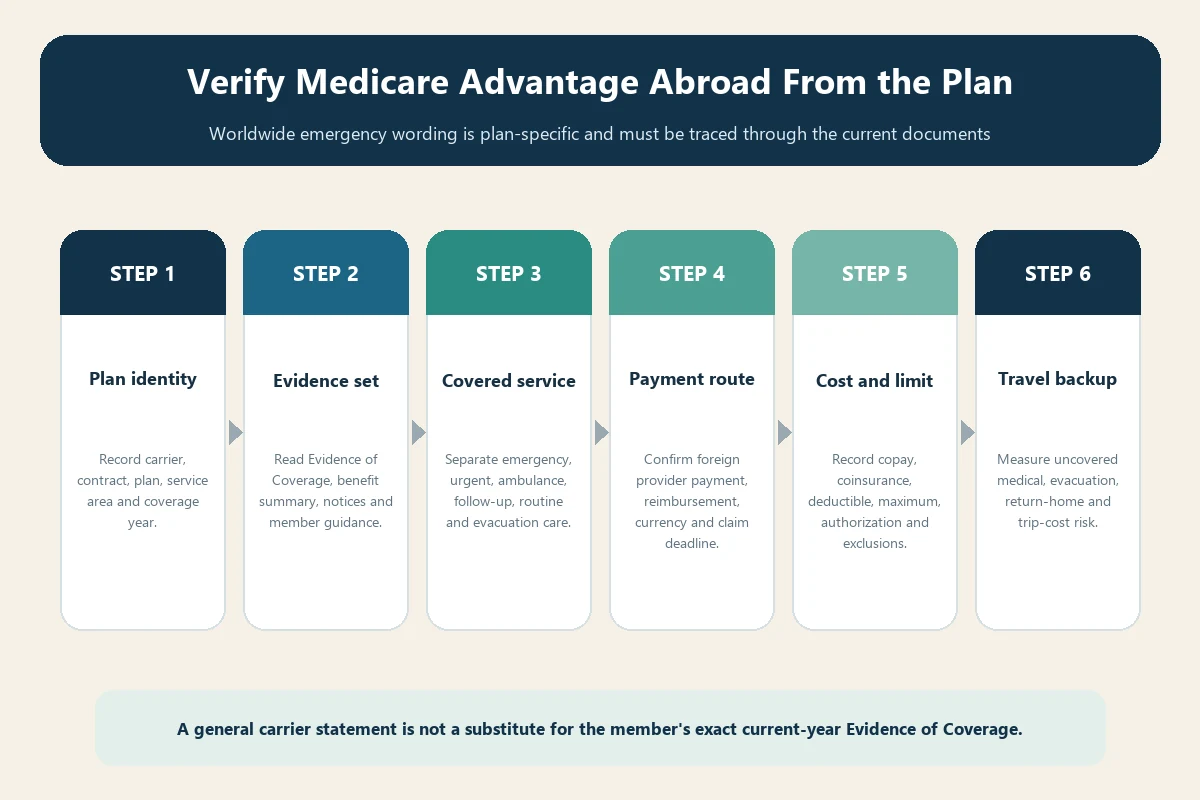
Collect the plan’s full marketing name, contract and plan identifiers, home service area, plan type, and coverage year. Do not rely on an old wallet card, a television advertisement, or a friend’s plan. A PPO, HMO, HMO-POS, PFFS, MSA, or Special Needs Plan can have different network and out-of-area rules.
Use the member portal or request the current:
- Evidence of Coverage
- Summary of Benefits
- Annual Notice of Change
- provider and pharmacy directories
- formulary and drug rules
- claim and reimbursement form
- international assistance contact information
Search the Evidence of Coverage for “outside the United States,” “worldwide,” “foreign,” “emergency,” “urgently needed,” “ambulance,” “transportation,” “reimbursement,” and “post-stabilization.” The controlling details may be distributed across several sections.
Original Medicare is the baseline, not the whole answer
Medicare’s April 2026 publication says Original Medicare usually does not cover health care outside the United States. It identifies limited foreign hospital situations: a qualifying U.S. emergency when a foreign hospital is closer, certain direct travel through Canada between Alaska and another state, and a U.S. resident whose nearest hospital is across a border. There is also a limited cruise-ship rule linked to proximity to a U.S. port.
A Medicare Advantage plan must account for those Medicare-covered situations. But a plan can separately offer broader worldwide benefits. The practical question is therefore not simply “Does Medicare cover Europe?” It is “Which foreign services does this exact 2026 plan cover, under which provision, at what cost, and with what claim process?” Our Medicare coverage in Europe guide explains the Original Medicare baseline.
Separate the three worldwide benefit categories
CMS reporting specifications list worldwide emergency coverage, worldwide urgent coverage, and worldwide emergency transportation as distinct supplemental-benefit categories. A plan may report one, two, or all three. Even when they coexist, their limits and cost sharing may differ.
| Benefit lane | Question to verify | Common unresolved issue |
|---|---|---|
| Worldwide emergency care | How does the plan define an emergency and covered setting? | Care after the person is stabilized |
| Worldwide urgent care | What qualifies as urgently needed but not an emergency? | Clinic access, follow-up, or routine treatment |
| Worldwide emergency transportation | Which vehicle, route, endpoint, and medical necessity qualify? | International evacuation or return home |
A worldwide ambulance benefit may mean local transport to the nearest appropriate facility. It does not necessarily promise an air ambulance to the United States or a hospital chosen by the traveler.
Emergency, urgent, and routine care are not synonyms
An emergency generally involves a condition where a reasonable person could expect serious jeopardy without immediate attention. Urgently needed care can address a sudden illness or injury requiring prompt attention when the regular provider is unavailable. Routine or elective care is planned or can safely wait.
The classification matters after the first hospital visit. A foreign emergency may be eligible, while a scheduled specialist follow-up, rehabilitation, refill, durable medical equipment replacement, or hotel-based nursing care is not. Ask the plan when the emergency is considered stabilized and what authorization is required for continued care.
Networks abroad may work differently
Inside the plan’s U.S. service area, network rules may determine which providers are covered and at what cost. Overseas, the plan may operate through reimbursement or an assistance vendor rather than a normal provider network. A facility displayed in an assistance directory is not necessarily “in network,” and a provider’s willingness to treat a member does not guarantee payment.
Ask whether the plan has contracted international providers, whether a listed facility can bill directly, and whether the member remains responsible if the provider charges more than the plan’s allowed amount. Record the answer for each destination, especially on islands, cruises, and rural routes.
Cost sharing needs more than one number
Review the foreign emergency copayment or coinsurance, separate ambulance cost sharing, annual or trip maximum, currency-conversion method, reimbursement basis, and whether foreign spending counts toward the in-network or combined maximum out-of-pocket amount. A plan may cap a supplemental international benefit even though other Medicare-covered services use a broader annual structure.
Also confirm whether costs are counted by date of service, admission, claim processing date, or benefit year. A trip spanning December and January can cross two plan years, with new documents and cost-sharing schedules.
Medical evacuation and return home require explicit language
“Emergency transportation” can sound broader than it is. Break the event into local ambulance, interfacility transfer, medically necessary air ambulance, international evacuation, medically escorted commercial travel, and transport to a preferred hospital or home. Ask the plan about each segment and endpoint.
For route-based planning, use our destination evacuation guide. To understand why approval language matters, review who decides whether an evacuation is covered. A separate travel policy or membership may be useful, but it must be coordinated with the Medicare Advantage plan.
Preauthorization and assistance calls
Immediate emergency treatment should not be delayed to make an insurance call. As soon as reasonably possible, however, the member or companion should contact the plan using the international number. Ask who can authorize continued care, a transfer, or an evacuation; what happens outside U.S. business hours; and whether a third-party assistance company acts for the plan.
Document the time, number called, representative, reference number, instructions, and any promised follow-up. Verbal guidance is helpful during an emergency, but the Evidence of Coverage and written determination remain important.
Expect possible payment up front
A foreign provider may not submit a claim to the U.S. plan and may require a deposit or full payment. Confirm whether the plan offers a payment guarantee, direct settlement, or only reimbursement. Determine how the member can send records securely from abroad and whether translations or currency receipts are required.
Keep itemized bills, proof of payment, diagnosis and treatment records, admission and discharge notes, prescriptions, ambulance records, travel dates, and correspondence. If transport occurs, the medical evacuation claim-document guide can help separate medical, transport, and assistance evidence.
Prescription drugs and medical equipment
International medical coverage does not automatically extend a Part D benefit abroad. Ask the plan and pharmacy benefit manager about vacation overrides, replacement medication, permitted quantities, controlled substances, temperature-sensitive drugs, and claim rules. Carry prescriptions in original packaging and check destination laws.
Travelers using oxygen, wheelchairs, scooters, CPAP equipment, or other devices should confirm supplier access and repair or replacement coverage. Our senior mobility-equipment insurance guide separates medical necessity from baggage and property protection.
Use a five-scenario test
- Emergency department: sudden chest pain requires immediate foreign hospital care.
- Urgent clinic: an infection needs prompt treatment but is not life-threatening.
- Post-stabilization: the traveler needs three more days of monitoring.
- Transport: a local hospital recommends transfer to a better-equipped regional center.
- Return: the traveler is stable but cannot fly home unassisted.
For each scenario, ask about eligibility, cost sharing, limit, authorization, direct billing, documents, and endpoint. A plan that answers the first scenario may still leave the other four exposed.
When a separate travel policy may add value
Separate travel coverage can address trip cancellation, interruption, delay, baggage, travel medical limits above the plan benefit, evacuation, repatriation, and assistance. It can also create complexity through exclusions and coordination. Compare the traveler’s age, health history, destination, duration, prepaid cost, activities, and desired transport outcome.
Seniors should examine the pre-existing-condition provision rather than assume a diagnosis makes coverage impossible. Our senior pre-existing-condition questions provide a policy-reading checklist. Frequent travelers can compare single-trip designs with annual senior travel insurance, paying close attention to maximum trip length.
Questions to ask the plan before departure
- Does this exact plan provide worldwide emergency, worldwide urgent, and worldwide transportation benefits?
- What countries, territories, cruises, and trip durations qualify?
- What cost sharing and maximum apply to each lane?
- What happens after stabilization?
- Does the benefit include only local ambulance or also medical evacuation?
- Which destination is authorized: nearest appropriate facility, regional center, or United States?
- Is preauthorization required when reasonably possible?
- Can the assistance vendor guarantee payment?
- How are foreign currency, excess charges, and translations handled?
- Do covered foreign amounts count toward the plan’s maximum out-of-pocket limit?
- What claim deadline and form apply?
- Will next year’s benefits change during this trip?
FAQ
Do all Medicare Advantage plans cover emergencies overseas?
Do not assume that. International benefits can be supplemental and plan-specific. Verify the current Evidence of Coverage for the exact plan.
Is worldwide emergency transportation the same as evacuation home?
No. It may cover a narrower ambulance service or endpoint. Confirm the mode, medical-necessity test, route, authorization, and destination.
Will a foreign hospital accept the Medicare Advantage card?
Acceptance and direct billing are not guaranteed. The member may need to pay and seek reimbursement.
Does an overseas benefit cover routine care?
Not unless the plan explicitly says so. Emergency, urgent, follow-up, and routine services should be verified separately.
Bottom line
Medicare Advantage outside the United States is a contract question, not a brand promise. Gather the current plan documents, isolate worldwide emergency, urgent, and transportation benefits, test post-stabilization and return-home scenarios, and document the claim process. Add separate travel coverage only after identifying the gaps the exact plan leaves behind.
