

Medical evacuation insurance cruise ship coverage begins with one question: which stage of the incident is being discussed? A passenger can receive care in the ship medical center, be moved by a public rescue service, enter a port ambulance, receive treatment at a shoreside hospital, and later need an insured hospital transfer. Calling the entire chain “an airlift” hides the decisions and bills that determine coverage.
Seek the ship medical team and local emergency help first. This guide is educational, not medical, insurance, maritime, aviation, or legal advice. The captain, rescue authority, clinicians, carrier, receiving hospital, and insurer control different decisions. No policy guarantees a particular rescue resource, route, hospital bed, or reimbursement.
Key takeaways
- Shipboard treatment and medical evacuation are separate expenses.
- The captain and public rescue authority control access to the vessel.
- A hoist or boat transfer may end at a port, ambulance, or local hospital.
- A later hospital-to-hospital flight can require new medical and insurance approval.
- Build a separate evidence folder for every operator and benefit.
Reviewed August 16, 2026. Read the issued policy and cruise contract. Government rescue examples show operational possibilities, not a promise that the same assets or payment rules apply to another voyage.
Why “evacuation from the ship” is ambiguous
A medical event at sea creates at least three possible movements. The ship can change course toward a port. A rescue authority can move the patient from ship to shore. An assistance company can later arrange medically necessary transportation from one hospital to another.
The existing cruise insurance clause guide explains onboard bills and the narrow Medicare exception. This guide follows the physical handoffs after the patient reports sick.
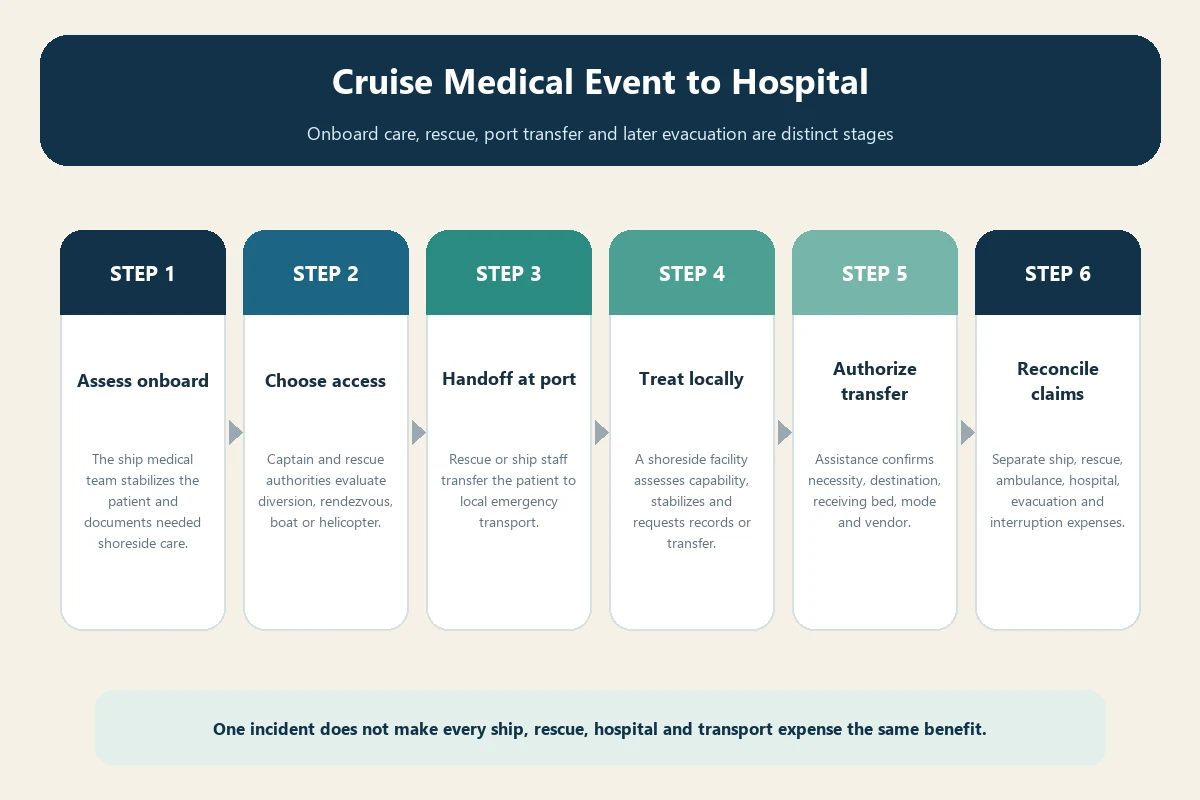
Stage 1: assessment and stabilization onboard
The ship medical team evaluates the passenger, provides available emergency care, records vital signs and treatment, and decides whether shoreside capability is needed. The patient should obtain the clinical note, medication record, itemized charge, and a summary of the recommended care.
The CDC Yellow Book cruise chapter says most acute conditions reported to ship medical centers are managed onboard, while a smaller share need shoreside consultation or evacuation. It also warns that urgent ship-to-shore movement creates logistical challenges and additional patient risk.
The ship medical bill is not the evacuation benefit
Consultation, medication, testing, oxygen, monitoring, and observation onboard can fall under a travel-medical benefit, a domestic plan’s limited rules, or the passenger’s responsibility. The emergency-evacuation maximum does not automatically pay every clinical service delivered before transport.
Ask the ship for an itemized statement rather than a single cabin-account total. The passenger might need to submit it separately from ambulance, hospital, or evacuation invoices.
Stage 2: the captain and rescue authority choose access
The assistance company does not command the vessel or a coast guard. The captain considers the patient, ship position, weather, sea state, port options, and instructions from maritime authorities. The ship might divert, increase speed toward a rendezvous, approach helicopter range, or continue to a planned port with medical reception arranged.
A rescue authority decides whether and how its assets can respond. Aircraft range, fuel, daylight, deck or hoist conditions, crew safety, and competing emergencies can change the plan. Insurance approval cannot make an unsafe operation available.
Course diversion and off-ship transfer are different decisions
A captain can divert toward a port without immediately moving the patient off the vessel. The altered course may shorten rescue range, reach safer water, meet a pilot, or deliver the patient directly to port. Conversely, a rescue craft might remove the patient while the ship continues its voyage.
Record the original itinerary, diversion order, revised port, reason, and time. Trip-interruption or missed-connection expenses can follow the passenger’s disembarkation, while the cruise line’s vessel decision remains outside the passenger’s control. Do not merge the ship’s operating choice with the insurer’s later hospital-transfer authorization.
A Coast Guard case shows the operational chain
In a 2025 U.S. Coast Guard case report, watchstanders received the ship’s request, consulted a flight surgeon, and coordinated a fixed-wing aircraft and helicopter rendezvous. The helicopter later moved the patient to a Honolulu hospital.
That is one documented mission, not a consumer coverage rule. Save the vessel position, initial call, medical recommendation, authority accepting the case, revised course, rendezvous point, and final destination for the actual incident.
Stage 3: identify where the rescue ends
A helicopter or boat may deliver the passenger to a pier, airport, landing zone, local clinic, or hospital. That endpoint matters. A public rescue can end before a private ambulance, emergency department, or international air ambulance begins.
The helicopter rescue handoff guide separates search, extraction, local delivery, and interfacility transport. Use the same method for a boat or ship diversion.
Build the port handoff record
- Ship name, voyage, position, date, and time zone
- Onboard clinician’s assessment and treatment summary
- Captain or rescue-coordination case reference
- Transfer method and public or private operator
- Port, landing zone, and handoff time
- Ambulance provider and destination facility
- Patient condition at each handoff
- Invoices, receipts, guarantees, and assistance messages
A clean timeline prevents the insurer from receiving one undifferentiated “cruise evacuation” charge.
Map payment responsibility before the records scatter
Create one row for the ship medical center, rescue operator, port ambulance, local hospital, later transport, companion travel, and unused bookings. For each, record the billed party, currency, deposit, guarantee, receipt, refund request, other insurance, and claimed benefit.
A zero-dollar public-rescue invoice is still an important record because it shows where that stage ended. It prevents a later private vendor from appearing to have performed the entire movement and helps the claim reviewer avoid duplicate payment.
Stage 4: local hospital treatment comes before a later transfer
The first shoreside hospital can assess and stabilize the patient. If it lacks the needed specialty, clinicians and the assistance team may consider another facility. The existence of unused policy limit does not itself prove that a longer flight home is medically necessary.
The evacuation destination guide explains nearest-adequate-facility wording, hospital acceptance, later transfer, and home-hospital options.
Stage 5: a second authorization may be required
The insurer or administrator may need the local hospital record, diagnosis, current stability, unavailable specialty, requested destination, receiving physician, bed acceptance, proposed mode, escort, and vendor quote. A shipboard recommendation or rescue dispatch is not automatically authorization for the next aircraft.
Use the pre-authorization timeline to record notice, medical review, exact approved route, vendor, payment arrangement, and emergency exceptions.
Medicare’s cruise rule is narrow
Medicare’s official travel coverage page says Medicare usually does not cover care outside the United States, with limited exceptions. It notes that Part B may cover certain shipboard services in territorial waters adjoining the United States and describes rare foreign-hospital situations.
Do not convert that exception into a promise for an itinerary. Verify location, timing, provider, admission, ambulance, plan type, Medigap terms, and claim procedure. Even covered shipboard care does not automatically include return transportation home.
Public rescue does not settle private medical bills
A public authority might perform one movement without billing the passenger, charge under local law, or use a private operator. Whichever applies, later ambulance, hospital, hotel, airline, escort, and air-ambulance costs can remain private.
The U.S. Department of State’s travel-insurance guidance says the U.S. government does not pay citizens’ medical costs abroad. Consular help and rescue coordination should never be treated as an insurance benefit.
Audit the policy for maritime gaps
- Is shipboard medical care eligible, and under which benefit?
- Does search or rescue have a separate definition or sublimit?
- When does emergency medical evacuation begin?
- Who must approve a private boat, helicopter, or aircraft?
- Is the destination the nearest adequate facility or another location?
- Are companions, children, escort, and return travel included in the same maximum?
- Does an itinerary inside the United States or its territories change eligibility?
- How must the passenger notify assistance when the ship controls communication?
A state-specific Travel Guard cruise policy form is useful as one example of detailed evacuation conditions. It is not proof of coverage in another state or plan.
Companion and itinerary costs need their own benefits
A companion may leave the ship, travel to the hospital, need lodging, miss the return voyage, or arrange childcare. Those costs might depend on trip interruption, bedside visit, family transportation, or unused-trip provisions rather than the patient’s evacuation benefit.
The transpacific cruise route guide shows why sea days, distant ports, separate air tickets, and long return paths should be recorded before departure.
Do not self-arrange a later aircraft casually
Once the patient is stable in a hospital, a family may want an immediate flight to a preferred U.S. facility. A private quote is not the same as medical necessity, receiving acceptance, carrier fitness, or policy authorization.
Call the assistance team, connect the treating physician, request the insurer’s proposed plan in writing, and document any disagreement. The assistance-line guide explains why live coordination and final claim review remain separate.
Prepare the ship file before sailing
Save the policy, assistance contacts, cruise emergency number, itinerary with time zones, passport details, medication list, allergies, clinician contacts, companion authority, and any medical-device requirements offline. Confirm how the ship can contact the assistance center when ordinary mobile service is unavailable.
If a traveler has a condition that might require advanced care, ask the cruise line about onboard capability and accessible ports without assuming the answer guarantees treatment. Preparation should improve communication, not substitute for a clinician’s fitness-to-travel advice.
Bottom line
Medical evacuation insurance cruise ship claims should be divided into onboard treatment, maritime access, rescue movement, port ambulance, shoreside hospital care, later medical evacuation, and companion or interruption expenses. Identify who ordered each stage, where it ended, which benefit applies, what was authorized, and which operator billed it. That evidence is more useful than a dramatic “airlift” label or a universal limit recommendation.
A personal travel companion, medical escort, bedside visitor, and child attendant are different roles. Use the medical evacuation travel-companion guide to identify the correct benefit, seat, expense limit, authorization, and evidence file for each person.
A parent’s hospitalization can create a separate child-safeguarding and return-transport problem. Use the dependent-children medical evacuation guide to coordinate benefit triggers, an attendant, custody and consent documents, border clearance, a receiving adult, fares, and claim proof.
A senior cruise medical claim can move through six care locations with different payers and authorizations. Use the senior cruise travel medical insurance claim map to connect shipboard care, Medicare, shore transfer, port hospitals, regional evacuation, return and claim evidence.
Medicare coverage at sea depends on the ship’s location and timing, not simply the cruise line or emergency. Use this Medicare cruise ship six-hour rule guide to map onboard treatment, U.S. port proximity, doctor eligibility, foreign care, and evacuation gaps.
