

A senior with Parkinson’s disease can often buy travel insurance, but coverage depends on the condition’s stability, recent symptoms or falls, medication changes, hospital care, mobility, cognition, and the policy’s pre-existing-condition rules. The trip should be designed around medication timing, accessibility, rest, communication, and a companion plan before comparing cancellation, emergency medical, interruption, baggage, and evacuation benefits.
This article is educational, not neurologic, medical, rehabilitation, legal, aviation, or insurance advice. Parkinson’s symptoms, therapies, and travel fitness vary. The treating neurologist, movement-disorder team, therapist, pharmacist, and insurer should guide the exact plan. Never change medication or stimulation settings based on general travel content.
Key takeaways
- Build the itinerary around the traveler’s medication and function pattern, not the tour’s maximum pace.
- Parkinson’s, recent falls, medication changes, and related care can affect pre-existing-condition eligibility.
- Request airport, rail, cruise, and lodging accessibility in advance and verify the details.
- Carry medicines, mobility aids, device records, and a concise communication card.
- A companion’s extra trip costs and a medical evacuation require explicit benefit language.
Reviewed: August 16, 2026.
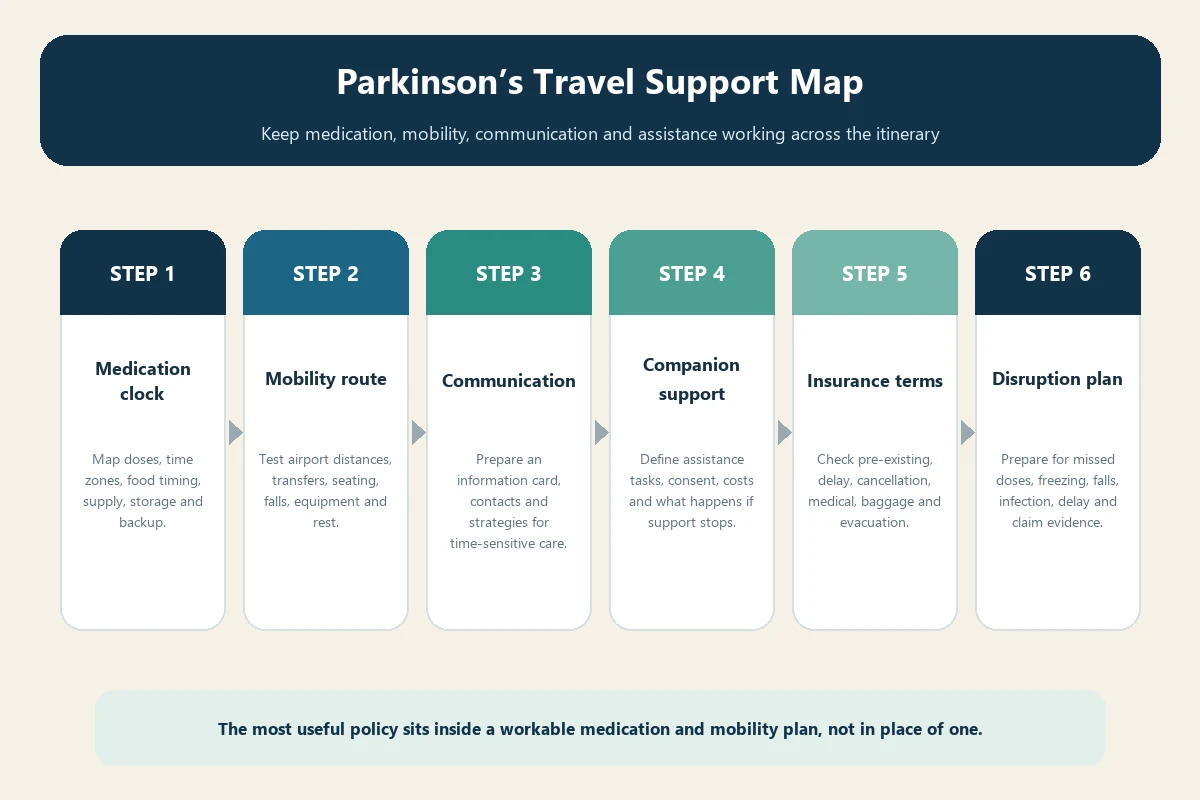
Start with the traveler’s daily pattern
Parkinson’s symptoms and medication response can change across the day. Ask the clinical team how the trip should account for mobility, freezing, tremor, balance, speech, swallowing, fatigue, sleep, cognition, blood-pressure changes, and bathroom access. Plan demanding transfers during the traveler’s more reliable periods when possible.
Do not treat one good clinic visit as proof that a fast, multi-city itinerary is suitable. Rehearse a normal travel day from waking through transport, meals, activities, medication, and sleep.
Clinical review before deposits
Review recent falls, injuries, hallucinations, fainting, swallowing problems, infection, hospitalization, rehabilitation, medication adjustments, and device programming. Ask whether the flight length, altitude, heat, cruise, remote route, and planned activities are appropriate.
Insurance availability does not equal medical readiness. Use refundable bookings until the clinical and policy questions are resolved.
Medication timing across time zones
Precise timing can be important for some Parkinson’s regimens. The clinician or pharmacist should provide a written schedule for departure, flight, destination, and return. The plan should address meals, delayed flights, sleep, and what to do after a missed or late dose.
Do not change a medicine clock by intuition. Phones can switch time zones automatically while pill organizers and cruise schedules remain on another time.
Medication supply and foreign refills
Arrange enough U.S.-dispensed medicine for the door-to-door trip plus a permitted delay buffer. Keep original labels, generic names, strengths, schedules, storage instructions, and prescriber contacts. Some medicines can be restricted in transit or destination countries.
Medicare Part D generally does not cover retail prescriptions bought outside the United States. Use the chronic medication travel guide for refills, storage, and legal transport.
Carry-on organization
Keep essential medicine and assistive devices accessible. Divide the lawful supply only if both portions remain clearly labeled and usable. Carry a short list for emergency staff and a backup copy stored securely.
Ask TSA and foreign screening authorities about liquids, patches, pumps, needles, or other medical items. Allow extra time for screening without placing all medicine in checked luggage.
Mobility, freezing, and transfers
Airports, buses, trains, cruise tenders, cobblestones, stairs, and moving walkways can increase complexity. Request wheelchair or escort assistance where useful, even if the traveler does not normally use it at home. Verify the meeting point, connection support, and transfer method.
For canes, walkers, wheelchairs, or scooters, use our mobility-aid insurance guide to document equipment and baggage limits. The traveler’s clinical transfer technique should come from the rehabilitation team.
Accessible lodging is more than an elevator
Confirm step-free entry, room distance, bathroom layout, grab bars, shower access, bed height, nighttime lighting, refrigeration when needed, and emergency evacuation. Ask for photos or measurements rather than relying on the word “accessible.”
Record the hotel contact and the requested room features. A room assignment failure may not be a covered travel-insurance event, so keep a backup lodging option.
Communication and cognition
Soft speech, delayed response, facial masking, or cognitive changes can be misunderstood as confusion or lack of consent. Carry a card explaining the diagnosis, baseline communication, medicines, allergies, clinician, and emergency contact. A companion can help without speaking over the traveler.
If the person needs help understanding policy, medical, or travel decisions, arrange lawful authorization before departure. An insurer may not discuss a claim with a companion solely because they are traveling together.
Traveling alone versus with support
A traveler who independently manages medicine, transfers, communication, and emergencies may travel alone. Another person may need a companion for personal care, navigation, nighttime help, or advocacy. The clinical team and traveler should decide.
Our senior solo travel insurance guide offers a communication and check-in framework. Verify whether the policy covers a companion’s lodging, return, or bedside travel after a covered event.
Deep brain stimulation and implanted devices
A traveler with deep brain stimulation should carry the device identification card, programmer or controller instructions, and manufacturer contact. Airport screening, magnets, charging, regional support, and medical imaging can require device-specific precautions.
Follow the neurology team and manufacturer. Do not adjust stimulation because of travel symptoms without instruction. Identify a destination center familiar with the system when the route is long or remote.
Pre-existing-condition rules
Parkinson’s and its treatment are known before policy purchase. The look-back period can include symptoms, falls, testing, treatment, prescriptions, dose changes, therapy, and hospitalization. A policy may exclude connected losses unless a waiver applies.
A waiver removes an exclusion only for otherwise covered losses and may require purchase soon after the initial trip payment plus medical ability to travel. Use our senior pre-existing-condition checklist.
Falls, injuries, and emergency medical coverage
An unexpected fall can produce an injury claim, but the insurer may evaluate whether the event is connected to a pre-existing condition and whether a waiver applies. Emergency medical coverage also follows its deductible, coinsurance, limit, exclusions, and coordination.
Seek urgent care according to the clinical plan. Preserve incident reports, witness details, medical records, imaging, itemized bills, and proof of payment.
Direct billing and appropriate hospitals
A foreign hospital may require a deposit. Assistance may identify a neurologic center, guarantee payment for an eligible event, or only provide a referral. Ask how the company verifies capability and what happens outside U.S. business hours.
The direct-billing guide explains the difference between referral and payment.
Trip cancellation
Cancellation may apply when an unexpected covered change makes the traveler medically unable to depart. A recent fall, infection, medication problem, hospitalization, or worsening symptom can be evaluated under the pre-existing-condition and medical-ability rules.
Keep clinician records, trip deposit and policy purchase dates, supplier refunds, and nonrefundable cost. A tour being too demanding after booking is not automatically a covered reason.
Trip delay
A delay can disrupt medicine timing, meals, mobility support, accessible lodging, and caregiver schedules. The policy may reimburse eligible expenses only after a defined trigger. Operational continuity must exist before the claim.
Carry the medication buffer, accessible transfer contacts, and backup lodging. Save the carrier notice and receipts.
Trip interruption and companion costs
Interruption can address eligible unused arrangements and additional transport after a covered event. A companion’s extra hotel, change fee, or return may have a separate limit or require the insured’s hospitalization.
Ask who books the return and what medical certification is required. Do not assume a companion benefit covers ordinary caregiving throughout the trip.
Medical evacuation
Evacuation may be authorized when local care is inadequate. The endpoint is often the nearest appropriate facility, not the home neurologist. Parkinson’s-related mobility or swallowing needs can affect escort and transport, but medical professionals and the insurer decide the route.
Use the evacuation approval guide and preserve clinical and authorization records.
Five-scenario rehearsal
- Connection delay: protect medication timing and accessibility assistance.
- Mobility aid damaged: obtain the carrier report and an appropriate temporary device.
- Fall abroad: seek care and separate medical, equipment, and interruption claims.
- Medicine lost: contact the prescriber, assistance, and a licensed pharmacy.
- Symptoms worsen: follow the clinical emergency plan and identify appropriate care.
Document packet
- Diagnosis, baseline symptoms, and recent change timeline
- Medication list and written time-zone schedule
- Neurology, therapy, pharmacy, and manufacturer contacts
- Mobility aid and implanted-device information
- Communication preferences and companion authorization
- Clinical clearance and emergency instructions
- Accessible transport and lodging confirmations
- Destination hospitals and assistance contacts
- Travel policy and Medicare-related cards
- Trip payments, refunds, and claim evidence
Questions for the insurer
- How do Parkinson’s, symptoms, falls, therapy, and medication changes fit the pre-existing-condition definition?
- Is a waiver available and valid?
- What medical-ability requirement applies?
- How are falls or symptom worsening handled?
- Are routine therapy and medication excluded?
- Can assistance locate and pay an appropriate neurologic facility?
- What accessibility or equipment loss benefit applies?
- Does interruption cover a companion?
- What evacuation endpoint and authorization apply?
- Which records and deadlines control the claim?
FAQ
Can a senior with Parkinson’s get travel insurance?
Often, yes, but availability, price, exclusions, and waiver eligibility depend on symptoms, recent care, age, destination, and policy.
Must Parkinson’s be disclosed?
Answer the application’s questions accurately, including diagnosis, medication, recent treatment, falls, or hospitalization when asked.
Will travel insurance pay for lost Parkinson’s medicine?
Do not assume so. Medicare Part D generally does not cover foreign purchases, and travel policy baggage or medical benefits vary.
Will evacuation return the traveler home?
Not necessarily. Many policies cover the nearest appropriate facility, with a separate decision about return after stabilization.
Bottom line
Travel insurance for Parkinson’s works only when the trip already fits the traveler’s medication, mobility, communication, and support needs. Build that operational plan first. Keep every written confirmation. Then test pre-existing-condition, delay, cancellation, emergency, interruption, equipment, and evacuation provisions against specific scenarios.
Sources
- American Parkinson Disease Association — Tips for Traveling With Parkinson’s
- Parkinson’s Foundation — Traveling With Parkinson’s
- CDC Yellow Book — Travelers With Chronic Illnesses
- U.S. Department of Transportation — Passengers With Disabilities
- U.S. Department of State — Travelers With Disabilities
- U.S. Department of State — Insurance Coverage Overseas