

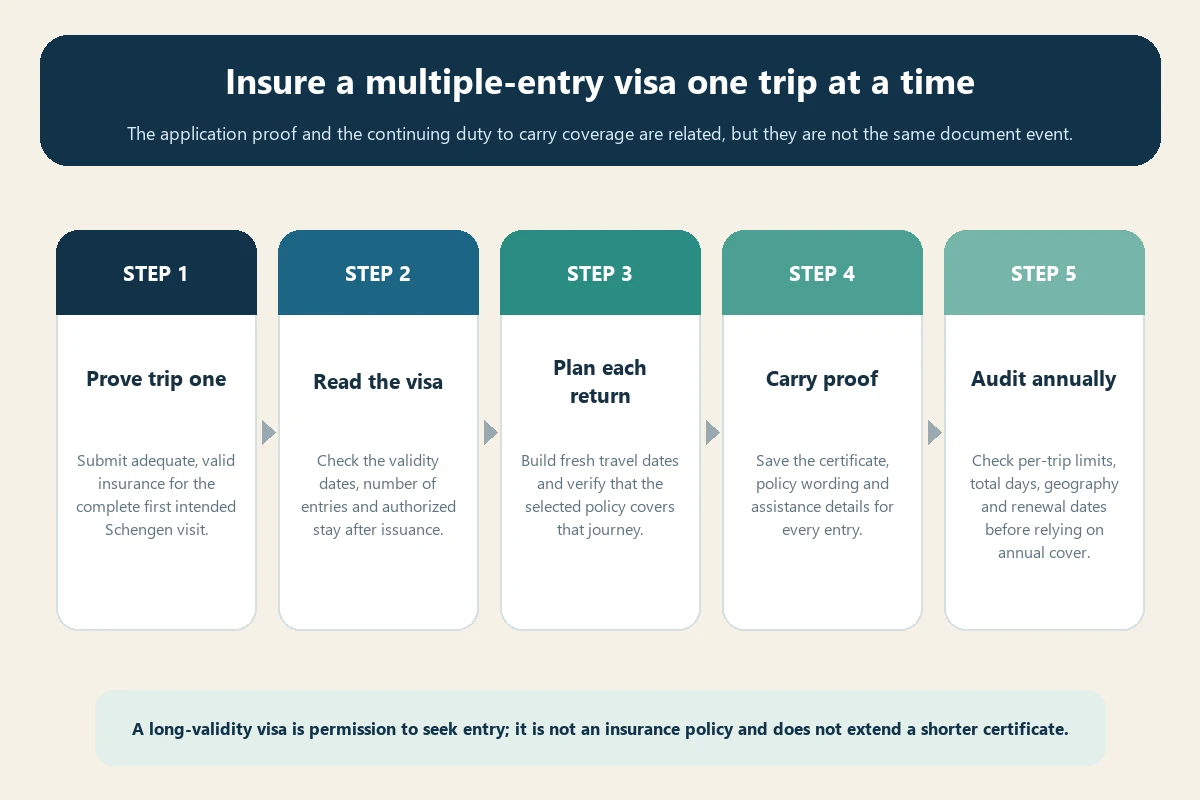
Schengen travel insurance for a multiple-entry visa works in two stages: the application normally needs adequate, valid medical insurance for the first intended visit, while the traveler remains responsible for having suitable insurance on every later Schengen stay. A visa that lasts one, two or five years does not create one equally long insurance contract. Treat the visa as an entry framework and insure each actual journey inside it.
Key takeaways
- For a multiple-entry application, EU Visa Code Article 15 focuses the submitted proof on the first intended visit.
- The applicant also acknowledges the need to hold travel medical insurance for later stays.
- Visa validity, authorized length of stay and insurance dates are separate limits.
- An annual or multi-trip policy can be convenient, but its per-trip and total-day limits still control.
- Carry a current certificate and policy details on every trip; do not rely on the document used months earlier.
The first-trip rule in the EU Visa Code
Article 15 of the EU Visa Code requires adequate and valid travel medical insurance for visa applicants. For an application covering multiple entries, it says the applicant proves insurance for the first intended visit and signs the application statement acknowledging the need for insurance on subsequent stays. The cover must address medical repatriation, urgent medical attention, emergency hospital treatment and death, remain valid throughout the relevant Member States, and meet the stated minimum.
This is not permission to travel uninsured later. It is a document-timing rule for the application. The European Commission’s application guide describes a multiple-entry visa as allowing several visits while the visa remains valid and lists medical insurance among the application documents. The first-trip certificate proves the known itinerary; the signed statement addresses the later trips that may not yet be booked.
Our Schengen visa insurance requirements guide explains the full amount, territory and benefit test. This page concentrates on the lifecycle after a traveler requests more than one entry.
Three clocks govern a multiple-entry trip
| Clock | What it controls | Common mistake |
|---|---|---|
| Visa validity | The window in which the document may be used, subject to all other conditions | Assuming it guarantees entry or insurance for the whole window |
| Authorized stay | The permitted days, also subject to the 90-in-180 framework where applicable | Reading “valid until” as the number of days available |
| Insurance period | The dates and trip conditions actually covered by the policy | Assuming a first-trip certificate renews itself for later visits |
Read all three independently. A visa can remain valid after a single-trip policy ends. An annual policy can remain in force while a traveler has exhausted its maximum days per insured trip. Neither contract language nor a visa sticker replaces the Schengen stay calculation.
What to submit for the first intended visit
Build the insurance certificate around the real first itinerary. The name should match the passport used in the application; the dates should include the complete intended Schengen stay or transit; the territory should be clear; and the medical amount and required benefits should be identifiable. The Spanish Consulate in Washington, for example, states that insurance for a multiple-entry application must be valid at least for the first planned trip and that the applicant undertakes to obtain insurance for future trips.
That consular page also illustrates why a wallet card is not enough: it asks for an insurance-company certificate showing the applicant, dates and coverage. Use the current checklist of the authority responsible for the actual application; documentary instructions can differ even when the Visa Code baseline is common.
Run the issued proof through the Schengen insurance certificate audit. If the amount is difficult to interpret, the minimum-coverage guide separates the headline limit from sublimits, benefits and claim mechanics.
What changes after the visa is issued
Once the visa arrives, read the sticker or official digital record carefully. Confirm the validity dates, number of entries and authorized duration. Then compare those limits with the dates actually planned. Insurance does not fix an itinerary that exceeds the visa conditions, and a long-validity visa does not make an expired policy usable.
For each later journey, create a new trip record:
- Record the local date of first Schengen entry and final Schengen exit.
- Check every country and non-Schengen side trip on the itinerary.
- Confirm the policy will be active for the complete required period.
- Verify the traveler is still eligible under residence, age and trip-origin rules.
- Obtain or download a current certificate tied to the correct insured person and dates.
- Save the policy wording, assistance contact and proof of payment with the itinerary.
The Schengen insurance dates guide provides a calendar method for overnight flights, re-entry and non-Schengen connections. Do not copy the dates from trip one into trip two unless the contract genuinely covers both.
Single-trip versus annual multi-trip insurance
There is no universally superior format. A single-trip policy can match one itinerary precisely and produce a straightforward certificate. An annual multi-trip plan can reduce repeated purchases when the traveler expects several journeys. The correct comparison is contractual, not merely “one policy versus many.”
| Question | Single-trip plan | Annual or multi-trip plan |
|---|---|---|
| Dates | Usually one defined journey | Policy year plus a maximum length for each trip |
| Certificate | Often displays the exact trip window | May display an annual period; confirm consular usability |
| Repeated visits | New purchase or extension may be needed | Trips may be covered automatically only if every condition is met |
| Day limits | Chosen duration controls | Per-trip and aggregate limits can both matter |
| Renewal risk | Each new policy has new terms | A trip crossing the renewal date needs special checking |
Use the Europe policy comparison worksheet to record maximum trip length, total travel days, medical limits, repatriation, geographic scope, deductibles and renewal terms. A plan advertised as “annual” may still stop covering a journey after a shorter consecutive-day limit.
Five annual-plan limits that matter
Maximum days per trip
A 12-month policy period does not necessarily permit a 12-month journey. Count each departure-to-return span under the plan’s definition. A 45-day visit can fall outside a policy limited to 30 days per trip even though the annual premium is paid.
Total travel days
Some contracts cap the combined number of insured days in the policy year. Keep a simple ledger of every trip rather than relying on memory. A later Schengen visit may begin while the policy is active but after the total allowance is exhausted.
Residence and trip-origin rules
Eligibility can depend on where the insured ordinarily resides and where the trip begins and ends. A move, long absence or one-way itinerary can change the analysis. Confirm definitions in the issued contract, not only in a quote screen.
Geographic scope
Check the entire route, including the United Kingdom, Ireland, microstates, non-Schengen Balkans or a transit country. The multi-country Europe insurance guide shows how to audit a mixed itinerary without treating Europe and Schengen as interchangeable.
Renewal and known events
A renewal can issue new wording, exclusions or limits. It generally does not turn a known loss into an unknown future risk. If travel crosses the renewal date, obtain written confirmation about uninterrupted coverage rather than assuming the second policy year continues every benefit.
What to carry on later entries
Border and in-country document checks are separate from the original application. Carry a current insurance certificate, the policy number, assistance contact, itinerary and proof of the planned return or onward travel. Store secure offline copies in case a phone is lost or has no service.
The European Commission’s 2021 implementation report noted the practical challenge of checking insurance each time a person travels on a multiple-entry visa that may remain valid for years. That does not remove the traveler’s obligation. It makes current, accessible proof more important. The report is available through EUR-Lex.
Changes, cancellations and replacement certificates
If a later itinerary changes, ask the insurer whether the existing policy can be updated before the affected travel. Do not edit a certificate yourself. A legitimate correction should come from the issuer and remain tied to the policy record. Check whether extra days change the price, exceed a trip-length limit or create a new eligibility issue.
If a visa application is still pending, follow the consulate’s authorized channel for revised documents. If the visa has already been issued, preserve both the old and new records. A corrected certificate does not amend visa dates, and an amended itinerary does not automatically alter insurance.
A repeat-trip record that takes five minutes
- Trip number and purpose
- Passport used
- First Schengen entry and final exit
- Countries visited and transit points
- Policy and certificate numbers
- Coverage start and end dates
- Per-trip days used and annual days remaining
- Emergency assistance telephone number
- Certificate file saved offline
- Visa validity and authorized-stay check completed
Add the record to the Europe trip insurance checklist before every departure. The method is deliberately repetitive: a multiple-entry visa reduces repeated visa applications, not the need to verify each new journey.
The practical decision
Choose a single-trip policy when the next itinerary is known and exact matching is the priority. Consider annual multi-trip cover when several journeys are likely and the contract’s per-trip, annual-day, residence and geography rules fit them. In either case, produce first-trip proof for the application and keep current proof for every return.
General educational information, not legal, visa, medical or insurance advice. Visa practices and policy terms can change. Confirm the current checklist with the consulate responsible for the application and read the issued insurance contract before every trip.
Traveling for meetings or a conference? Use the Schengen insurance audit for business travelers to verify personal visa proof, employer coverage, leisure dates and equipment gaps.
