

A travel insurance arbitration consent award is an arbitral award that records settlement terms agreed by the parties during the case. It is not simply a private settlement uploaded to a portal. Turning a bargain into an award can change privacy, finality, correction, confirmation, payment, and enforcement consequences.
The arbitration agreement, current provider rules, settlement law, applicable federal or state arbitration law, and the parties’ written terms control. This U.S. consumer guide is general information, not legal or tax advice. A consent award should be requested only after every party understands the operational and legal effect.
Confirm the governing consent-award rule
Identify the administrator, rule edition, arbitrator appointment status, submitted claims, and whether the case remains open. Current AAA Consumer Arbitration Rule R-47 says that if the parties settle during the arbitration and request it, the arbitrator may set out the settlement terms in a consent award.
The word “may” matters: do not promise that the arbitrator will sign any text the parties provide. Submit the request through the AAA and comply with any instruction about form, authority, costs, or revisions.
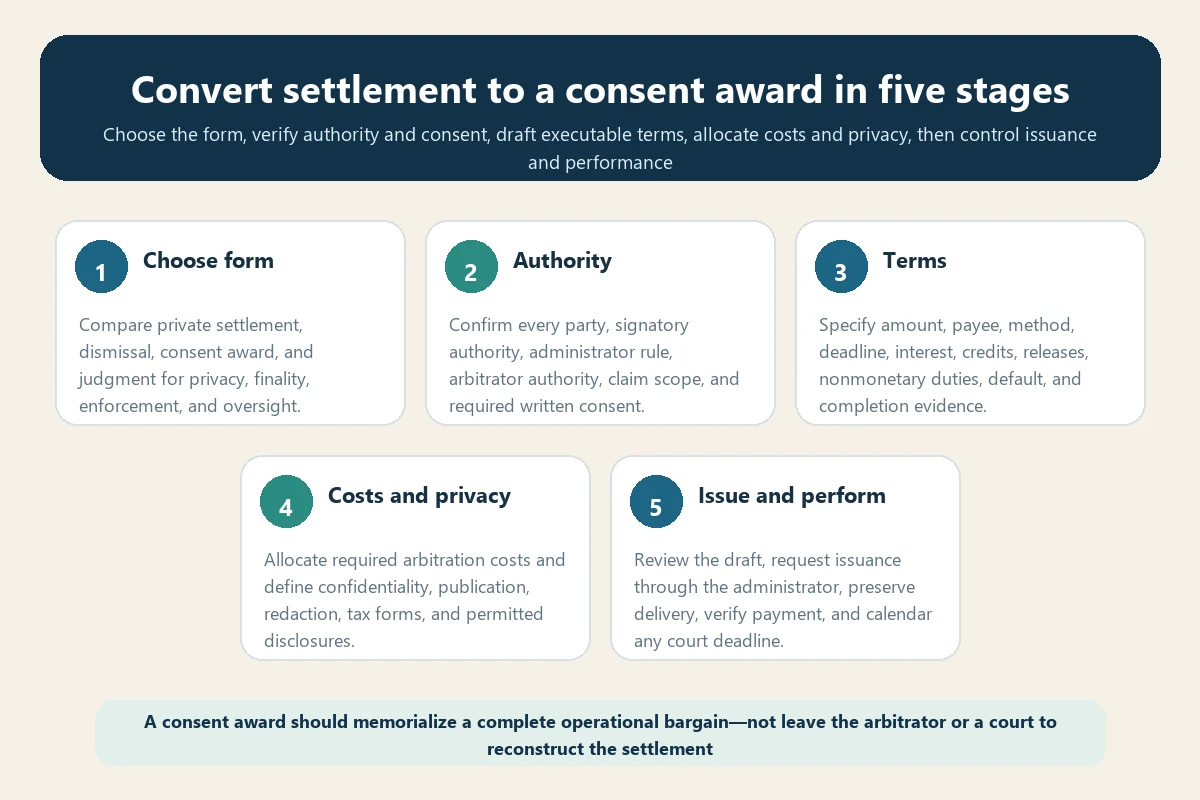
Compare the available settlement forms
Before drafting, compare at least four possible outcomes:
- Private settlement: a contract between the parties, often followed by dismissal or withdrawal.
- Consent award: agreed terms embodied in an arbitral award.
- Dismissal order: termination of claims, potentially with or without prejudice, without necessarily stating the full bargain.
- Consent judgment: terms entered by a court when jurisdiction and procedure permit.
These forms are not interchangeable. Evaluate confidentiality, public filing, enforcement path, correction authority, challenge risk, remedies for default, and whether continuing oversight is needed.
Do not confuse settlement with an award
A signed settlement can bind parties under contract law, but it does not become an arbitral award merely because arbitration was pending. A consent award requires arbitrator action under the governing rule and formal issuance.
The arbitration settlement guide explains negotiation, releases, confidentiality, payment, and dismissal. Use the consent-award route only when the additional award form serves a defined purpose.
Verify every party and signatory
List the claimant, insured traveler, policyholder, insurer, administrator, business entity, assignee, medical provider, or other participant affected by the bargain. Confirm the exact legal names used in the case.
For every signer, document authority to bind the party. A claims adjuster’s authority to negotiate a dollar amount may not include authority to accept a consent award, confidentiality term, tax representation, or release of unrelated rights.
Define which claims are resolved
Attach a claim matrix showing each demand, counterclaim, defense, policy period, traveler, trip, loss, and requested relief. Mark each as released, dismissed, preserved, or outside the agreement.
A broad phrase such as “all matters” can create later disputes about another traveler, a separate trip, future medical bills, subrogation, or an unrelated policy. The arbitration demand guide helps match the settlement scope to the actual submitted claims.
Choose operative terms before legal boilerplate
Start with a term sheet that answers who must do what, by when, and how completion is proven. Include:
- gross settlement or award amount;
- payee and payment allocation;
- currency, method, and verified instructions;
- payment deadline and cleared-funds standard;
- interest before and after default;
- supplier refunds, credits, deductibles, and prior payments;
- nonmonetary acts and delivery format;
- release effective date;
- dismissal or withdrawal mechanics;
- default notice, cure, and remedy.
If these terms are incomplete, boilerplate cannot make the bargain executable.
Reconcile the settlement amount
Create a ledger from claimed loss to agreed net payment. Show each benefit, deductible, coverage limit, refund, voucher, chargeback, prior insurer payment, other insurance recovery, currency conversion, interest, fee, and cost.
The claim partial-payment guide provides a reconciliation method. Preserve the ledger even if the consent award states one lump sum.
Specify payment mechanics securely
Identify the payee, payment method, deadline, reference, fee allocation, and proof of clearance. Verify bank instructions through a trusted second channel and avoid putting medical details or full account numbers in the award.
The award payment guide explains payoff, secure transmission, partial payment, variance, and satisfaction. State whether the release becomes effective on signing, award issuance, payment initiation, or cleared payment.
Address installments and default
For installments, list each amount and due date, acceptable delivery method, grace period if any, and the effect of a missed payment. Define whether default accelerates the remaining balance, adds interest, or permits confirmation or enforcement.
A default clause should not create an ambiguous penalty. Obtain legal advice about enforceability and state clearly whether notice and cure are conditions to the remedy.
Define nonmonetary obligations
A travel insurance settlement may require a corrected claim letter, return of documents, deletion or preservation of data, assistance with a provider balance, or another act. Name the responsible party, recipient, format, content, deadline, and completion evidence.
Do not require the arbitrator or a later court to invent missing operational details. A consent award should state an objective standard that can be verified.
Draft the release deliberately
Define released persons, releasing persons, claims, time period, policies, trips, losses, known and unknown matters, and exclusions. Preserve rights against nonparties or for unrelated events when intended.
Separate release scope from confidentiality, non-disparagement, tax reporting, indemnity, and cooperation. Each provision has a different purpose and risk.
Allocate arbitration costs expressly
AAA R-47 requires a consent award to allocate arbitration costs, including administrative fees and expenses and arbitrator compensation and expenses as addressed by R-46(c). Include the allocation in the proposed award rather than stating only that the parties “bear their own costs.”
The arbitration cost guide distinguishes administrator charges, arbitrator compensation, party expenses, attorney fees, and claim damages. Confirm which categories the required allocation covers.
Handle attorney fees separately
State whether the settlement amount includes attorney fees, whether each party bears its own fees, or whether a defined fee payment is separate. Do not treat attorney fees and AAA administrative costs as the same item.
Confirm authority, payee, reporting, lien, and payment instructions. Avoid making tax or professional-responsibility conclusions in the award without qualified advice.
Understand the publication rule
Current R-47 states that consent awards will not be made available to the public under R-42(c) unless the parties agree otherwise. That rule concerns AAA publication; it does not guarantee the document can never become public through a court filing, legal requirement, regulator, auditor, or permitted disclosure.
The arbitration confidentiality guide separates administrator practice, party duties, protective orders, and public court records. Draft permitted disclosures for counsel, tax advisers, insurers, regulators, and enforcement as needed.
Minimize sensitive information
Use claim references and defined terms instead of diagnoses, passport numbers, bank details, dates of birth, and full medical histories. Put confidential payment instructions in a secure separate communication rather than the award text.
If limited medical facts are necessary, request appropriate redaction or protective treatment before issuance. Remember that later confirmation may require filing the award.
Address tax language carefully
State payment allocation only when the parties have a supported basis and understand that tax authorities are not necessarily bound by private labels. Identify required forms, taxpayer information exchange, withholding, and delivery deadlines without guaranteeing a tax result.
Obtain qualified tax advice for damages, interest, fees, and reporting. Keep tax identifiers out of the public-facing award whenever procedure permits.
Decide whether reasons are needed
A consent award records agreed terms rather than adjudicating contested merits. Decide whether it should contain background, findings, or only operative provisions, subject to the rule and arbitrator’s authority.
The reasoned award guide explains current AAA’s brief-explanation rule and the distinction between a concise explanation and full findings. Avoid language that falsely suggests the arbitrator decided facts the parties merely compromised.
Use an agreed drafting process
Set a drafting owner, redline protocol, response deadline, approval method, and final clean version. Compare the term sheet, settlement agreement, and proposed consent award line by line.
Submit only the version all necessary parties approved. Identify whether the arbitrator may make nonmaterial formatting changes and how substantive requested revisions will be handled.
Request issuance through the administrator
Use the case number, caption, rule, joint request, authorized signatures, proposed award, and any required cost allocation. Do not contact the arbitrator privately.
Confirm whether the hearing should remain open until issuance, whether pending deadlines are suspended, and when dismissal or withdrawal occurs. Preserve the administrator’s transmittal as delivery evidence.
Audit the issued consent award
Compare the signed award with the approved final draft. Verify parties, amount, payee, dates, releases, costs, confidentiality, default, signatures, and attachments. Record every variance.
If a clerical or computational defect exists, use the authorized procedure described in the award correction guide. Do not negotiate a silent side version that conflicts with the issued award.
Plan confirmation before default
Section 9 of the Federal Arbitration Act describes confirmation when its requirements are satisfied, including the parties’ agreement that judgment may be entered. It also contains a one-year application period and venue language.
Do not assume Section 9 supplies federal subject-matter jurisdiction or governs every consent award. Analyze the arbitration agreement, governing statute, court jurisdiction, venue, service, and state law before relying on confirmation.
Preserve the court filing package
FAA Section 13 identifies papers used with an order on an award, including the agreement, award, and notices or other papers used on the application. A resulting judgment has the force and effect of a judgment in an action.
The award enforcement guide explains confirmation and judgment concepts. Court filings can expose terms that remained nonpublic in AAA administration, so address redaction and sealing under applicable rules in advance.
Document performance and satisfaction
After issuance, track every payment and nonmonetary duty. Preserve cleared-funds evidence, delivery receipts, acknowledgments, completion records, and any court satisfaction filing.
Do not destroy the settlement record after payment. Maintain the consent award, administrator transmittal, ledger, releases, and performance proof under an appropriate retention and access policy.
Avoid common consent-award mistakes
- Assuming a private settlement automatically becomes an award.
- Failing to verify signatory authority.
- Leaving claims or parties undefined.
- Using vague payment or nonmonetary terms.
- Omitting the required allocation of arbitration costs.
- Confusing AAA nonpublication with absolute confidentiality.
- Including unnecessary medical or banking data.
- Submitting a draft that not every party approved.
- Ignoring jurisdiction and confirmation requirements.
- Failing to document performance and satisfaction.
Final consent award checklist
- Confirm the forum, rule edition, arbitrator authority, and open-case status.
- Compare private settlement, dismissal, consent award, and judgment.
- Verify parties and signatory authority.
- Define released and preserved claims.
- Draft executable payment and nonmonetary terms.
- Allocate arbitration costs expressly.
- Control privacy, publication, redaction, and tax data.
- Use a documented joint drafting and approval process.
- Audit the issued award against the approved text.
- Track payment, performance, confirmation, and satisfaction.
A sound consent award does more than announce that the case settled. It records a complete, authorized, operational bargain; allocates required costs; protects sensitive information; anticipates performance and default; and gives every party a clear path from issuance to final satisfaction.