

Medical evacuation insurance international hospital transfer coverage depends on six gates aligning. The current hospital must document a medical need, the destination must accept the patient, the patient must be fit for the proposed transport, the route must satisfy the policy, an operator must safely complete every handoff, and the expenses must survive final claim review.
Emergency care comes first. This guide is educational, not medical, insurance, aviation, or legal advice. Treating and receiving clinicians, carriers, transport medical directors, assistance teams, and insurers control different decisions. Never move an unstable patient or delay appropriate care for a coverage question.
Key takeaways
- A transfer starts with unavailable medical capability, not traveler preference.
- Receiving-physician and bed acceptance are operational gates.
- Fitness to move is specific to patient, mode, altitude, equipment, and timing.
- Authorization must identify destination, route, vendor, and conditions.
- Preserve the clinical and custody record at every handoff.
Reviewed August 16, 2026. Copy the policy definitions for medical necessity, adequate or suitable facility, emergency evacuation, authorization, reasonable and customary expense, and other insurance.
What counts as an international hospital transfer?
The patient is already under facility-based care and needs movement to another hospital across a border or through an international route. The transfer might use ground critical-care ambulance, helicopter, fixed-wing air ambulance, or a medically escorted commercial flight.
This differs from field rescue and from an ordinary return trip after discharge. The destination guide explains the broader ladder; this workflow follows one hospital-to-hospital case.
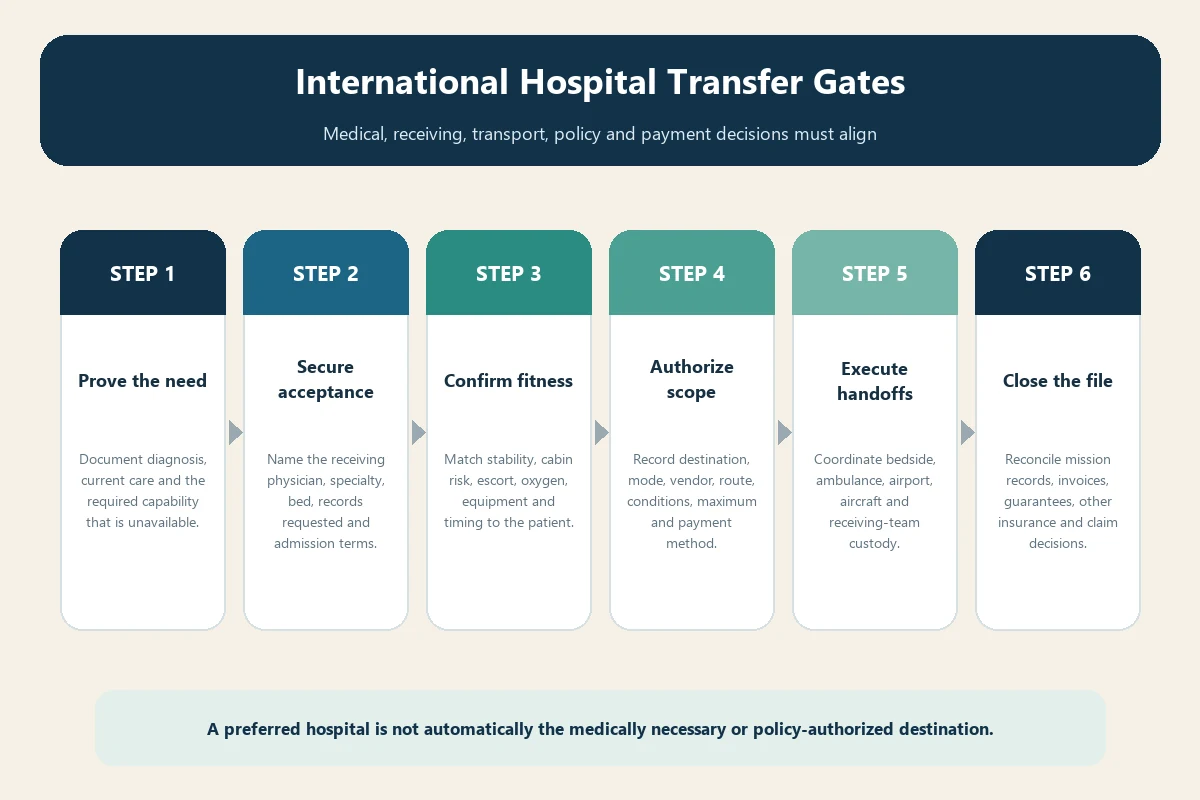
Gate 1: document why current care is inadequate
The treating clinician should describe the diagnosis or working diagnosis, care already provided, current condition, likely course, required specialty or procedure, and the capability that the current hospital lacks. A request to be “closer to home” is not the same evidence.
The CDC Yellow Book insurance chapter explains that evacuation can be needed from a resource-poor setting to definitive care and that insurers generally control the evacuation decision. It describes hospitalization and unavailable specialized treatment as common factors.
Translate capability into a destination requirement
Specify the needed service: neurosurgery, cardiac intervention, intensive care, neonatal care, burn treatment, infection isolation, dialysis, trauma surgery, or another capability. Then identify facilities able to deliver it.
The nearest adequate hospital may be in another city or country, not the traveler’s home network. If the family requests a different destination, ask whether the policy treats the additional distance as covered, partially covered, or private.
Gate 2: secure receiving physician and bed acceptance
A hospital name is not acceptance. Record the receiving physician, specialty, accepting department, bed type, admission or transfer center, case reference, records reviewed, financial requirements, and how long the acceptance remains valid.
Bed availability can change while an aircraft is positioning. Ask who will reconfirm acceptance before departure and which alternate facility is approved if the bed disappears.
Acceptance can be clinical and financial
A receiving physician may accept the clinical transfer while the admissions office still requires a deposit, guarantee, insurer letter, identity document, or payment arrangement. Record both approvals and the people who issued them.
Ask whether acceptance covers only the emergency department, a named inpatient bed, or a specialty service. Reconfirm any expiration time and the process for keeping the place while transport is delayed.
Records must move before the patient
The receiving team may need the clinical summary, imaging, laboratory results, medication and infusion list, allergies, procedures, infection status, airway details, oxygen requirement, blood products, devices, and consent. Translation might be necessary.
Use secure channels approved by the hospitals. Record what was sent, when, by whom, and who confirmed receipt. Do not place sensitive medical records in an ordinary public link.
Gate 3: determine fitness for the proposed mode
“Stable” is incomplete. A patient can be stable in an intensive-care bed but unsafe for ground vibration, airport delay, lower cabin pressure, limited access during flight, or prolonged transport. Fitness must be reassessed when condition or route changes.
The CDC air-travel chapter explains that cabin pressure and reduced oxygen can worsen some cardiopulmonary, blood, or cerebrovascular conditions. It also notes that travelers needing oxygen must plan ground, layover, and arrival supply.
Match medical crew and equipment to the patient
The transport plan can require a physician, nurse, respiratory therapist, paramedic, or other escort; oxygen; ventilator; infusion pumps; monitor; suction; stretcher; isolation system; neonatal equipment; or medication stock. Define the clinical configuration rather than requesting “an air ambulance.”
The route-cost guide shows how crew, equipment, ground legs, positioning, distance, and permits become mission components.
Commercial escort and dedicated air ambulance are different
A stable patient might travel seated or on a stretcher aboard a commercial flight with a medical escort. A critically ill patient may need a dedicated aircraft. The choice depends on patient risk, airline acceptance, schedule, route, equipment, access, and receiving timing.
The CDC travelers-with-disabilities chapter notes that airlines can require advance notice for services such as oxygen, a stretcher, ventilator power, or an incubator. Accessibility duties do not make an acutely ill traveler fit to fly.
Gate 4: obtain precise policy authorization
Ask the assistance team to identify the authorized destination, receiving facility, mode, operator, medical configuration, ground legs, route, validity window, conditions, benefit maximum, and payment arrangement. Save the approval in writing.
The pre-authorization timeline separates a medical recommendation, assistance arrangement, advance benefit authorization, guarantee of payment, and final claim adjudication.
Reauthorization follows material change
A new diagnosis, deterioration, improvement, infection-control result, lost bed, airport closure, aircraft change, or longer route can invalidate part of the plan. Ask which changes require a new medical review or written authorization.
Keep every version with its timestamp. The current mission should be compared with the current approval, not an earlier plan that named another mode, facility, or patient configuration.
A guarantee of payment is not final coverage
A guarantee can secure a hospital, ambulance, or aircraft while reserving the insurer’s right to review eligibility, exclusions, other insurance, or reasonable charges later. Ask which vendor and amount it covers and whether the traveler remains responsible for anything.
The direct-billing guide explains why a provider’s willingness to accept a guarantee differs from a final paid claim.
Gate 5: coordinate every custody handoff
A complete route can include current bedside, hospital ambulance bay, departure airport, aircraft, fuel stop, arrival airport, destination ambulance, and receiving bedside. Name who holds clinical responsibility at each point.
Record departure and arrival time, patient condition, medications and infusions, equipment, crew, complications, supplies transferred, and receiving signature. A mission invoice without a clinical handoff record can leave the claim incomplete.
Border and entry logistics are patient-safety issues
Passports, visas, public-health rules, customs, medical import permission, controlled medication, airport slots, landing permits, and ground access can delay a route. The operator and assistance team should identify requirements and alternates.
Do not promise that emergency status waives ordinary government or carrier controls. Keep identity documents, medical letters, consent, and contact authority available to the coordinating team.
Consent and communication need named owners
Identify who can consent to treatment, release records, approve expenses, and receive updates if the patient lacks capacity. Hospitals, carriers, and insurers may require different forms under different laws.
Choose one family contact and one clinical contact. Record interpreter use and translated documents. Conflicting instructions from several relatives can delay acceptance, quotes, and payment without improving care.
When the patient or family prefers another hospital
Ask the insurer for its medically necessary and policy-authorized plan first. Then request a written comparison showing whether the preferred destination adds distance, crew time, positioning, ground transport, or private hospital requirements.
A family may sometimes pay the difference, but that must be confirmed before dispatch. Declining an adequate authorized facility can affect coverage and timing.
When the insurer proposes another mode
An insurer might propose local stabilization, ground transfer, commercial escort, or a different adequate facility instead of the requested air ambulance. Ask for the clinical and policy reasons, the patient-safety plan, and the escalation route.
The approval-chain guide shows how treating, assistance, receiving, transport, and benefit decisions can disagree without any one actor controlling the entire case.
Gate 6: close the claim file by expense and payer
Separate current-hospital care, ground ambulance, aircraft, medical escort, supplies, receiving-hospital deposit, companion travel, accommodation, interruption, and later return costs. Identify other health insurance, supplier refunds, memberships, and advance payments.
Keep itemized invoices, proof of payment, currency conversion, authorizations, guarantees, mission records, and explanations of benefits. The assistance-line guide explains why real-time coordination and final claim review produce different records.
A U.S. government warning about payment
The Department of State’s medicine and health guidance says the U.S. government does not pay citizens’ medical expenses abroad. Consular staff may provide information, but they do not replace insurance authorization or a receiving hospital’s payment requirements.
A policy example is only an example
An IMG U.S. policy summary includes interfacility ambulance transfer and precertification language. Use it to see how detailed a form can be, then verify the issued policy, state, eligibility, definitions, exclusions, and schedule that actually apply.
If the requested transfer is denied
Ask for the medical and contract reason, the covered alternative, missing evidence, internal escalation route, and appeal procedure. Request direct clinician-to-clinician discussion when the treating team believes delay creates immediate risk.
Do not interpret denial of one destination or aircraft as proof that all assistance has ended. Continue appropriate local care, document changing need, and obtain an independent private quote only with a clear understanding of authorization and financial responsibility.
The transfer worksheet
| Gate | Required record | Owner | Status |
|---|---|---|---|
| Medical need | Diagnosis, current care, missing capability | Treating clinician | ____ |
| Receiving acceptance | Physician, specialty, bed, case reference | Receiving hospital | ____ |
| Fitness and configuration | Mode, escort, oxygen, equipment, timing | Transport medical team | ____ |
| Policy authorization | Destination, vendor, route, conditions, payment | Assistance administrator | ____ |
| Mission handoffs | Custody, condition, medication, equipment | Each operator | ____ |
| Claim close | Invoices, proof, other insurance, decisions | Traveler or representative | ____ |
Bottom line
Medical evacuation insurance international hospital transfer coverage is a coordinated medical, receiving, aviation, policy, payment, and evidence process. Prove why current care is inadequate, secure real acceptance, match the mode to the patient, obtain precise authorization, document every handoff, and reconcile each expense. A preferred destination or unused limit cannot replace those six gates.
Transport to adequate care and transport back to the home country are not the same decision. Use the medical evacuation home-country guide to compare destination wording, medical fitness, transport mode, receiving acceptance, approval, and unused-ticket offsets.
A personal travel companion, medical escort, bedside visitor, and child attendant are different roles. Use the medical evacuation travel-companion guide to identify the correct benefit, seat, expense limit, authorization, and evidence file for each person.
Fit to fly is not one signature: the treating clinician, assistance medical team, and operating airline answer different questions. Use the medical repatriation fit-to-fly guide to coordinate clinical stability, cabin risk, equipment, escorts, carrier documents, ground legs, timing, and rechecks.
Commercial medical repatriation is a coordinated transport chain, not an ordinary ticket with a nurse added. Use the medical repatriation commercial flight guide to plan clearance, cabin configuration, escort, oxygen, equipment, ambulances, connections, receiving care, authorization, and contingency costs.
